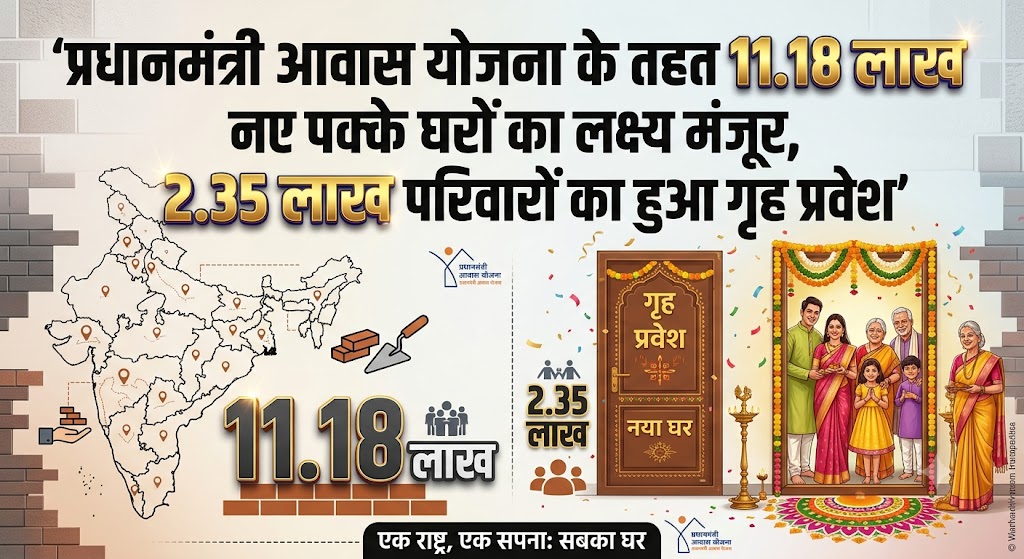
11.18 Lakh New Permanent Houses Approved Under PM Housing Scheme, 2.35 Lakh Families Enter New Homes
Patna: A major announcement has been made for poor and needy families in Bihar under the Pradhan Mantri Awas Yojana (PMAY). A target of 11,18,937 new permanent houses has been approved for Bihar for the financial year 2026-27. The announcement has raised hopes among millions of families who are still living in temporary, damaged or unsafe houses.
The government aims to provide eligible families with safe and dignified housing through the scheme. The new target is being viewed as an important step for rural and economically weaker families across Bihar.
At an event held at Bapu Sabhagar in Patna, the government also facilitated the housewarming ceremony for 2.35 lakh newly constructed houses. This means a large number of beneficiary families have now begun living in their new permanent homes.
Target of 11.18 Lakh Houses for 2026-27
A target of 11,18,937 new permanent houses has been approved for Bihar under the Pradhan Mantri Awas Yojana for 2026-27.
The target is intended to cover eligible families living in rural areas who do not have permanent houses.
For families living in temporary structures, a permanent house is not merely a building. It provides security, stability and dignity.
Once the new target is completed, a large number of families are expected to receive relief from unsafe and vulnerable housing conditions.
2.35 Lakh Families Entered New Homes
During the programme at Bapu Sabhagar in Patna, 2.35 lakh houses were formally inaugurated through housewarming ceremonies.
Moving into a newly constructed permanent home is an important moment for any family. For people who have spent years living in temporary houses, a permanent home can bring a greater sense of security and stability.
The housewarming programme also highlighted the government's efforts to present housing assistance as a means of improving the quality of life of poor families.
Nearly 19 Lakh People Received Permanent Houses in Two Years
According to the government, approximately 19 lakh people in Bihar have received permanent houses during the past two years.
With the approval of the new target of more than 11 lakh additional houses, the number of beneficiaries is expected to increase further.
A large section of Bihar's population lives in rural areas, where many economically weaker families cannot afford to construct permanent houses on their own.
For such families, government housing assistance can provide important financial support.
Hope of a Safe Roof for Poor Families
Families living in temporary houses often face greater risks during heavy rain, floods, strong winds and other adverse weather conditions.
Several rural parts of Bihar also experience waterlogging and flooding during the monsoon season.
A permanent house can therefore provide an important layer of protection for vulnerable families. The new housing target is expected to help families move away from unsafe structures and obtain more secure accommodation.
A permanent home can also contribute to greater social stability for the family.
Chief Minister Describes the Occasion as an Achievement
During the programme, Chief Minister Samrat Choudhary described the housing initiative as an important step toward changing the lives of poor families.
He reportedly described the occasion as a day of pride and achievement for Bihar.
The government is emphasizing the need to ensure that eligible families receive the benefits of the scheme and that construction work is completed within the stipulated time.
Rural Areas Could See Significant Change
The expansion of permanent housing could change the appearance and living conditions of rural Bihar.
The impact of providing a permanent house is not limited to the individual beneficiary family. When housing is accompanied by electricity, drinking water, sanitation, roads and other basic facilities, the overall quality of life in villages can improve.
Housing construction can also stimulate local economic activity involving construction materials, labour and transportation.
Important for Women and Children
A permanent home can also provide greater security and stability for women and children.
When a family receives a permanent house, it gains a more stable living environment. Housing security can also allow families to focus their limited income on education, healthcare and other essential needs.
For economically vulnerable households, permanent housing can therefore become an important foundation for long-term social and financial stability.
Transparency in Implementation Will Be Essential
The target of more than 11 lakh new houses is substantial. Ensuring transparency during implementation will therefore be extremely important.
Authorities will need to identify genuinely eligible families and maintain transparency in beneficiary selection.
Regular monitoring will also be required to ensure that the benefits reach families who genuinely do not have permanent houses.
Construction Quality Also Matters
Increasing the number of houses alone will not be sufficient. The quality of construction must also receive adequate attention.
Permanent houses should be structurally safe, durable and suitable for long-term use. Construction materials and technical standards need to be properly followed.
Regular inspections and monitoring by local authorities can help ensure that the houses being constructed meet the required standards.
Major Relief for Beneficiary Families
The new target is expected to provide significant relief to families that have been waiting for permanent housing.
Building a house is difficult for low-income families because of rising construction costs and limited earnings. As a result, many families remain in temporary houses for years.
Government assistance can help such households construct permanent homes while allowing them to use their limited income for education, healthcare and other essential expenses.
Possible Boost to Rural Economy
Large-scale housing construction can also have an impact on the rural economy.
Construction work creates demand for masons, labourers, transport services, building materials and local businesses.
Therefore, construction of a large number of houses could also generate economic activity and employment opportunities at the local level.
The housing scheme can thus serve both as a social welfare initiative and as a potential driver of rural economic activity.
Effort to Reduce Temporary Housing
The government is seeking to reduce the number of families living in temporary and unsafe houses in rural areas.
The Pradhan Mantri Awas Yojana is being used to provide permanent homes to eligible beneficiaries.
Following the government's claim that nearly 19 lakh people received permanent houses during the previous two years, the approval of more than 11 lakh additional houses represents another major step in the programme.
Meeting the Target Will Be the Next Challenge
After the announcement of the new target, the biggest challenge will be ensuring effective implementation.
Several stages will be involved, from identifying beneficiaries and providing financial assistance to completing construction and verifying the finished houses.
Timely release of funds, regular monitoring and administrative support will be important for ensuring that construction progresses smoothly.
If these processes are implemented effectively, a large number of families could receive their permanent homes within the stipulated period.
Bihar has received approval for 11,18,937 new permanent houses under the Pradhan Mantri Awas Yojana for 2026-27. The announcement has brought fresh hope to poor and rural families across the state.
At Bapu Sabhagar in Patna, housewarming ceremonies were held for 2.35 lakh newly constructed houses. According to the government, approximately 19 lakh people received permanent houses in Bihar during the past two years.
The new target will now bring more than 11 lakh additional families under the housing programme. It is expected to provide safer and more stable homes to families currently living in temporary or unsafe structures.
However, transparency in beneficiary selection, construction quality, timely completion and effective monitoring will be essential for the success of the initiative.