132 KV Power Transmission Line from Sultanganj to Deoghar to Get Bird Guards, Protection Against Bird-Related Faults and Breakdowns
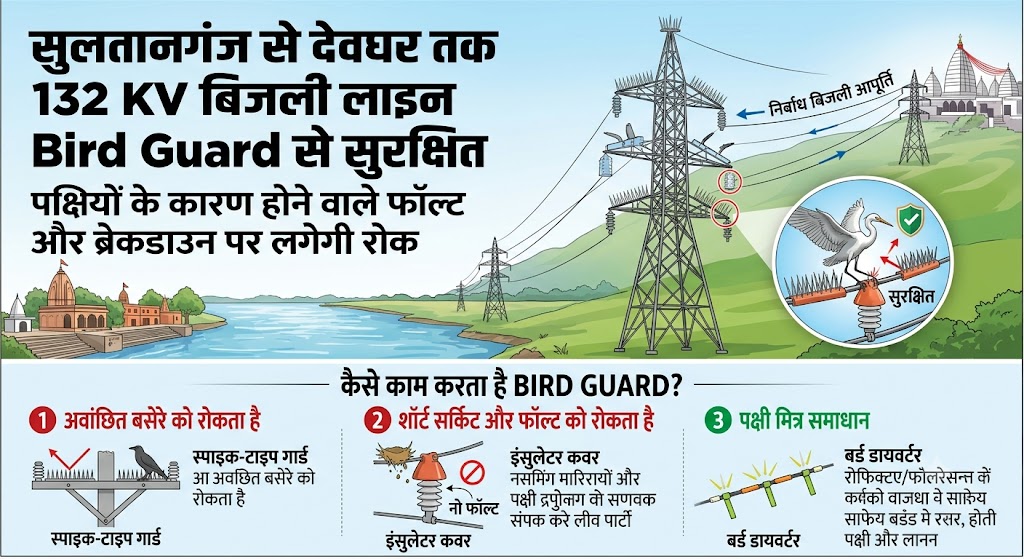
Bhagalpur/Sultanganj: The important 132 KV (132,000-volt) power transmission line running between Baba Ajgaivinath Dham in Sultanganj and Baba Baidyanath Dham in Deoghar is set to receive additional protection against technical faults and breakdowns caused by birds.
The Bihar State Power Transmission Company Limited (BSPTCL) has prepared a comprehensive plan to install special Bird Guards and other necessary safety equipment on the transmission towers along the high-voltage line.
The initiative is aimed at reducing disruptions caused by birds and ensuring a more reliable and uninterrupted electricity supply. Engineers have identified bird nests, droppings and nesting materials as potential causes of faults in high-voltage transmission infrastructure.
Importance of the Sultanganj-Deoghar Transmission Line
The transmission line between Sultanganj and Deoghar is an important part of the regional electricity network.
Both Sultanganj and Deoghar are major religious destinations, and large numbers of devotees travel between the two areas. Reliable electricity supply is therefore important not only for local residents but also for commercial establishments, institutions and activities connected with the religious centres.
A 132 KV transmission line is an important component of the electricity network because it carries large amounts of electrical power over considerable distances.
Any serious technical fault on such a line can affect the stability of the connected power network. Strengthening the line’s protection is therefore considered important for maintaining reliable electricity transmission.
Bird Guards to Be Installed on Transmission Towers
Under the BSPTCL plan, special Bird Guards will be installed on transmission towers.
The main purpose of these devices is to discourage birds from sitting or building nests near sensitive electrical components, particularly around insulators and live conductors.
Bird Guards are designed to prevent birds from coming into close contact with electrical equipment. Depending on the requirements of individual locations, other protective equipment may also be installed.
The system is expected to help protect both the transmission infrastructure and birds by reducing the possibility of accidental contact with high-voltage components.
How Bird Nests Can Cause Short Circuits
According to electrical engineers, transmission towers located in open areas, fields and forests can become attractive nesting locations for birds.
Because of their height and structure, birds often sit on transmission towers. In some cases, they collect twigs, dry branches, wires and other materials and build nests near the upper sections of the towers.
If these materials come too close to insulators or live conductors, they can create electrical risks.
The risk may increase when the nesting material becomes wet during rainfall. Under certain conditions, moisture can create an unwanted path for electrical current, potentially leading to flashovers or short circuits.
Bird Droppings Can Also Affect Insulators
Bird-related problems are not limited to nests.
Bird droppings can also create technical challenges for high-voltage transmission systems. When birds regularly sit around a tower or insulator, droppings can accumulate on the surface of electrical insulation equipment.
If the accumulated material becomes wet, it can affect the insulating properties of the equipment.
This may increase the possibility of unwanted current leakage and line tripping. Regular inspection and appropriate protective measures are therefore important.
Line Tripping Can Disrupt Power Supply
When a fault occurs on a transmission line, protective systems may automatically trip the line.
This is an important safety mechanism designed to protect electrical equipment from serious damage. However, line tripping can temporarily affect electricity supply to connected areas.
If repeated tripping occurs because of bird-related incidents, technical teams have to inspect the line and carry out necessary maintenance.
Installing Bird Guards is expected to reduce the frequency of such incidents and help the transmission system operate more reliably.
Risk Can Increase During the Monsoon
Bird-related problems may become more significant during the rainy season.
Nesting materials can absorb moisture, potentially increasing electrical risks around transmission equipment. Similarly, bird droppings and accumulated dirt on insulators can become more conductive when exposed to moisture.
For this reason, monitoring transmission lines becomes particularly important during the monsoon.
The installation of Bird Guards and other protective equipment could help reduce these risks before they result in major technical problems.
Focus on Uninterrupted Electricity Supply
One of the main objectives of the BSPTCL initiative is to improve the reliability of the electricity supply.
Electricity demand continues to grow, making it increasingly important to maintain a stable and dependable transmission network.
Repeated technical faults can place additional pressure on the electricity system and require maintenance teams to visit affected transmission towers.
Reducing bird-related faults can help save maintenance time and resources while improving the overall reliability of the network.
Role of Technical Teams
Technical teams regularly inspect transmission towers and electrical equipment to identify potential problems.
Even after Bird Guards are installed, regular inspection will remain important. Protective equipment itself needs to be checked periodically to ensure that it remains in proper working condition.
Engineers can also identify locations where bird activity is particularly high and introduce additional protective measures where necessary.
Protecting Birds Along With Electrical Infrastructure
The purpose of installing Bird Guards is not to harm birds but to keep them away from dangerous electrical equipment.
Birds coming into contact with live wires or electrical components can themselves be seriously injured or killed. At the same time, such contact can cause a transmission fault.
Bird Guards can therefore serve a dual purpose by helping protect both birds and high-voltage electrical infrastructure.
Benefits for Local Areas
Residents and businesses in areas connected to the transmission network could benefit indirectly from the proposed safety measures.
If bird-related tripping and technical faults are reduced, the reliability of electricity supply could improve.
This could benefit households as well as shops, small businesses, offices and other establishments that depend on a stable electricity supply.
Reliable power is particularly important for local economic and social activities.
Maintenance Work Could Also Become Easier
Transmission maintenance teams sometimes have to deal with bird nests built on or around towers.
Removing nests near high-voltage equipment requires significant caution because workers operate around potentially dangerous electrical components.
If Bird Guards are installed at sensitive locations, birds may be less likely to build nests there. This could make maintenance operations more systematic and reduce the need for repeated intervention.
However, regular inspection and maintenance of the protective equipment will remain essential.
Need to Protect High-Voltage Transmission Lines
Protecting important transmission networks such as a 132 KV line is essential for maintaining the stability of the electricity system.
A technical fault on one transmission line can potentially affect other parts of the connected network.
Transmission companies therefore regularly inspect towers, insulators, conductors and other components. Bird Guards can provide an additional layer of protection against one specific category of technical problems.
Possibility of Similar Measures on Other Lines
If the Bird Guard initiative on the Sultanganj-Deoghar 132 KV line proves effective, similar measures could potentially be considered for other transmission networks experiencing bird-related faults.
Transmission lines passing through forests, riverside areas, agricultural land and open spaces can experience significant bird activity.
Identifying such locations and introducing preventive measures in advance could strengthen the overall reliability of the power transmission network.
The 132 KV high-voltage transmission line between Baba Ajgaivinath Dham in Sultanganj and Baba Baidyanath Dham in Deoghar is set to receive additional protection against technical faults and breakdowns caused by birds.
BSPTCL has prepared a comprehensive plan to install special Bird Guards and other necessary safety equipment on the transmission towers along the line.
Bird nests, dry branches, twigs and bird droppings can sometimes create technical problems around insulators and live conductors. The risk can become greater during rainy and humid conditions, potentially leading to short circuits, flashovers and line tripping.
The installation of Bird Guards is expected to keep birds away from sensitive electrical equipment while also helping protect the birds themselves from dangerous contact with high-voltage components.
The initiative is particularly significant for the Sultanganj-Deoghar region because reliable electricity supply is important for residents, businesses and institutions.
Overall, the BSPTCL plan could become an important step toward making the power transmission network safer and more reliable. Regular monitoring, timely maintenance and protective measures such as Bird Guards can help reduce bird-related faults and improve the continuity of electricity transmission.