
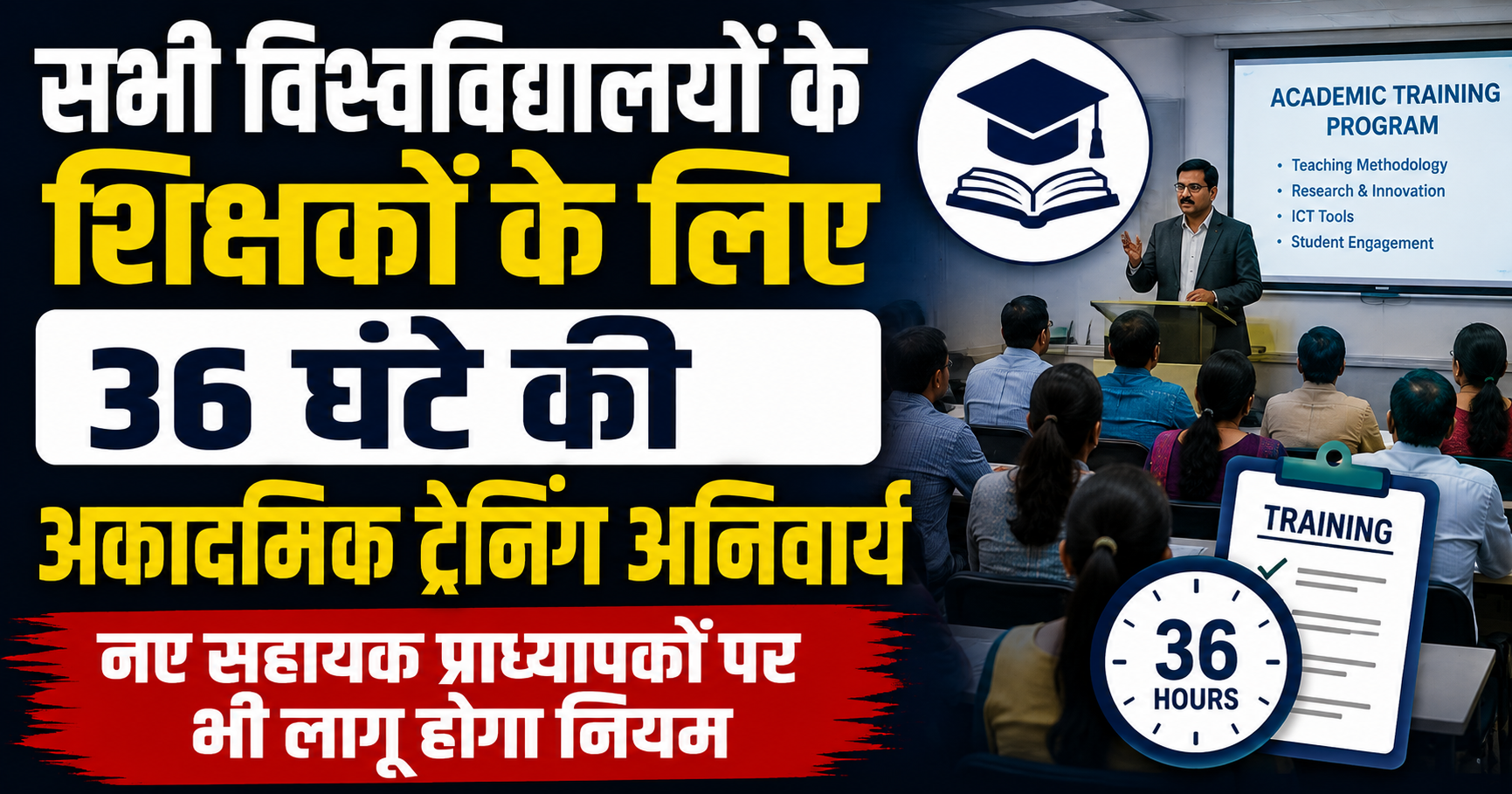
36-Hour Academic Training Made Mandatory for Teachers, New Assistant Professors Also Covered
Patna: The Bihar Governor’s Secretariat has introduced an important initiative aimed at improving the teaching skills and professional capabilities of teachers working in universities across the state. In line with the objectives of the National Education Policy (NEP), teachers will now be required to undergo academic training under a Faculty Development Programme.
A 36-hour academic training programme has been planned for teachers to improve classroom teaching and familiarize them with modern teaching methods, educational technologies and changing student needs.
The requirement will not be limited to teachers working directly in universities. It will also apply to teachers serving in all constituent and affiliated colleges under the universities. Newly appointed assistant professors will also have to undergo academic training before or as part of their transition into regular classroom teaching.
The new arrangement emphasizes that academic qualifications alone are not sufficient for effective teaching. Along with degrees and research achievements, teachers will also need appropriate teaching and classroom-management skills.
36-Hour Training to Be Mandatory
Under the Faculty Development Programme, teachers will be required to complete 36 hours of academic training. The main objective is to strengthen their professional capabilities and prepare them for the changing requirements of higher education.
The education system is changing rapidly. Traditional teaching methods based solely on textbooks and blackboards are increasingly being supplemented by digital resources, presentations, online materials, interactive classrooms and student-centered learning.
Teachers therefore need to remain updated with modern teaching techniques and educational technologies. The proposed training is intended to help them develop these skills.
Initiative Linked to the New Education Policy
The academic training programme is being introduced in line with the objectives of the National Education Policy. NEP places significant emphasis on improving the quality of education, strengthening teacher training, promoting research and encouraging the overall development of students.
In higher education, the role of teachers is no longer limited to delivering information about a particular subject. Teachers are also expected to help students develop analytical thinking, problem-solving abilities and independent learning skills.
Training can help educators become familiar with these modern approaches and make classroom learning more effective.
Constituent and Affiliated Colleges Also Included
The new requirement will extend beyond universities to teachers working in constituent and affiliated colleges.
A large number of students in Bihar pursue higher education through these institutions. Therefore, improving the professional and teaching skills of faculty members in colleges could have a direct impact on the overall quality of higher education in the state.
The training programme could also help bring greater consistency in teaching standards across universities and their affiliated institutions.
Newly Appointed Assistant Professors Will Also Need Training
One of the significant aspects of the new arrangement concerns newly appointed assistant professors.
Under the proposed system, simply receiving an appointment and entering the classroom will not be enough. Newly appointed assistant professors will also be required to undergo academic training.
Many newly appointed teachers enter universities with strong academic qualifications. They may hold PhD degrees, have qualified UGC-NET, worked as JRF scholars and published research papers or participated in seminars.
However, subject expertise and effective teaching are two different skills. Academic training is intended to bridge this gap.
PhD and NET Qualifications Alone May Not Be Enough
The new system emphasizes that a teacher's quality cannot be judged only by academic degrees or research achievements.
A professor may have a PhD, qualify for UGC-NET or JRF and have several research publications. However, effectively explaining complex concepts to students requires additional classroom and communication skills.
The academic training programme is therefore expected to focus on strengthening teaching abilities alongside existing academic qualifications.
Improving Classroom Teaching Quality
One of the primary objectives of the training will be to improve the quality of classroom teaching.
When teachers present subjects according to students' learning levels and use appropriate teaching techniques, the learning process can become more effective.
Today's students have access to a huge amount of information through digital platforms. Therefore, teachers increasingly need to act not only as providers of information but also as guides who help students identify reliable information, analyze it and apply it practically.
Training can introduce educators to methods that make classrooms more interactive and student-oriented.
Greater Focus on Digital Education
The use of digital technology in higher education has increased significantly. Online study materials, digital libraries, smart classrooms, presentations and other technological resources are increasingly becoming part of teaching.
Teachers therefore need to understand how these resources can be used effectively.
Academic training could help faculty members make better use of digital tools and integrate them into classroom teaching. For younger students in particular, appropriate use of digital resources can make learning more engaging and accessible.
Better Coordination Between Research and Teaching
University teachers have responsibilities related to both research and teaching. Through research, they contribute to the creation of new knowledge and can bring that knowledge into the classroom.
Academic training could help strengthen the connection between research and teaching. Faculty members can use their research experience to provide students with practical insights and a deeper understanding of their subjects.
This could also contribute to strengthening the research culture in higher education institutions.
Students Expected to Benefit Directly
Students are likely to be the biggest beneficiaries of the initiative if the training is implemented effectively.
Teachers trained in modern educational methods could make classroom learning more engaging and effective. Students may receive greater opportunities to ask questions, participate in discussions and understand concepts instead of simply completing the syllabus.
Improved teaching can contribute not only to better academic performance but also to stronger critical-thinking and practical-learning skills among students.
Need for Continuous Professional Development
The education sector is constantly evolving. New technologies, research methods and educational resources make continuous professional development increasingly important for teachers.
A teacher's learning does not end after obtaining a degree or securing an academic position. Faculty members need to remain updated both in their subject areas and in modern teaching techniques.
Faculty Development Programmes can strengthen this concept of continuous professional development.
Quality of Training Will Also Be Important
While making 36 hours of academic training mandatory is significant, the quality of the training will also be crucial.
The programme should not become merely a formal requirement. Training sessions need to be practical and relevant to the actual challenges faced by teachers in classrooms.
Faculty members could be introduced to real classroom situations, modern teaching techniques, digital resources, new assessment methods and student-centered learning approaches.
If the training is designed according to teachers' practical requirements, its impact could be visible in classrooms.
Step Toward Improving Higher Education
Teacher training can become an important component of efforts to improve the quality of higher education in Bihar.
As the number of students and responsibilities in universities and colleges increases, teachers need opportunities to continuously develop their professional skills.
The new arrangement could encourage educators to adopt innovative teaching methods and share their experiences and best practices with colleagues.
The decision to make 36 hours of academic training mandatory for teachers working in Bihar's universities, constituent colleges and affiliated colleges represents an important development in the state's higher education system.
The Faculty Development Programme, aligned with the National Education Policy, aims to strengthen teaching skills and improve the quality of classroom education.
The requirement will also apply to newly appointed assistant professors. This means that qualifications such as a PhD, UGC-NET, JRF experience, research publications and seminar participation will need to be complemented by effective teaching skills.
If implemented in a practical and high-quality manner, the training programme could directly benefit students. It could encourage modern teaching methods, greater use of digital education and more student-centered learning across Bihar's higher education institutions.