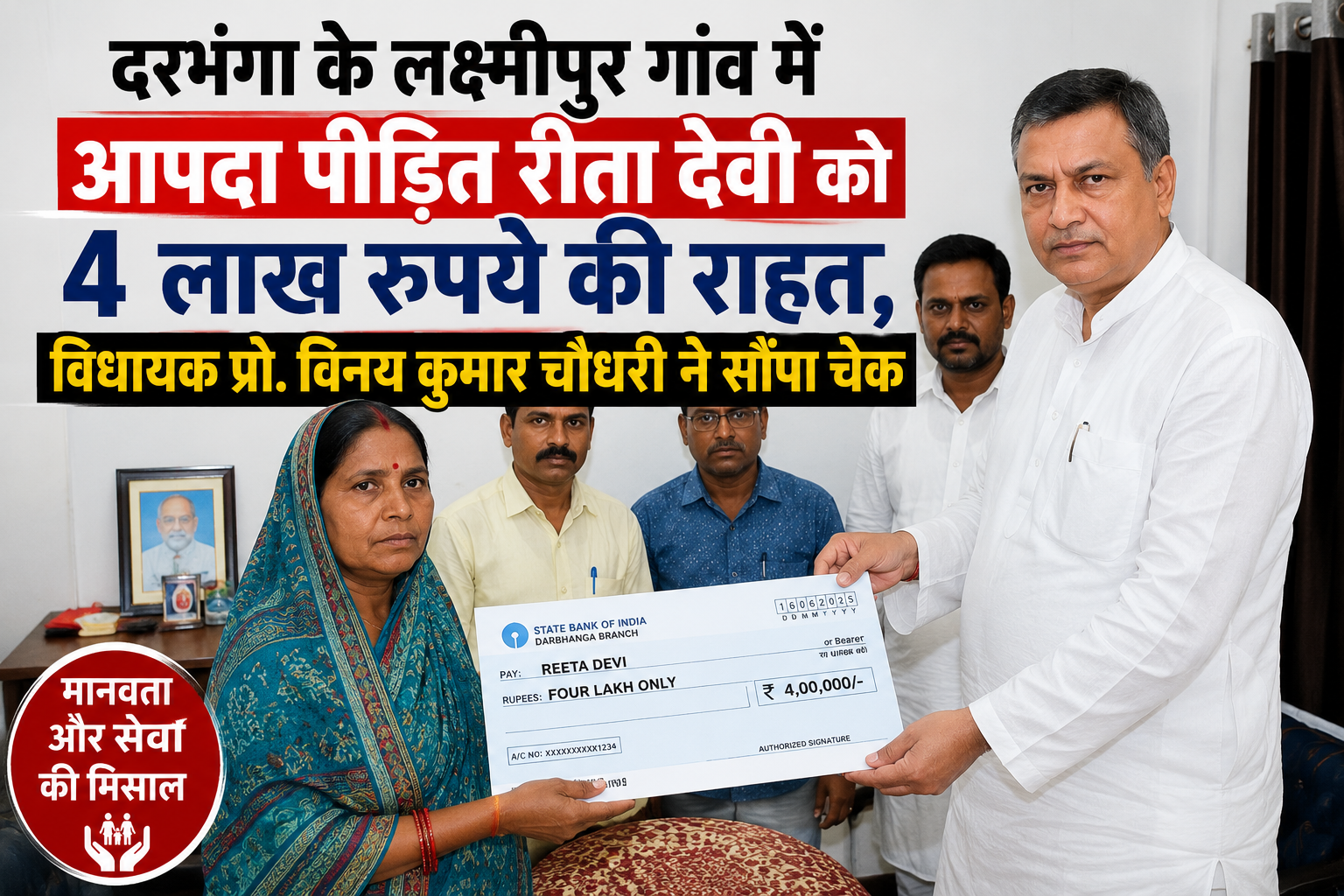
₹4 Lakh Relief Given to Disaster-Affected Rita Devi in Lakshmipur, Darbhanga MLA Prof. Vinay Kumar Chaudhary Hands Over Cheque
Darbhanga: A relief cheque of ₹4 lakh was handed over to Rita Devi, a disaster-affected resident of Lakshmipur village in Darbhanga district. MLA Prof. Vinay Kumar Chaudhary provided the financial assistance to the affected family. On the occasion, he said that natural disasters cannot be completely prevented, but their impact can be reduced through awareness, preparedness and timely preventive measures.
Several other local leaders and public representatives were also present during the cheque distribution programme. Discussions were held regarding the difficulties faced by disaster-affected families, with emphasis on ensuring that eligible people receive government assistance without unnecessary delays.
Relief Initiative for the Affected Family
During the programme organized in Lakshmipur village, MLA Prof. Vinay Kumar Chaudhary handed over a relief cheque of ₹4 lakh to Rita Devi. The financial assistance was provided to support the affected family following the disaster and help them deal with the economic difficulties resulting from the incident.
Disaster-affected families often face several financial and social challenges. In such circumstances, government relief assistance can help families meet immediate needs and begin the process of recovering from their losses.
During the cheque distribution, those present emphasized the importance of ensuring that government assistance reaches affected families in a timely manner.
The MLA said that coordination among the administration, elected representatives and local residents is essential during disasters. Better coordination can help ensure that relief reaches affected people more quickly and that rescue and rehabilitation efforts are carried out effectively.
MLA Emphasizes the Importance of Preparedness
While handing over the relief cheque, MLA Prof. Vinay Kumar Chaudhary also spoke about disaster management and the importance of remaining alert. He said that it is not possible for humans to completely prevent natural disasters, but preparedness and timely action can significantly reduce their impact.
He appealed to residents to take weather warnings and official advisories seriously. During emergencies, people should avoid panic, follow administrative instructions and move to safer locations whenever necessary.
He also stressed the need to spread awareness about disaster preparedness in rural areas. If local residents know basic safety and evacuation procedures in advance, they can respond more effectively during emergencies.
Local Leaders Attend the Programme
Several local leaders and public representatives were present during the relief cheque distribution programme. They expressed solidarity with the affected family and assured them of all possible assistance.
The local representatives said that standing with affected residents during a disaster is an important responsibility of elected representatives. They also urged the administration to identify affected families and provide eligible government assistance as quickly as possible.
Those present at the programme said that government relief schemes are intended to provide financial support to families facing difficulties following disasters. They emphasized the need to make the application, verification and assistance process as simple and timely as possible.
Need for Greater Disaster Awareness
Several parts of Bihar remain vulnerable to floods, waterlogging, thunderstorms, lightning and other natural disasters. The impact can sometimes be particularly serious in rural areas. This makes disaster preparedness and public awareness extremely important.
Experts generally emphasize that preparation before a disaster can play a major role in reducing damage. People should know about safe locations, emergency contacts and official warnings issued by the administration.
Awareness programmes can be organized at the panchayat level to educate residents about safety measures to follow during emergencies. Special attention should be given to the safety of elderly people, children and persons with disabilities.
Relief Assistance to Provide Financial Support
The ₹4 lakh relief assistance provided to Rita Devi is expected to help the family cope with the financial difficulties caused by the disaster. Affected families may face losses involving their homes, belongings or other essential resources.
In such circumstances, financial assistance can provide immediate support and help families begin rebuilding their lives.
However, financial assistance alone may not address all the challenges faced by disaster-affected families. In many cases, they may also require support related to housing, healthcare, education and livelihood. Therefore, both immediate relief and long-term rehabilitation need to be considered.
Coordination Between Administration and Public Representatives
Coordination between the administration and elected representatives plays an important role in making disaster relief operations effective. Local representatives can help communicate the actual conditions in affected areas to the administration.
The administration, meanwhile, implements relief and rehabilitation measures according to government rules and eligibility criteria. Better coordination between the two can reduce delays in providing assistance to affected families.
The cheque distribution programme in Lakshmipur can be viewed as an effort in this direction. During the event, the problems of disaster-affected residents were discussed and emphasis was placed on facilitating government assistance.
Appeal to Residents to Remain Alert
MLA Prof. Vinay Kumar Chaudhary appealed to residents to remain alert during disasters and follow official instructions issued by the administration. He also advised people not to rely on rumours and to inform the relevant authorities in case of an emergency.
In rural areas, lack of information can sometimes increase difficulties during natural disasters. Strengthening communication systems at the panchayat and local administrative levels can therefore be useful.
Residents should receive timely information about weather warnings and disaster-related government advisories. Stronger local communication networks can help people respond quickly when emergencies arise.
Rehabilitation After Disaster Also Important
Providing immediate relief after a disaster is essential, but rehabilitation of affected families is equally important. Many families need considerable time to recover financially and rebuild their lives.
Such families may need to be connected with government welfare schemes, assisted with necessary documentation and guided toward additional support for which they are eligible.
The relief assistance provided to Rita Devi represents immediate financial support. If the family requires further assistance, the concerned departments may need to assess its needs and provide eligible support.
Important Role of Elected Representatives
The role of elected representatives during disasters is not limited to distributing relief assistance. They can also raise the concerns of affected families before the administration and help eligible residents access government schemes.
On this occasion, MLA Prof. Vinay Kumar Chaudhary also emphasized the importance of preparedness and public awareness. His remarks highlighted the need to focus not only on relief after a disaster but also on preventive planning and preparedness beforehand.
Community participation, along with the involvement of local leaders and residents, can make disaster management more effective at the panchayat level. Regular awareness campaigns and community-based training programmes can contribute significantly to this effort.
Focus on Safety Along With Relief
The relief programme in Lakshmipur served two purposes: providing financial assistance to a disaster-affected family and spreading awareness about the importance of disaster preparedness.
The ₹4 lakh relief cheque provides Rita Devi and her family with financial support during a difficult period. At the same time, the MLA's emphasis on preparedness highlighted the need for collective efforts to reduce the impact of future disasters.
Effective disaster management requires coordination among the administration, elected representatives and local residents. Timely information, knowledge of safe locations and efficient relief arrangements can help reduce the impact of emergencies.
Overall, the handing over of a ₹4 lakh relief cheque to disaster-affected Rita Devi in Lakshmipur, Darbhanga, represents an important step toward providing government assistance to an affected family. The programme, attended by MLA Prof. Vinay Kumar Chaudhary and other local leaders, also highlighted the importance of preparedness and awareness before disasters occur. Going forward, ensuring continued support for affected families and strengthening disaster-management awareness at the local level will remain important.