

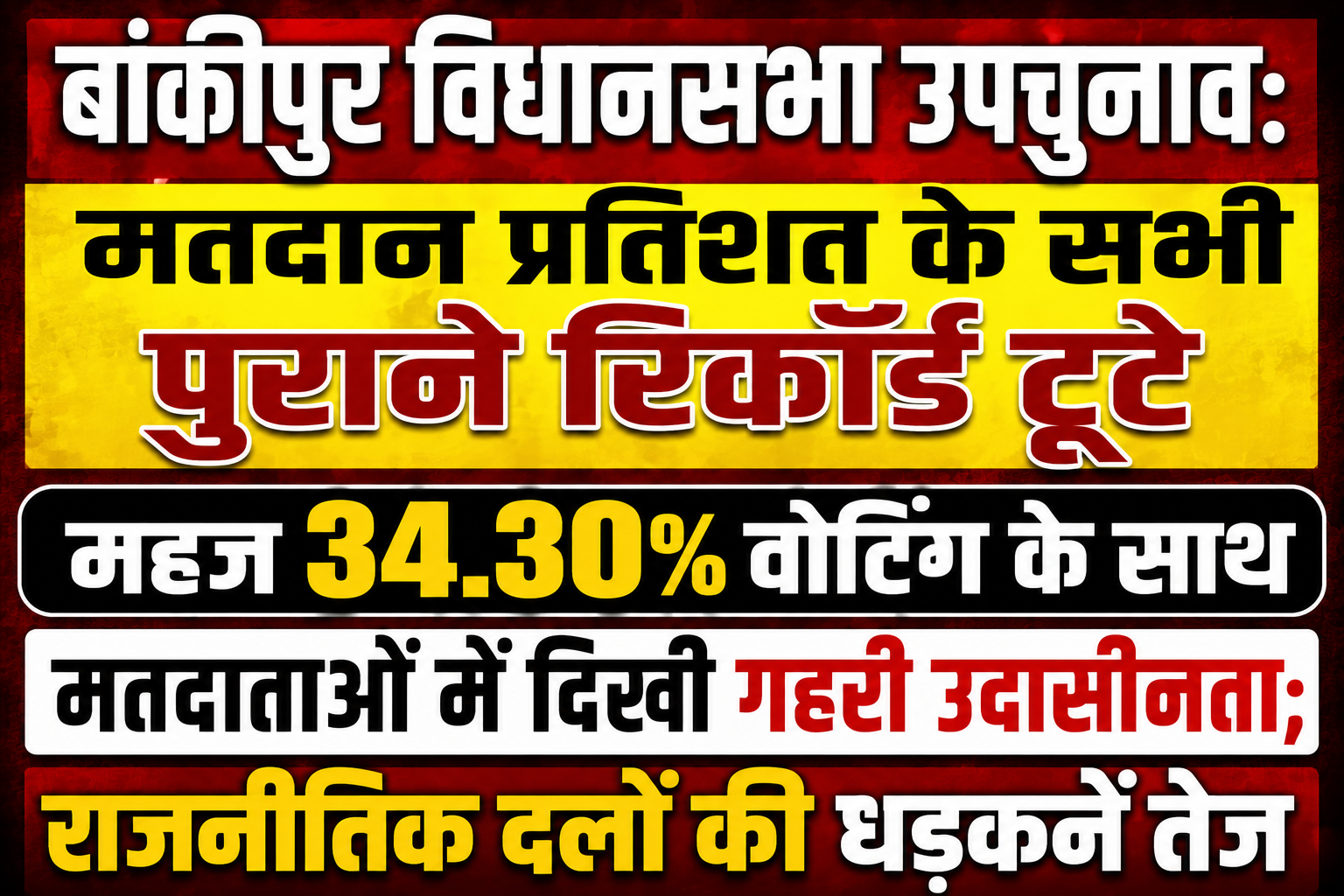
Bankipur Assembly By-Election: All Previous Records of Voter Turnout Broken, Deep Apathy Seen Among Voters with Merely 34.30% Voting; Political Parties' Heartbeats Race
The by-election for the VIP Bankipur Assembly Constituency in Patna, considered the focal point of Bihar politics, has written a new and shocking history on the polling front. All previous records of voter turnout have been shattered in this high-profile by-election, and the majority of voters here did not even bother to step out of their homes. According to official data released by the Election Commission up to 6 PM, total voting in the Bankipur seat was restricted to just 34.30 percent.
This massive voter apathy in an assembly segment counted among the capital's urban and posh areas has left political analysts and stalwarts of all contesting parties in deep contemplation. While on one hand this is being seen as a symbol of urban voter indifference, on the other hand, these low turnout figures have completely complicated the political equations. Let us analyze in detail this low voter turnout in the Bankipur by-election, the reasons behind it, and its political impacts.
Background: Why Was a By-Election Being Held in Bankipur?
The Bankipur assembly seat has consistently been regarded as a traditional and extremely strong bastion of the Bharatiya Janata Party (BJP).
Reason for Seat Falling Vacant: This seat fell vacant after senior BJP leader and sitting MLA Nitin Nabin moved to the Rajya Sabha, making a by-election here mandatory.
Triangular Contest: The contest in this by-election was highly interesting and triangular. Neeraj Kumar सिन्हा (Sinha) contested from the ruling NDA (BJP), while Rekha Gupta took up the charge from the Mahagathbandhan (RJD). Meanwhile, the entry of political strategist-turned-politician Prashant Kishor's party, 'Jan Suraaj', turned this election into a topic of discussion at the national level.
In the Words of Data: Why Is the 34.30% Figure Special and Alarming?
Such deep apathy among the capital's voters in this biggest festival of democracy raises several major questions in itself.
Sharp Decline Compared to Previous Elections: Looking at data from past elections, Bankipur has always witnessed lower voter turnout compared to other rural seats, but this time's record touches the lowest trough. In the previous assembly election (held in 2025), approximately 41.39 percent voting took place here. Consequently, compared to the last election, a direct decline of around 7 percent in voter turnout was recorded this time.
Urban Apathy: The entire Bankipur region is surrounded by urban and cosmopolitan voters. Desolation was witnessed at various polling booths right from the morning on election day. Although long queues were briefly seen at certain booths during morning hours, the pace of voting slowed down completely as the day progressed.
What Are the Main Reasons Behind Low Turnout?
According to political experts and analysts, several major psychological and social reasons lie behind the drop in voter percentage during urban by-elections:
Illusion of Difference Between General Elections and By-Elections: A common perception forms among urban and middle-class voters that changing a single MLA does not make a massive difference to the government or system, due to which they refrain from visiting polling booths.
Administrative and Weather Impact: Although foolproof security arrangements and multiple efforts to raise voter awareness were made at the administrative level, this urban voter apathy has nonetheless become a matter of concern for political parties.
Who Benefits and Who Loses from Low Voting? Political Parties' Heartbeats Race
With the voter turnout percentage plunging low, the breaths of all political parties and their candidates are now stuck. Everyone is deciphering the meanings of this low turnout according to their own calculations:
Hopes Pinned on Traditional Cadre Votes: Political pundits believe that when turnout in an urban seat drops to around 34 percent, it signifies that general or neutral voters did not step out of their homes. Under such circumstances, outcomes depend entirely on which party succeeded the most in bringing its steadfast and loyal core voters to the polling booths.
BJP's Core Voter and Upper Caste-Vaishya Dominated Area: The population of upper castes (Kayasthas, Bhumihars, Brahmins, Rajputs) and Vaishyas is considered decisive in the Bankipur seat, traditionally viewed as strong supporters of the BJP. Following the low turnout, the party believes that its loyal voter turned out, whereas opposition parties claim that anger against the government is reflected in low turnout as indifference or a desire for change.
Jan Suraaj and RJD's Hopes: Jan Suraaj, seeking to carve out its political ground, and the primary opposition Rashtriya Janata Dal (RJD) had also thrown their full weight into this election. Amidst low voting, it will be interesting to see which party's ground-level management proved strongest.
Sporadic Skirmishes and Peaceful Voting
Barring sporadic incidents, the overall situation remained peaceful throughout the polling process. However, minor altercations between Jan Suraaj and BJP workers outside some booths in Patna (such as Anandpuri, Peermuhani, and Kidwaipuri), allegations and counter-allegations of bogus voting, and technical glitches in a few EVMs also surfaced, which administrative machinery promptly rectified. The Election Commission clarified that this is not the final figure, as several voters standing in queues after 6 PM also exercised their franchise, but overall the trend remained that of low voter turnout
This minimum turnout percentage of 34.30 percent in the by-election for the Bankipur assembly seat in Bihar clearly conveys that enthusiasm toward democracy is steadily declining in urban areas. Regardless of what the outcomes are and whose head the crown of victory rests upon, the record-breaking low turnout has proved that raising awareness among urban voters and ensuring their participation is turning into a massive challenge for both political parties and the Election Commission. All eyes are now pinned on the vote counting scheduled for August 3 and the upcoming results.