Bihar Moves Ahead With Plan to Set Up Mining Police, Action Against Illegal Sand Mining to Be Strengthened
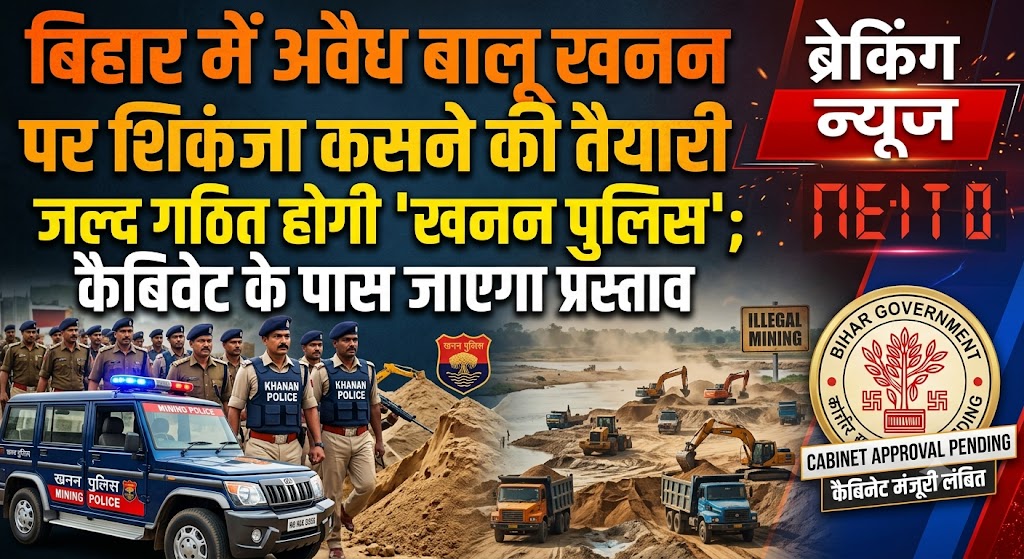
Patna: The Bihar government has moved forward with its plan to establish a dedicated mining police force to curb the illegal mining, transportation and storage of sand and other minor minerals across the state.
The Department of Mines and Geology has finalized the proposed framework for the creation of mining constable posts. The department is now preparing to give the proposal its final shape. After receiving approval from the concerned minister, the proposal will be sent to the state Cabinet for consideration.
The proposed mining police system is being viewed as an important step toward strengthening the protection of mineral resources and taking more effective action against illegal mining activities.
Illegal extraction, unauthorized transportation and illegal storage of sand and other minor minerals have remained challenges for the authorities in Bihar. Although enforcement agencies have regularly conducted raids and taken action, monitoring large mining areas and transportation routes remains difficult.
The proposed dedicated mining police force is expected to make this monitoring system more organized and effective.
Formula for Mining Constables Finalized
The Department of Mines and Geology has finalized the framework for creating mining constable posts under the proposed mining police system.
The department is now working on the final version of the proposal. Mining constables are expected to play an important role at the ground level in monitoring mining areas, identifying illegal activities, collecting information and assisting officials in enforcement operations.
However, their exact powers and responsibilities will become clear only after the government approves the proposal and the relevant rules are finalized.
Once the proposal is prepared, it will move through the departmental process. After approval from the minister, it will be placed before the state Cabinet.
Government Focusing on Illegal Sand Trade
Sand is an important raw material for construction activities. It is widely used in roads, buildings, bridges and other infrastructure projects.
Because demand for sand remains high, illegal extraction and transportation can become a major challenge for the authorities.
Illegal mining can result in loss of government revenue while also affecting the environment and river ecosystems. For this reason, the government has been focusing on strengthening monitoring of sand mining sites and mineral transportation.
The proposed mining police force is expected to strengthen this monitoring mechanism.
Transportation and Storage Also Under Watch
Illegal mining is not limited to the extraction of minerals. Illegally mined sand and other minerals also have to be transported and stored.
Unauthorized transportation and storage can therefore form an important part of enforcement activities.
The proposed mining police may be involved in checking vehicles, verifying mineral transportation documents and reporting suspicious activities to senior officials. The final responsibilities will be determined after government approval.
Challenges in the Existing System
At present, various government departments and local administrative authorities are involved in monitoring illegal mining activities.
However, the large geographical spread of mining areas and changing methods used for illegal activities create significant challenges.
Many mining sites are located in remote rural and riverine areas, making continuous monitoring difficult. Preventing illegal transportation also requires regular surveillance of roads and important transportation routes.
A dedicated mining police force could provide the mining department with specialized personnel focused specifically on these activities.
Focus on Preventing Revenue Loss
Illegal mining directly affects government revenue. When minerals are extracted or transported without proper authorization, the government loses the applicable royalty, fees and other revenue.
With construction and infrastructure development increasing in Bihar, demand for minerals is also significant. Protecting revenue generated through legal mining and transportation is therefore an important priority for the government.
A dedicated mining police system could help strengthen enforcement and improve monitoring of mineral-related activities.
Environmental Protection Also Important
Illegal sand mining is not merely a revenue issue. Excessive and uncontrolled removal of sand from rivers can affect river systems and the surrounding environment.
Unregulated mining along riverbanks can contribute to erosion and may affect natural water flow.
Ensuring that mining activities are conducted according to prescribed rules is therefore essential.
If the proposed mining police system becomes operational and effective, violations of mining regulations could be identified and acted upon more quickly.
Technology Could Strengthen Monitoring
Technology could also become an important part of the proposed mining enforcement system.
Vehicle monitoring, online permits, digital verification of transportation documents, GPS-based tracking and digital records could help authorities identify unauthorized transportation and suspicious activities.
Combining physical inspections with technology could make enforcement more effective and improve the speed of investigations.
The exact extent to which technological tools will be incorporated into the mining police system will become clear after the proposal and associated rules receive approval.
Mining Constables Could Play a Key Ground-Level Role
Mining constables could have an important role in the new system. Regular patrolling and inspection of mining areas could help identify illegal activities and provide information to senior officials.
A clear monitoring mechanism could also encourage legal operators and mineral transporters to comply with regulations.
However, it will be important to provide mining personnel with adequate training, equipment and security so that they can carry out their responsibilities effectively.
Transparency and Accountability Will Be Important
Along with creating a mining police force, transparency and accountability will also be essential.
The enforcement system should ensure that legitimate businesses and legal mineral transporters do not face unnecessary difficulties. Clear rules and standardized procedures will be required to distinguish legal operations from illegal activities.
Documentation and permit requirements for legal mineral transportation should also remain clear and accessible.
Similarly, procedures related to seizure, penalties and other legal actions should be governed by clearly defined guidelines.
Cabinet Approval Will Be the Next Major Step
With the framework for mining constable posts already finalized, the department is now preparing the proposal for final approval.
After the minister gives consent, the proposal will be sent to the state Cabinet.
Cabinet approval will be an important stage in the process. Once approved, further decisions can be taken regarding the number of posts, recruitment procedures, responsibilities, deployment areas and the administrative structure of the proposed mining police.
For now, the department is focused on completing the proposal and the necessary administrative procedures.
Important Step Against Illegal Mining
The establishment of a dedicated mining police force could represent a significant change in Bihar's strategy to protect mineral resources and control illegal mining.
If the proposal receives approval and adequately trained mining constables are deployed, the government could expand monitoring across mining areas.
This could strengthen action not only against illegal extraction but also against unauthorized transportation and storage of sand and other minor minerals.
The Bihar government has moved ahead with the process of establishing a mining police force to strengthen action against the illegal mining, transportation and storage of sand and other minor minerals.
The Department of Mines and Geology has finalized the framework for creating mining constable posts and is now preparing to finalize the proposal.
After approval from the concerned minister, the proposal will be placed before the state Cabinet. Further action will begin once the Cabinet gives its approval.
The biggest challenge will be to ensure that the new system has sufficient manpower, proper training, modern technology and clearly defined powers.
If implemented effectively, the mining police could help Bihar achieve three important objectives: controlling illegal mineral activities, protecting government revenue and strengthening environmental protection.