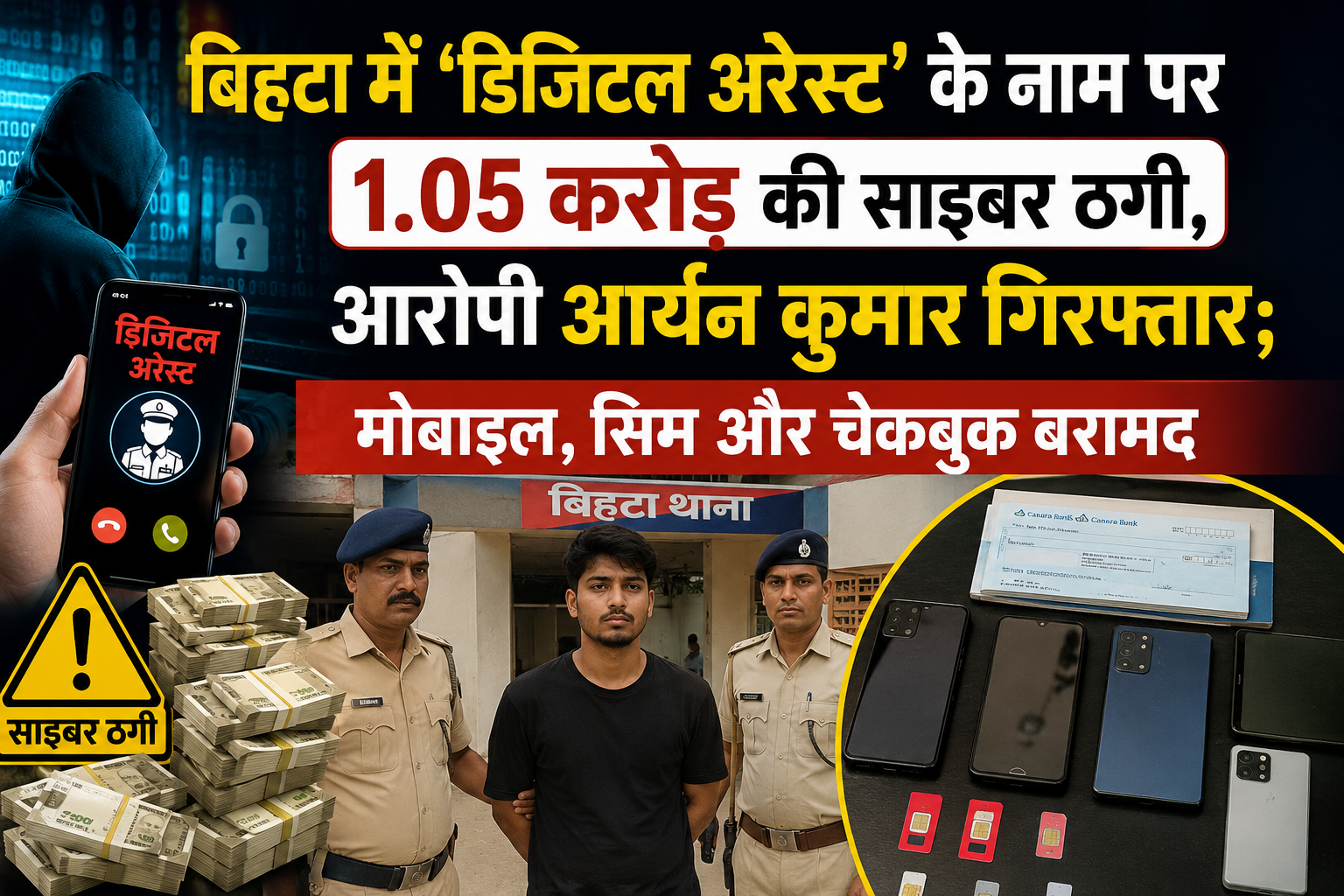
Cyber Fraud of ₹1.05 Crore in Behta Under the Pretext of ‘Digital Arrest’; Accused Aryan Kumar Arrested, Mobile Phones, SIM Cards and Cheque Book Recovered
Patna: Amid the growing number of cybercrime cases in Bihar, a major case has come to light from the Behta police station area of Patna district. Police have arrested a young man, identified as Aryan Kumar, from Raghopur SS Colony on allegations of committing cyber fraud worth approximately ₹1.05 crore under the pretext of a “digital arrest.”
According to police, two mobile phones, four SIM cards and a cheque book were recovered from the accused. Investigators suspect that these electronic devices and banking documents may have been used for communication and financial transactions linked to the alleged cyber fraud. The investigation is ongoing, and police are questioning the accused to uncover the wider network behind the operation.
“Digital arrest” is a method used by cybercriminals in which they impersonate police officers, CBI officials, Enforcement Directorate officials, narcotics officers or other government authorities. They frighten victims by claiming that they are involved in a criminal case and then keep them engaged through phone or video calls. Under the pretext of an investigation, the victims are pressured into transferring money.
Arrest Made From Raghopur SS Colony
Police arrested the accused from Raghopur SS Colony under the Behta police station area of Patna.
Two mobile phones and four SIM cards were recovered from him. Police also recovered a cheque book.
Investigators are now trying to determine who the accused was communicating with through the recovered numbers and whether the banking documents were used for receiving or transferring money.
Police may examine the call records, chats, bank transactions and other digital activities associated with the devices. Such information could help investigators identify additional members of the alleged cybercrime network.
Alleged Fraud Worth ₹1.05 Crore
The most serious aspect of the case is the alleged cyber fraud involving approximately ₹1.05 crore.
Police are investigating where the allegedly defrauded money was transferred, which bank accounts were used and how many people were involved in the operation.
In many cybercrime cases, fraudulently obtained money is transferred through multiple bank accounts. Therefore, investigators have to trace not only the role of the arrested person but also the entire financial network.
How Does the ‘Digital Arrest’ Scam Work?
“Digital arrest” is a frightening tactic increasingly used by cybercriminals.
Fraudsters first contact potential victims by phone. They may claim that a suspicious parcel has been sent in the victim’s name, that their bank account has been linked to illegal activities or that their name has appeared in a serious criminal investigation.
The call is then allegedly transferred to a senior police officer or investigating officer.
The victim may be asked to join a video call. Criminals often use fake identity cards, government logos, police uniforms and fabricated documents to make their claims appear legitimate.
The victim is then frightened into believing that they are under “digital arrest” and are not allowed to contact anyone until the supposed investigation is completed.
Victims Are Pressured to Transfer Money
The main objective of cybercriminals is to create fear and psychological pressure.
They may threaten victims with arrest, imprisonment, seizure of property or freezing of bank accounts.
Under the pretext of verification or investigation, victims may then be instructed to transfer money to another bank account.
Fraudsters sometimes claim that the transferred amount will be returned after the investigation is completed.
In reality, the money is often moved through several accounts controlled by the criminals.
Recovered Mobile Phones and SIM Cards to Be Examined
Police recovered two mobile phones and four SIM cards from the accused.
These devices could provide important evidence during the investigation.
Investigators may examine call records, text messages, social media conversations, banking applications and other digital activity stored on the phones.
The SIM cards may also help establish which numbers the accused was communicating with and how those connections were allegedly being used.
If links to an organized cybercrime group are discovered, police may take further action against other suspects.
Cheque Book May Provide Additional Clues
The recovery of a cheque book is also considered relevant to the investigation.
Police can examine the bank account associated with the cheque book and investigate recent transactions.
The account holder's identity, deposits, withdrawals and transfers could help investigators determine whether the account was allegedly used in connection with the fraud.
If suspicious transactions are found, investigators may follow the financial trail to identify additional people involved.
Investigation Into Wider Cybercrime Network
Police efforts are unlikely to be limited to the arrest of one person.
In major cyber fraud cases, investigators need to determine who else may have been involved.
Different individuals can have different roles in cybercrime operations. One person may arrange SIM cards or bank accounts, another may contact victims and another may transfer the stolen money between accounts.
Police may therefore investigate whether Aryan Kumar was allegedly working with a larger network.
Digital Evidence Will Be Important
Digital evidence can play a major role in cases involving cybercrime.
Mobile phones, SIM cards, bank accounts, call records, internet activity and digital payment information can be analyzed together to reconstruct the alleged crime.
Chats, recordings or other communications with victims may also provide important evidence if recovered during the investigation.
Public Needs to Remain Alert
The Behta case is another reminder that cybercriminals are increasingly using fear and intimidation to target people for large sums of money.
If someone claims to be a government official and demands an immediate money transfer over a phone or video call, people should be extremely cautious.
If a caller claiming to be a police or investigative officer threatens arrest, the information should be independently verified before taking any action.
What Is a ‘Digital Arrest’?
The most important point is that “digital arrest” is not a genuine legal procedure for arresting someone.
Cybercriminals use the term to frighten people and create psychological pressure.
A person cannot legally be placed under “digital arrest” simply through a phone or video call.
Therefore, anyone receiving such a call should remain calm and independently verify the claim.
Beware of Fake Police Officers
Cybercriminals often use official-sounding language and claim to be police officers or senior government officials.
They may try to convince victims that a serious case has already been registered against them.
Sometimes they may even use fake police-station backgrounds or uniforms during video calls.
People should remember that a uniform, identity card or official-looking background visible on a screen does not prove that the caller is genuine.
Never Share Banking Information
People should never share bank account details, ATM card information, OTPs, UPI PINs or internet banking passwords with unknown callers.
If someone claiming to be a government official demands an immediate money transfer, it can be a major warning sign of cyber fraud.
Any suspicious call related to a bank or government department should be independently verified through official channels.
Families Should Educate Elderly Members
Cybercriminals may particularly target people who have limited knowledge of digital security or official procedures.
Families should educate elderly members about these scams.
They should understand that genuine government officials do not normally threaten people over phone calls and demand immediate money transfers to avoid arrest.
Police Investigation May Reveal More Details
Behta Police are questioning the arrested accused to determine the full details of the case.
The two mobile phones, four SIM cards and cheque book could provide important digital and financial clues.
Investigators are expected to examine where the allegedly defrauded ₹1.05 crore went and whether the case is connected to a larger cybercrime network.
If the investigation reveals the involvement of additional suspects, further arrests may follow.
The arrest of Aryan Kumar from Raghopur SS Colony in connection with an alleged ₹1.05 crore cyber fraud under the pretext of “digital arrest” has once again highlighted the growing threat of cybercrime in Bihar.
Police recovered two mobile phones, four SIM cards and a cheque book from the accused. Examination of these items could provide important clues about the alleged fraud network and the movement of money.
The case is also an important warning for the public. If anyone impersonates a police officer, CBI official, ED officer or another government authority and threatens arrest through a phone or video call, people should remain calm and verify the claim independently.