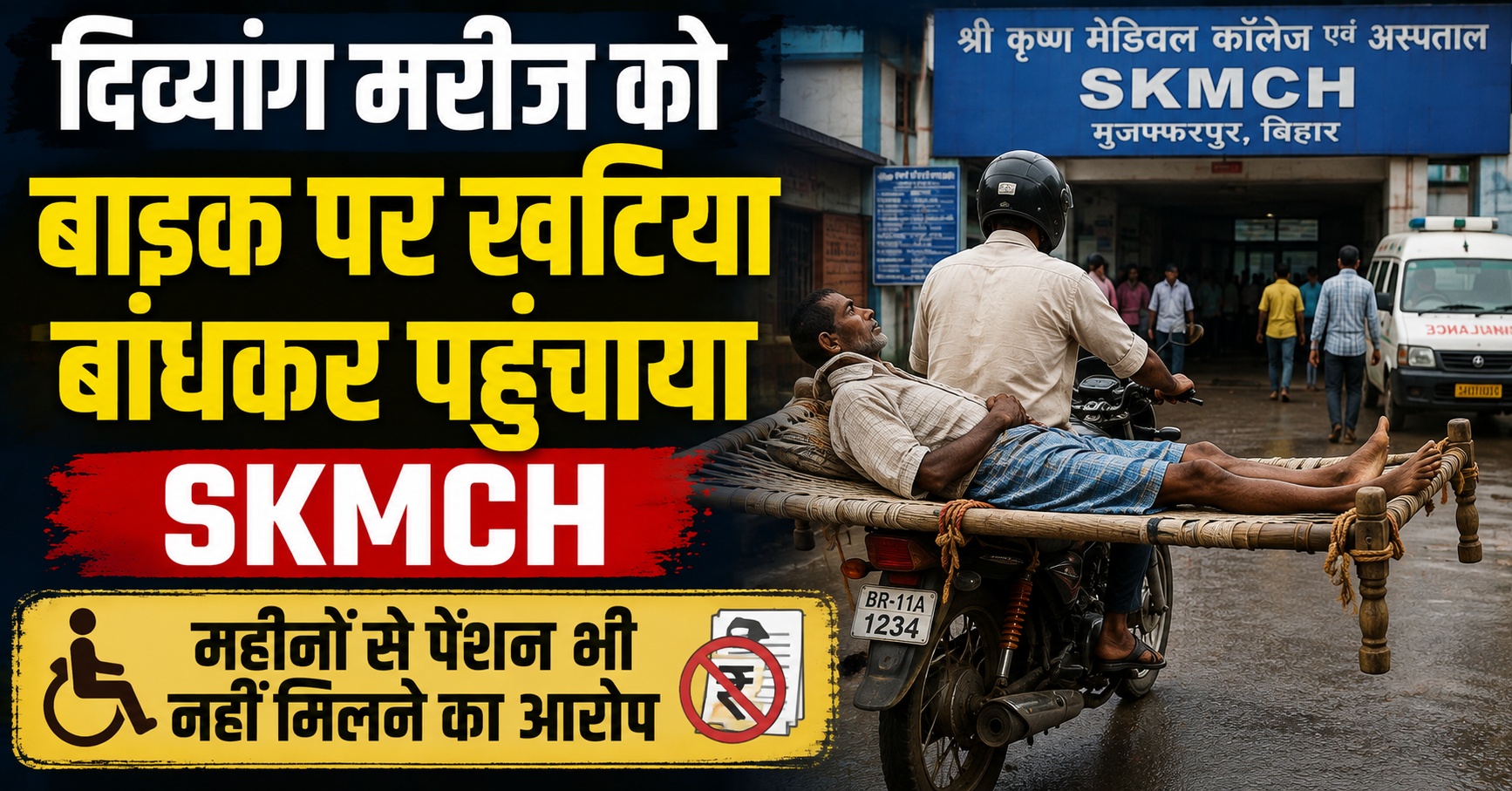
Disabled Patient Brought to SKMCH on a Cot Tied to a Motorcycle, Questions Raised Over Rural Healthcare and Transport System
Muzaffarpur: A shocking incident at Sri Krishna Medical College and Hospital (SKMCH) in Muzaffarpur has raised serious questions about healthcare facilities, rural transport and social security support in Bihar. A disabled patient reportedly had to be taken to the hospital on a cot tied to the back of a motorcycle because his family was unable to arrange a suitable vehicle for his treatment.
The unusual and distressing sight attracted the attention of people inside the hospital premises. A crowd gathered as the patient was brought into the hospital on the makeshift arrangement. Several people expressed concern over the difficulties faced by poor and physically vulnerable patients in accessing medical care.
The patient has been identified as Vinod Sah, a resident of Shahpur village under the Hathauri police station area of Muzaffarpur. Vinod is disabled and reportedly suffered a leg fracture in a road accident some time ago. Since the accident, he has had severe difficulty walking and moving independently.
He is currently also suffering from bedsores. According to information from his family, his financial difficulties have worsened because he has allegedly not received his social security pension for the past three to four months.
Patient Brought to Hospital on a Cot
Vinod was reportedly unable to travel to the hospital in an ordinary manner because of his physical condition.
His family or accompanying persons tied a cot to a motorcycle and placed him on it before taking him to SKMCH.
The arrangement appears to have been made because the family was unable to arrange more suitable transportation for the disabled patient.
When the motorcycle carrying the cot reached the hospital, the unusual scene attracted considerable attention from people present on the premises.
Many questioned why a seriously ill and disabled person had to be transported in such a difficult manner to receive medical treatment.
Life Changed After Road Accident
Vinod's problems reportedly began after a road accident in which he suffered a serious injury to his leg.
The injury affected his ability to walk and perform daily activities independently.
Since then, he has reportedly required assistance from family members for movement and other routine activities.
His prolonged immobility has now been accompanied by bedsores, further complicating his health condition.
For a patient with limited mobility, regular medical care and proper nursing support are important.
However, getting the patient to a hospital itself became a major challenge for the family.
Bedsores Have Added to His Problems
Bedsores, also known as pressure sores, can develop when a person remains in the same position for long periods.
They can cause damage to the skin and underlying tissues and may require regular medical attention.
Patients who are disabled or unable to move independently are particularly vulnerable to such complications.
They may require frequent changes in position, proper hygiene, adequate nutrition and appropriate medical care.
Vinod's case reportedly involves both his earlier leg injury and the complications arising from prolonged immobility.
Family Claims Pension Has Not Been Received for Months
Vinod's difficulties are reportedly not limited to his health.
His family has alleged that he has not received his social security pension for the past three to four months.
For a disabled person dependent on government assistance, even a limited monthly pension can be important for meeting expenses related to food, medicines and daily needs.
A prolonged interruption in pension payments can place additional pressure on a financially vulnerable family.
The exact reason for the alleged delay in Vinod's pension payment has not been established. It would need to be examined by the concerned authorities to determine whether the issue is related to documentation, verification, a technical problem or another administrative reason.
Questions Over Rural Transport Facilities
The incident has also brought attention to the availability of patient transportation facilities in rural areas.
For seriously ill or disabled people, reaching a hospital can be a major challenge, particularly when they cannot sit or travel normally.
Ambulance services and other suitable patient transport facilities can play an important role in such situations.
The fact that Vinod reportedly had to be transported on a cot tied to a motorcycle raises questions about whether suitable emergency or patient transport was available to the family when it was needed.
Public Concern Over Healthcare System
The incident reportedly drew strong reactions from people at the hospital.
Those who witnessed the patient being brought on the makeshift arrangement expressed concern about the difficulties faced by vulnerable people.
Healthcare is not limited to providing doctors and hospital beds. Ensuring that patients can safely reach healthcare facilities is also an important part of an effective health system.
This is particularly relevant for disabled patients and people living in remote rural areas.
Reaching the Hospital Is Also Part of Healthcare
For a seriously injured or immobile patient, the manner in which they are transported can have an impact on their comfort and condition.
A person suffering from a broken leg and bedsores may require careful handling and appropriate transportation.
An improvised arrangement involving a motorcycle and cot may have been the family's only practical option at the time, but it also highlights the need for accessible transport for vulnerable patients.
Need for Effective Social Security Delivery
Social security schemes are designed to provide financial support to vulnerable sections of society.
For disabled people and low-income families, pension payments can help cover basic expenses and medical costs.
If an eligible beneficiary does not receive payments for several months, the reason should be promptly investigated.
In Vinod's case, authorities could examine whether his beneficiary records are up to date and whether any verification or administrative issue has interrupted payments.
Special Support Needed for Disabled Patients
Disabled patients often require support beyond standard healthcare services.
They may need assistance with transportation, registration, diagnostic procedures, hospital admission and movement within the hospital.
At the rural level, identifying vulnerable patients and connecting them with healthcare and social security services could help prevent situations in which families are forced to rely on unsafe or improvised transportation.
Financial Pressure on the Family
Vinod's disability and medical problems may also have increased the financial burden on his family.
A person who is unable to work because of an injury or disability may lose an important source of household income.
At the same time, expenses related to medicines, treatment, transportation and caregiving can increase.
In such circumstances, government health schemes and social security support can become particularly important.
Questions for the Administration
The incident raises several questions for the local administration.
One concerns the availability of suitable transportation for seriously ill and disabled patients.
Another concerns the alleged delay in Vinod's social security pension.
Authorities may also need to examine whether local healthcare facilities and support mechanisms are adequately equipped to assist people with severe mobility limitations.
If a patient has to be taken to a major hospital on a cot tied to a motorcycle, it is important to understand why more appropriate options were not accessible.
Effective Implementation Is as Important as Government Schemes
Government schemes can provide meaningful benefits only when they reach eligible people on time.
Healthcare, transportation and social security are interconnected.
A patient needs safe transportation to reach a hospital, medical care after arrival and financial support when treatment places pressure on the family.
If any one of these systems fails, the difficulties faced by a vulnerable family can increase significantly.
Need to Learn From the Incident
Vinod's case highlights several challenges beyond the individual incident.
Rather than viewing the episode only as a distressing photograph or news story, authorities may need to examine the circumstances that led to it.
Was emergency transportation available in the village? Did the family attempt to contact an ambulance service? If they did, was assistance available in time? Why has the social security pension reportedly stopped? Are there local mechanisms for helping disabled patients reach healthcare facilities?
Answers to these questions could help identify gaps in the existing system and improve services.
The incident at SKMCH in Muzaffarpur, where a disabled patient was reportedly brought to the hospital on a cot tied to a motorcycle, has highlighted serious concerns regarding rural healthcare access, patient transportation and social security support.
Vinod Sah, a resident of Shahpur village under Hathauri police station, reportedly became unable to walk properly after suffering a leg injury in a road accident. He is also suffering from bedsores associated with prolonged immobility. His family has alleged that he has not received his social security pension for the past three to four months, adding to their financial difficulties.
The sight of a patient being transported on a cot tied to a motorcycle demonstrates that the effective implementation of government services is as important as announcing schemes.
Ensuring safe transportation, timely medical treatment and uninterrupted social security assistance for disabled and seriously ill people should remain a priority.
The circumstances surrounding Vinod's pension payments and access to suitable transportation should be examined so that necessary assistance can be provided and similar situations can be prevented in the future.
The incident is not merely a story about one family's hardship; it is also an opportunity to assess how easily Bihar's rural healthcare and social security systems are reaching the most vulnerable citizens.