
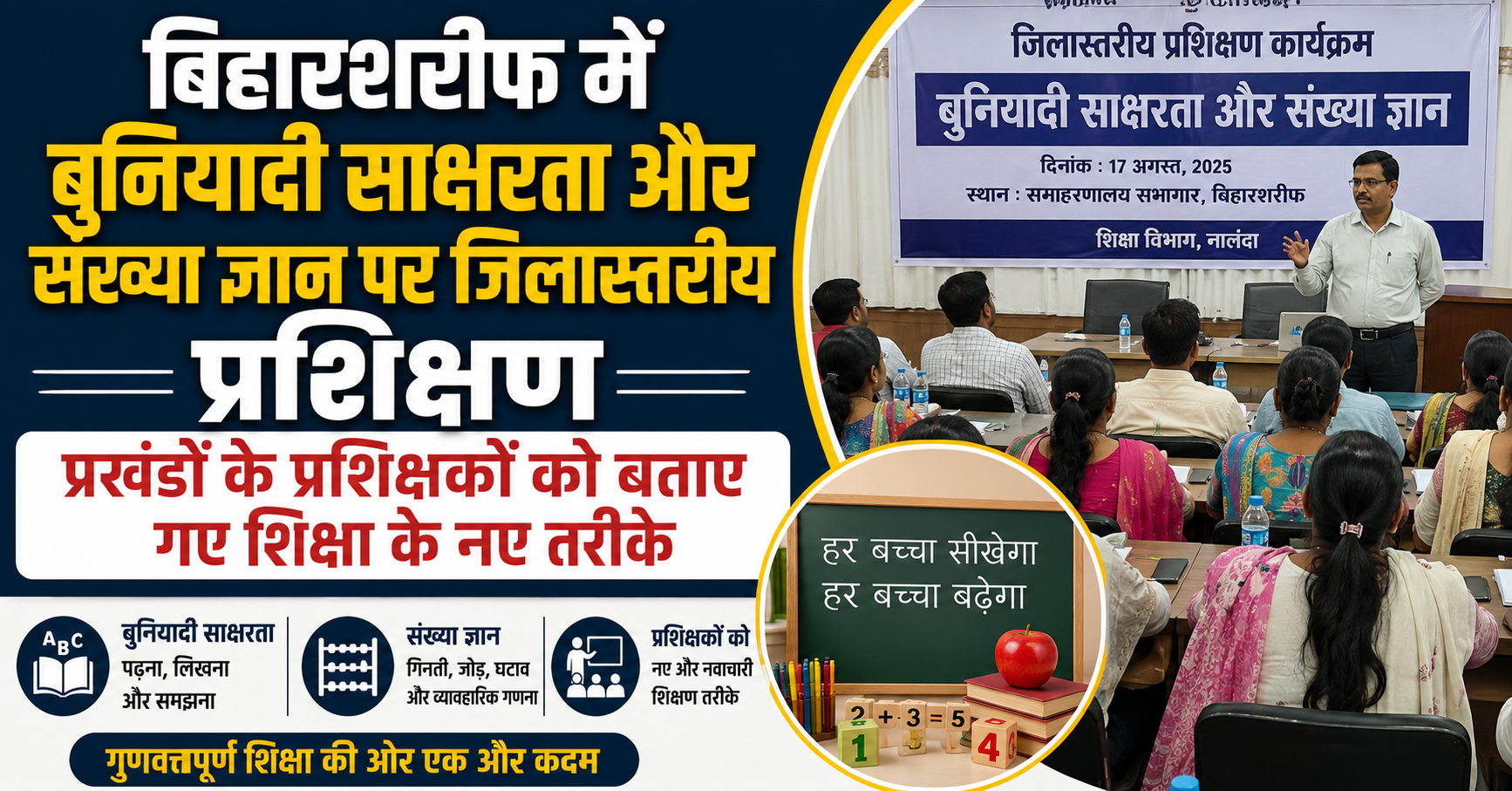
District-Level Training on Foundational Literacy and Numeracy Held in Biharsharif
Biharsharif: A district-level training programme focused on Foundational Literacy and Numeracy (FLN) was organised at Nalanda Collegiate in Biharsharif. Trainers from different blocks of the district participated in the programme, which aimed to strengthen teaching methods for children at the foundational stage of education.
District-level trainers provided participants with information about new and activity-based teaching methods. Sunil Kumar Tanti and other trainers introduced participants to innovative approaches designed to make early education more effective, engaging and child-friendly.
Focus on Foundational Literacy
Foundational literacy is an important part of early education. It includes helping children recognise letters, read words, understand sentences and express their thoughts effectively.
During the training, participants were introduced to methods of encouraging children to read through stories, poems, pictures and interactive activities. Such approaches can make learning more interesting and help children develop reading skills more effectively.
Trainers also emphasised the importance of using examples related to children's local environment and language so that they can understand concepts more easily.
Emphasis on Numeracy Skills
Along with literacy, basic numeracy was another major focus of the training programme.
Participants were introduced to methods of helping children understand numbers through practical activities. Counting, addition, subtraction, comparison and number recognition can be taught through games and examples from everyday life.
The objective is not simply to make children memorise numbers but to help them understand basic mathematical concepts and their practical applications.
Sunil Kumar Tanti and Other Trainers Conduct Sessions
District-level trainers conducted various sessions during the programme. Sunil Kumar Tanti, along with other trainers, provided information about new teaching approaches and ways to improve children's learning outcomes.
The trainers encouraged participants to ensure active involvement of students in the classroom. Instead of relying only on teacher-led instruction, they highlighted the importance of discussions, activities and interactive learning.
Participants were also given guidance on developing teaching strategies according to different classroom situations.
Promotion of Activity-Based Learning
Activity-based learning was given particular importance during the training. Children can be encouraged to learn through games, pictures, stories, songs and other classroom activities.
For students in the foundational years, learning becomes more effective when it is engaging and enjoyable. Teachers were therefore encouraged to use locally available materials to create learning activities.
Giving children opportunities to ask questions, answer them and express their ideas was also highlighted as an important part of effective teaching.
Understanding Individual Learning Needs
Every child learns at a different pace. While some children may quickly develop reading and numeracy skills, others may require additional time, practice and individual support.
Participants were trained to identify children's learning levels and design teaching strategies accordingly. The importance of providing additional support and practice to students who are struggling was also discussed.
This approach can help ensure that children do not fall behind in the learning process.
Training to Reach Block Level
An important objective of the district-level training is to enable participants to pass on the knowledge they gain to teachers in their respective blocks.
This means that a single district-level training programme can potentially reach a much larger number of teachers through subsequent block-level training sessions.
At the block level, teachers can also discuss challenges faced in their schools and identify practical solutions based on local circumstances.
Importance of a Strong Foundation
The foundation for a child's future education is developed during the early years of schooling. If children develop strong reading, writing and basic mathematical skills at this stage, they may find it easier to understand more advanced subjects later.
However, if children struggle with foundational concepts, these difficulties can affect their learning in higher classes.
For this reason, strengthening foundational literacy and numeracy remains an important priority for improving educational outcomes.
Teachers Have a Key Role
Teachers play a central role in achieving FLN objectives. They are in the best position to identify children's learning needs and design appropriate classroom activities.
The training emphasised that a teacher's role should not be limited to completing the syllabus. It is equally important to determine what students have actually understood and whether they can apply what they have learned.
Regular assessment can help teachers identify learning gaps and modify their teaching strategies accordingly.
Importance of Parental Participation
Families also have an important role in supporting children's foundational education. Parents can encourage children to read, listen to stories, practise counting and use basic mathematical concepts in everyday activities at home.
Teachers were encouraged to maintain regular communication with parents. Cooperation between schools and families can provide children with stronger support for their educational development.
Use of Local Resources
Effective teaching does not always require expensive educational materials. Locally available objects can also be used to teach children basic concepts.
For example, stones, seeds, pencils and other everyday objects can be used to teach counting. Pictures, familiar objects and local stories can help children recognise letters and words.
Using familiar examples allows children to connect classroom learning with their everyday experiences.
Expected Improvement in Teaching Quality
District-level training programmes are designed to strengthen the skills and capabilities of teachers and trainers.
If participants successfully introduce these new approaches in their respective blocks and schools, the quality of classroom teaching can improve. Teachers can also learn from one another by sharing their experiences and discussing effective teaching practices.
A district-level training programme on Foundational Literacy and Numeracy was organised at Nalanda Collegiate in Biharsharif. Trainers from different blocks participated in the programme, where district-level trainers introduced them to new and activity-based teaching methods.
Sunil Kumar Tanti, along with other trainers, provided training on developing children's basic reading, writing and numeracy skills. The sessions focused on using stories, pictures, games and everyday examples to make learning more effective and engaging.
The programme aims not only to enhance the knowledge of participating trainers but also to prepare them to share these methods with teachers at the block level. This can help extend the impact of the district-level training across more schools.
Foundational literacy and numeracy provide an essential base for children's future education. Regularly updating teachers with modern, child-friendly and activity-based teaching techniques is therefore important. The training programme in Biharsharif is expected to contribute to improving early-grade teaching practices and strengthening children's foundational learning skills.