EOU Arrests Accused Atul Raj, Probe Into Alleged Exam-Rigging Network Intensifies
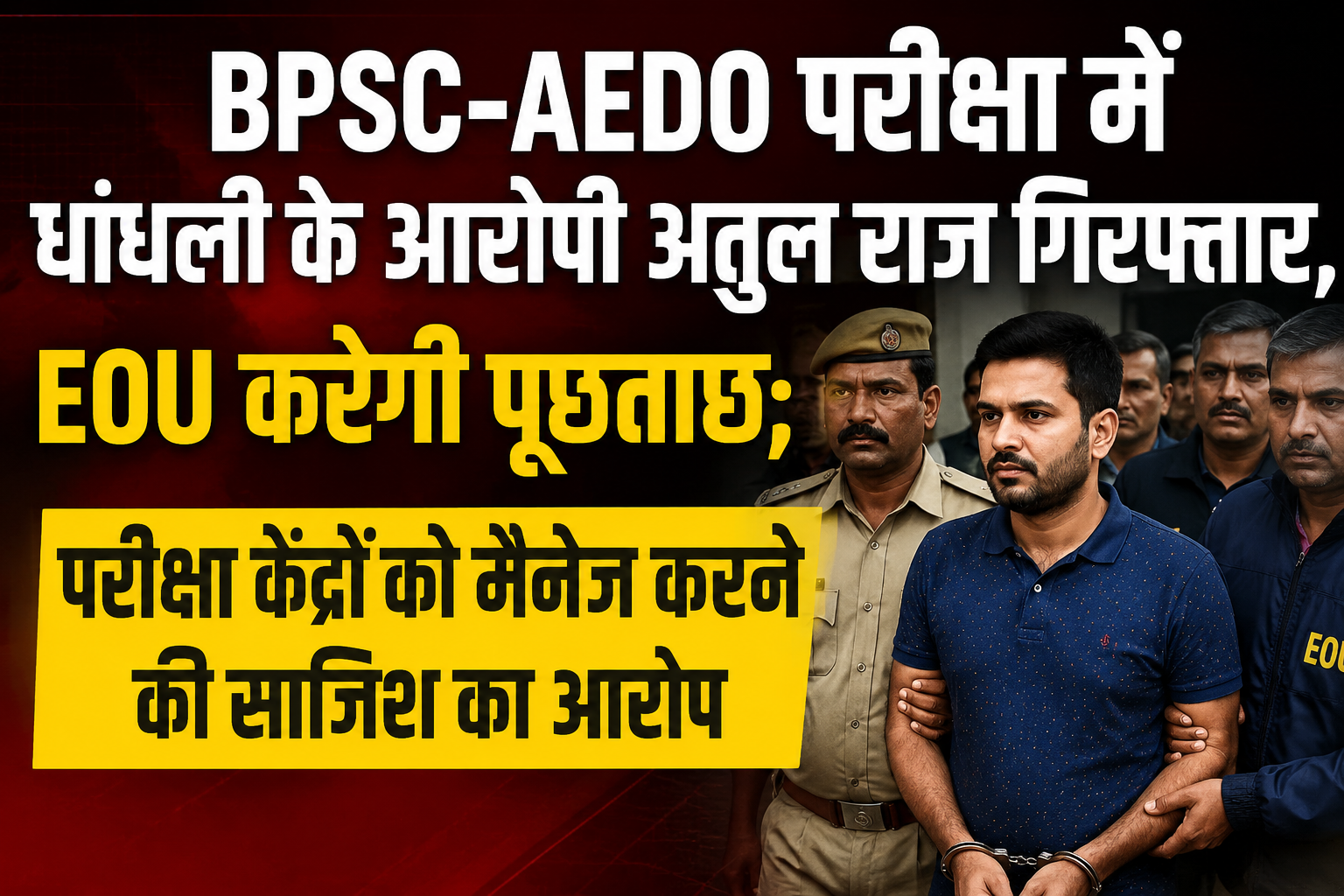
Patna: The Economic Offences Unit (EOU) has taken a significant step in the alleged irregularities case related to the BPSC Assistant Education Development Officer (AEDO) examination by arresting Atul Raj, who is accused in the case. Following his arrest, the investigating agency is expected to question him extensively to establish the complete chain of events and identify others who may have been involved.
According to the allegations, during the AEDO examination held in April 2026, a large-scale plan was allegedly prepared to manipulate several examination centres and provide unfair advantages to certain candidates.
The EOU is now investigating how the alleged network operated, who was involved, how access to examination centres was allegedly arranged and whether candidates were supposed to receive any unfair benefit.
Atul Raj's arrest is being viewed as an important development in the investigation. Officials are expected to seek information from him about the alleged network and its possible links.
Alleged Irregularities in AEDO Examination
The AEDO examination conducted by the Bihar Public Service Commission was important for thousands of candidates preparing for government jobs.
A large number of applicants appeared for the examination at different centres.
Following allegations of irregularities during the examination process, the matter came under investigation.
The allegations suggested that certain individuals may have attempted to influence the examination process and provide unfair benefits to selected candidates.
The EOU subsequently began investigating the people allegedly connected to the suspected network.
Atul Raj's Arrest May Accelerate Investigation
The arrest of Atul Raj could provide investigators with information that may help them establish the sequence of events.
The EOU may question him about his alleged role in the suspected irregularities and his contacts with other individuals.
Investigators may also seek information about examination centres, candidates, intermediaries and other people who may have been connected to the alleged plan.
The agency is likely to examine how the alleged operation was planned and whether it was actually implemented.
Allegation of Managing Multiple Examination Centres
One of the serious allegations in the case is that several examination centres were allegedly being managed or influenced as part of the suspected plan.
If established through evidence, such activity would raise serious concerns about the fairness and credibility of the examination process.
Manipulating examination centres could potentially affect the rights of thousands of candidates who appeared for the examination fairly.
The EOU will therefore seek to determine which centres were allegedly targeted and what arrangements were supposedly being made.
Questions Surrounding April 2026 Examination
The AEDO examination was held in April 2026. Allegations of irregularities during or after the examination prompted further scrutiny.
Whenever complaints involving a competitive examination arise, investigators need to determine their source, authenticity and whether an organized network was involved.
The EOU's investigation is aimed at establishing these facts.
Information obtained from Atul Raj could help investigators connect different parts of the alleged operation.
Investigation Into Other Possible Participants
Following Atul Raj's arrest, one important aspect of the investigation will be to determine who else may have been in contact with him.
Investigators could examine call records, digital evidence, financial transactions and other relevant documents, subject to applicable legal procedures.
Such evidence may help investigators identify other individuals potentially connected to the alleged network.
If sufficient evidence emerges against other people, further legal action could follow.
Candidates May Also Come Under Investigation
In alleged examination-rigging cases, investigators may examine not only those suspected of organizing the operation but also whether any candidates knowingly attempted to obtain an unfair advantage.
The EOU may investigate whether particular candidates or groups had contacted people allegedly associated with the network.
However, merely having contact with an accused person does not establish guilt. Any action against an individual would require appropriate evidence and must follow due legal process.
Possible Examination of Financial Transactions
Financial transactions could be an important part of the investigation if the alleged irregularities involved payments.
The EOU may examine whether money was allegedly exchanged between candidates, intermediaries or other individuals connected to the case.
Investigators could examine the source and purpose of suspicious transactions and determine whether they were connected to the alleged examination-rigging operation.
Banking and financial records could potentially help investigators understand the structure of the suspected network.
Digital Evidence Could Also Be Important
In modern examination-related investigations, digital evidence such as mobile phones, messages, emails and other electronic records can be significant.
Subject to legal procedures, the EOU may examine Atul Raj's communications and digital records to identify possible links with other suspects.
Call details and other digital evidence could help establish whether and when individuals allegedly involved in the suspected plan communicated with each other.
Concern Over Examination Credibility
Competitive examinations are directly connected to the careers and futures of thousands of young people.
Any alleged manipulation can undermine confidence in the examination system and create concerns among candidates who have prepared for months or years.
If unfair advantages are provided to selected candidates, it can adversely affect those who have competed honestly.
Therefore, allegations of irregularities in major recruitment examinations require a fair and thorough investigation.
EOU Interrogation Under Focus
Following Atul Raj's arrest, the questioning conducted by the EOU is expected to be closely watched.
Investigators may question him about the alleged conspiracy, examination centres, contacts, candidates and possible financial transactions.
They may also seek to establish when the alleged plan was prepared and what steps were allegedly taken to implement it.
Information obtained during questioning could determine whether the investigation expands further.
Need for Stronger Examination Security
The case also highlights the importance of strengthening security and monitoring mechanisms for competitive examinations.
Measures such as strict verification of candidates, enhanced surveillance at examination centres, secure handling of examination material and stronger digital monitoring can help reduce the possibility of malpractice.
Everyone involved in conducting an examination should have clearly defined responsibilities and accountability.
Investigation Will Establish the Facts
The investigation remains ongoing following Atul Raj's arrest.
The full nature of the alleged conspiracy and the authenticity of the allegations will become clearer only after the EOU completes its investigation and evaluates the available evidence.
The agency will need to establish through evidence how the alleged manipulation was planned, who was involved and whether examination centres were actually influenced.
The accused also has the right to defend himself through the legal process.
The arrest of Atul Raj in the alleged BPSC-AEDO examination irregularities case is being viewed as an important development in the EOU investigation. The allegations relate to the April 2026 examination, during which a large-scale plan was allegedly prepared to influence several examination centres and facilitate malpractice.
The EOU is now expected to question Atul Raj in an effort to establish the alleged conspiracy and identify other people who may have been involved.
Investigators may examine financial records, digital evidence, communications and other material to determine whether a wider network was operating.