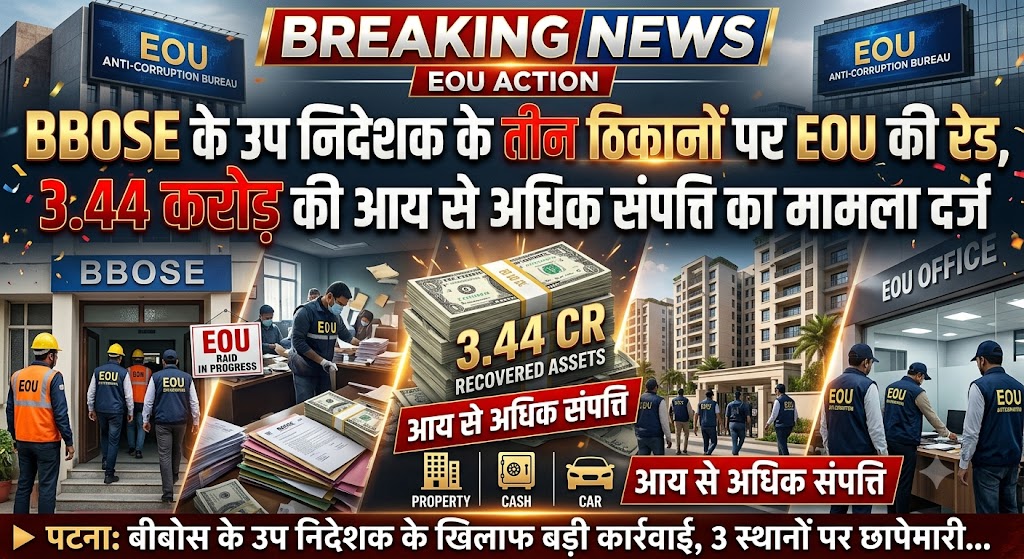
EOU Raids Three Premises of BBOSE Deputy Director in Disproportionate Assets Case, ₹3.44 Crore Alleged
Patna: The Economic Offences Unit (EOU) has taken major action in Bihar against the Deputy Director of the Bihar Board of Open Schooling and Examination (BBOSE) in connection with a disproportionate assets case. The agency conducted searches at three premises in Patna and Begusarai. The action has created a stir in administrative and educational circles.
According to preliminary information, the EOU has registered a case alleging that the officer possesses assets disproportionate to his known sources of income worth ₹3.44 crore. The searches in Patna and Begusarai were conducted as part of the investigation into the case. During the operation, officials examined various documents and records related to properties and financial transactions.
The action is part of the EOU's investigation into allegations of corruption and illegally accumulated assets. However, details of what exactly was recovered during the searches will become clear only after the investigating agency releases further information.
Searches Conducted at Three Premises
The EOU team conducted searches at three different premises in Patna and Begusarai.
Investigators examined documents and other materials found at the locations. In disproportionate assets cases, agencies generally examine bank accounts, property records, investments, vehicles, financial transactions and other assets.
The objective is to compare the official's known and legitimate income with the assets held in his name or linked to him.
Documents recovered during the searches could play an important role in determining the extent and source of the alleged disproportionate assets.
₹3.44 Crore Disproportionate Assets Alleged
According to the EOU, a case involving ₹3.44 crore in alleged disproportionate assets has been registered against the officer.
Such cases generally involve an assessment of whether the property and expenditure of a public servant are consistent with their known legitimate sources of income.
If investigators find a significant difference between an individual's lawful income and accumulated assets, they examine the sources from which those assets were acquired.
The EOU is now investigating the same aspect in this case.
Action Against BBOSE Official
The officer facing the investigation is serving as Deputy Director of the Bihar Board of Open Schooling and Examination.
BBOSE is an important institution involved in open-school education and examination-related activities in Bihar. Therefore, the EOU action against a senior official of the institution has attracted attention in administrative and educational circles.
However, merely registering a case or conducting searches does not establish guilt. The allegations will have to be examined through the investigation and subsequent judicial proceedings.
Searches in Patna and Begusarai
The EOU operation covered locations in both Patna and Begusarai.
Searching multiple premises can help investigators collect records from different locations and compare information relating to properties, bank accounts and financial transactions.
Documents recovered from different premises may be examined together to determine the alleged source and value of the assets.
Examination of Property Documents
Documentary evidence is particularly important in disproportionate assets investigations.
Investigators may examine records related to land purchases, houses, bank accounts, insurance policies, investments, vehicles and other financial assets.
If questions arise regarding the source of funds used to acquire a particular property, the related financial transactions may also be examined.
The agency can compare the officer's salary and other legitimate sources of income with the assets identified during the investigation.
Bank Accounts and Financial Transactions Under Scrutiny
Bank accounts and financial transactions can form an important part of the investigation.
The EOU may examine how much money was deposited into various accounts and identify the sources of significant transactions.
If large or unusual financial transactions are discovered, investigators may seek to establish their source and purpose.
Such financial analysis can help determine whether the alleged disproportionate assets are supported by legitimate income.
Property Valuation May Also Be Conducted
Determining the actual value of properties can also be important in such cases.
The value of land or a house may differ from the amount mentioned in official documents. Investigators can therefore examine purchase prices, payments made and, where required, the actual market value of properties.
This can help establish the total value of the assets and compare it with the individual's known income.
Role of EOU in Corruption Cases
The Economic Offences Unit investigates cases involving corruption, disproportionate assets and other economic offences in Bihar.
When information suggests a significant mismatch between the assets of a public official and their known income, the agency can initiate an investigation.
Such investigations aim to establish whether financial irregularities have occurred and whether there is sufficient evidence for further legal action.
Action Creates Discussion in Administrative Circles
The EOU's action against the BBOSE Deputy Director has generated discussion in administrative and educational circles.
The registration of a disproportionate assets case against a senior official is considered a serious matter and may also attract attention at the departmental level.
The next stage of the investigation will determine what important documents or evidence were found during the searches.
Investigation Will Clarify the Case
The investigation is currently at an early stage. After examining the material collected during the searches, the EOU may seek answers to several questions regarding the officer's assets and income.
Investigators will attempt to determine the sources from which the alleged additional assets were acquired and whether any financial irregularities were involved.
The allegations can only be conclusively established or rejected after the investigation and applicable legal proceedings are completed.
Guilt Cannot Be Presumed Before Judicial Process
A disproportionate assets case involves serious allegations, but an accused person cannot be considered guilty unless the allegations are established through the legal and judicial process.
The officer under investigation will also have the right to present their defence according to law.
Therefore, the searches and registration of the case should not be treated as a final finding of guilt.
Further Action Awaited
Attention is now focused on the next steps in the EOU investigation.
After analyzing the documents and other material collected during the searches, the agency may take further legal action.
Depending on the findings, investigators may question individuals, examine financial records and conduct detailed valuation of properties.
If additional assets or the involvement of other individuals are discovered, the scope of the investigation could potentially expand.
The EOU's action against the Deputy Director of BBOSE in an alleged disproportionate assets case has created a stir in Bihar's administrative and educational circles. The Economic Offences Unit conducted searches at three premises in Patna and Begusarai.
According to the EOU, a case involving ₹3.44 crore in alleged disproportionate assets has been registered against the officer. Investigators are examining documents related to properties, bank accounts, financial transactions and other assets.
The documents and evidence collected during the searches are expected to play an important role in determining the direction of the investigation. The agency will examine how the alleged disproportionate assets were acquired and whether they can be explained through legitimate sources of income.
The matter remains under investigation, and the allegations will ultimately be subject to the applicable legal and judicial process. Attention will now remain focused on the EOU's findings and any further action in the case.