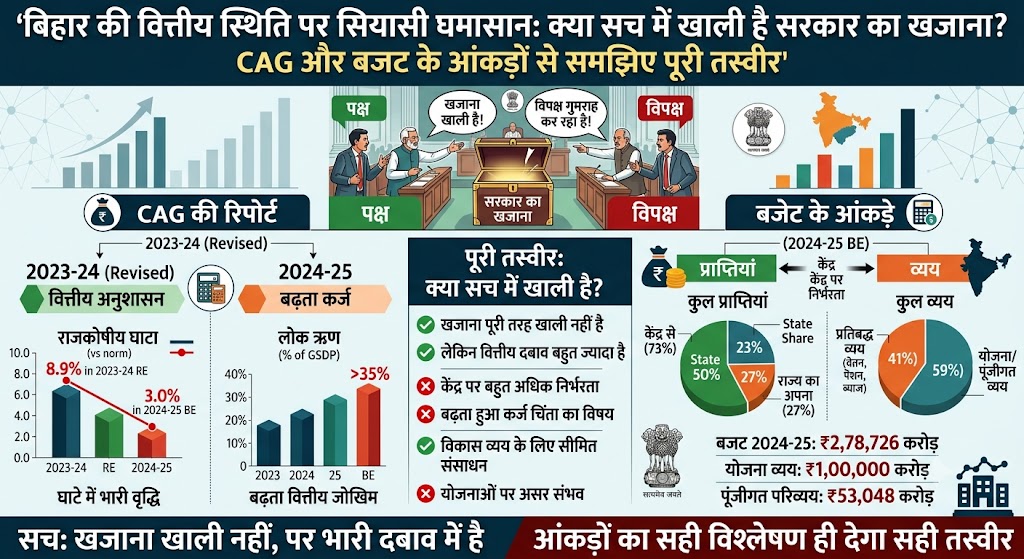
Is the State Treasury Really Empty? CAG and Budget Figures Explain the Full Picture
Patna: A fresh political debate has erupted over the financial condition of Bihar. Tejashwi Yadav, the Leader of the Opposition in the Bihar Legislative Assembly, has made serious allegations against the government, claiming that the state treasury has become empty and that the financial situation has deteriorated significantly.
He has alleged that the government is even having to rely on the contingency fund to make payments such as salaries and pensions. The key question, therefore, is whether Bihar is actually facing a serious financial crisis or whether the issue is primarily a political allegation. The answer can only be understood by examining budget estimates, revenue, fiscal deficit, expenditure and available financial data.
What Do the Budget Figures Show?
The budget figures for Bihar for 2026-27 do not, on their face, indicate that the state's treasury is completely empty.
According to the budget analysis by PRS Legislative Research, Bihar's total receipts excluding borrowings are estimated at around ₹2.86 lakh crore in 2026-27. The state has also projected a small revenue surplus of around ₹1,143 crore for the financial year.
The fiscal deficit has been targeted at approximately ₹39,112 crore, or around 3% of the Gross State Domestic Product (GSDP).
These figures indicate that the government has prepared its budget with an attempt to maintain fiscal balance. Therefore, the budget figures alone do not establish that Bihar is bankrupt or that its treasury is completely empty.
However, the picture becomes more complicated when the revised estimates for 2025-26 are examined.
Fiscal Pressure Increased in 2025-26
According to the PRS analysis, Bihar's revised estimates for 2025-26 projected a revenue deficit of approximately ₹76,315 crore, equivalent to around 6.7% of GSDP.
During the same period, the fiscal deficit was estimated at around 11.8% of GSDP, significantly higher than the initial target of 3%.
These figures provide grounds for the opposition to raise questions about the state's financial management. However, it is important to understand that budget estimates, revised estimates and actual expenditure are different categories.
During a financial year, figures can change because of variations in government expenditure, receipts from the Centre, implementation of schemes and other financial factors.
Therefore, the revised estimates for one financial year alone cannot establish that the entire financial system of the state has collapsed.
Why Is the Contingency Fund Issue Important?
Tejashwi Yadav has particularly questioned the reported use of the contingency fund for pension payments.
According to reports, he questioned the government's decision involving approximately ₹3,662 crore from the contingency fund for pension payments and described it as an indication of financial stress.
A contingency fund is a financial mechanism available to the government for unforeseen or urgent expenditure. Therefore, drawing money from such a fund does not automatically mean that a state is bankrupt.
However, if the government repeatedly needs to rely on such mechanisms for routine expenses, it can raise questions about cash-flow management and the timing of government receipts and expenditure.
This is one reason why the issue has become politically significant.
Is There Really a Crisis in Salary and Pension Payments?
Tejashwi Yadav has claimed that the government is facing difficulties in making salary and pension payments to employees and pensioners.
Reports in June quoted him as alleging that salary and pension payments had been affected for several months.
However, to determine the seriousness of such claims, it is necessary to examine the government's actual payment position, department-wise outstanding liabilities and treasury payment data.
One possible indicator of financial stress is when a government is unable to make routine payments on time. But a political statement alone cannot establish that the entire state treasury is empty.
Why Is the CAG Important?
The Comptroller and Auditor General of India (CAG) plays an important role in assessing the financial condition of state governments.
The CAG examines government revenue, expenditure, debt, deficits and financial management. Its reports can provide important information about how public finances are being managed.
Earlier CAG reports concerning Bihar have highlighted various challenges related to revenue and financial management.
However, older CAG reports cannot automatically be treated as evidence of Bihar's current financial position in 2026. The latest available CAG reports and actual accounts for the relevant financial year are necessary for drawing a current conclusion.
A Contradictory Picture of Bihar’s Finances
Bihar's financial situation presents a complex picture.
On one hand, the size of the state budget has been increasing and the government continues to spend heavily on development programmes. On the other hand, revenue collection, committed expenditure, salaries, pensions and debt-related obligations continue to place pressure on the state government.
For 2026-27, the government has targeted a fiscal deficit of around 3% of GSDP. This suggests that it is aiming to maintain fiscal discipline.
At the same time, the significant increase in the revised deficit estimates for 2025-26 indicates that the government has faced considerable financial challenges.
Debt and Interest Payments Are Also Major Challenges
A state's financial health cannot be judged solely by looking at how much money is available in its treasury.
The amount of debt accumulated by the government and the amount spent on interest payments are also important indicators.
For a state such as Bihar, balancing development expenditure with salaries, pensions, interest payments and other committed expenses is a major challenge.
If committed expenditure grows faster than revenue, the government's fiscal space for new development projects can become increasingly limited.
Opposition Claims vs Budget Figures
Tejashwi Yadav has claimed that Bihar is facing a serious financial crisis. On the other hand, the government's 2026-27 budget targets a revenue surplus and a fiscal deficit of around 3% of GSDP.
Therefore, both sides of the picture need to be considered.
The Real Challenge Could Be Cash-Flow Management
For a state government, maintaining an annual budget balance is not enough. It must manage its revenue and expenditure on a month-to-month basis.
If government receipts are delayed or lower than expected while salaries, pensions and other essential expenses have to be paid on time, the government may need to use available financial mechanisms to manage short-term cash requirements.
Therefore, if the contingency fund has been used, it is important to examine the complete financial process, the reason for the withdrawal and how the amount is subsequently adjusted.
Is Bihar on the Verge of Bankruptcy?
Based on the available budget figures, it would not be appropriate to conclude that Bihar is currently on the verge of bankruptcy.
The 2026-27 budget targets a revenue surplus and a fiscal deficit of around 3% of GSDP.
However, this does not mean that Bihar has no financial challenges. The revised estimates for 2025-26 show a substantial increase in both revenue and fiscal deficits, indicating significant pressure on state finances.
Therefore, the more accurate conclusion is that Bihar is facing financial pressure and financial-management challenges, but the available budget figures do not by themselves establish that the state has an empty treasury or is bankrupt.
Tejashwi Yadav's statement has certainly triggered an important debate about Bihar's financial health. The reported use of the contingency fund for pension payments raises questions about financial management, and complete details of the transaction should be made available.
At the same time, the 2026-27 budget figures show that the government has targeted a revenue surplus and a fiscal deficit of around 3% of GSDP.
The significant increase in the revised estimates for 2025-26 does, however, indicate that the state has faced considerable financial pressure.
Therefore, the issue should not be reduced to two extreme claims—either that “the treasury is empty” or that “there is no financial problem at all.”
The most reliable assessment of Bihar's current financial condition will require three key sets of information: the latest CAG findings and actual accounts, the government's treasury and payment position, and the final actual figures for 2025-26.
Only these figures can establish whether Bihar is facing a structural financial crisis or primarily a temporary cash-flow and financial-management challenge.