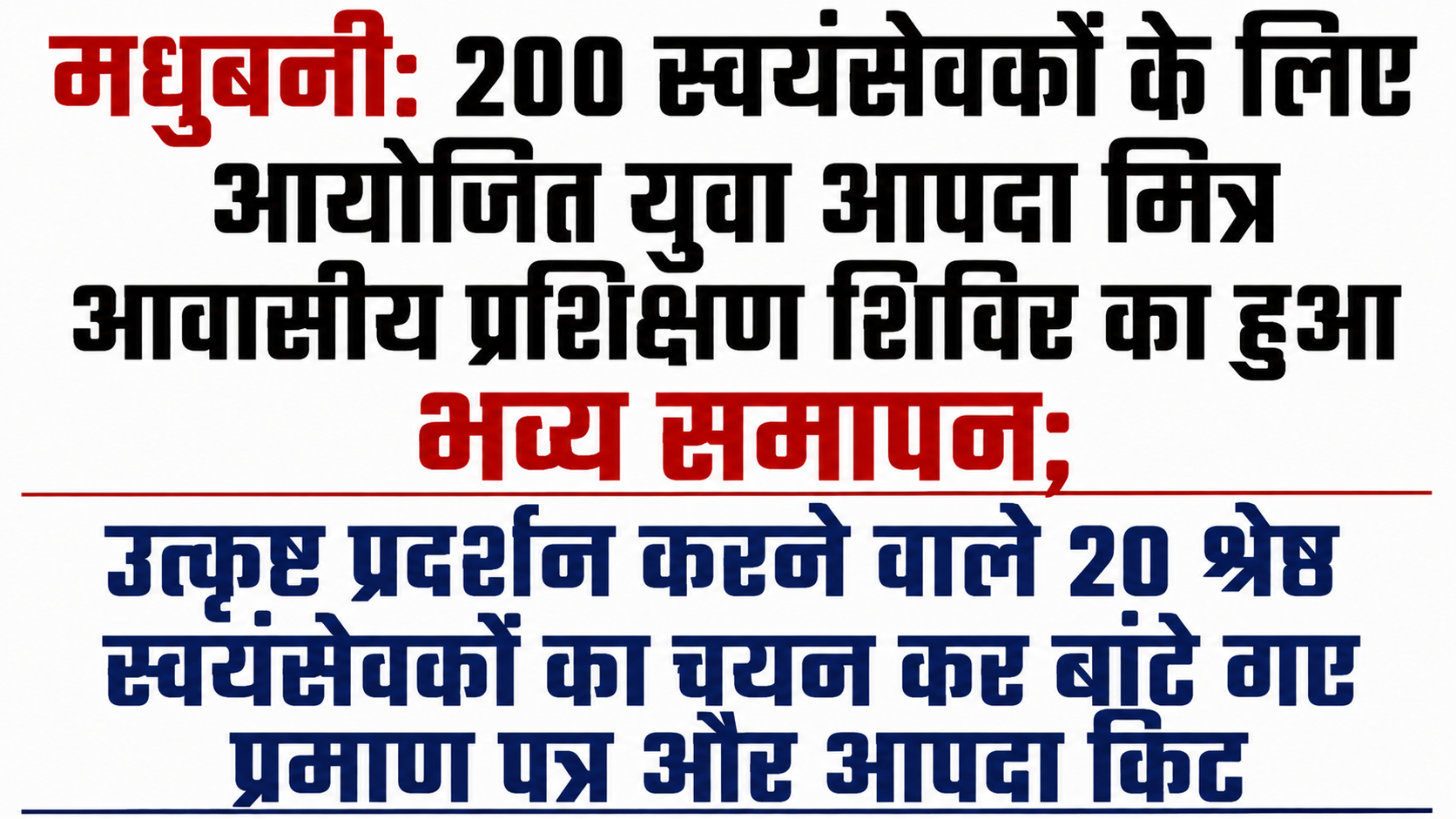
Madhubani: Grand Conclusion of the Youth Aapda Mitra Residential Training Camp Organized for 200 Volunteers; 20 Best Performing Volunteers Selected and Awarded Certificates and Disaster Kits
Madhubani (Bihar): An extremely inspiring and positive news story regarding youth empowerment, grassroots disaster management training, and community service has emerged from Madhubani district, which is counted among the disaster-prone regions of Mithil in Bihar. The special 'Aapda Mitra' (Disaster Friend) residential training camp organized for 200 youth volunteers, which had been running for the past several days in Madhubani district, successfully concluded on Friday in a joyous and dignified atmosphere. During the closing ceremony of this multi-day residential camp, 20 outstanding volunteers who demonstrated exceptional performance based on rigorous evaluation were specially selected and honored by chief guests. The keynote speaker and prominent educationist Prof. Hare Krishna Singh shed light on practical insights for dealing with disasters and the significance of this training, presenting certificates and state-of-the-art disaster management kits to all trained students. The event witnessed a heavy presence of administrative officials, disaster management trainers, and local dignitaries, driving the enthusiasm of the youths to its peak.
Let us understand a detailed, analytical, and point-by-point description of this unique initiative by the Disaster Management Department of the Bihar Government, youth participation in Madhubani district, and methods for coping with floods and other natural disasters.
Background of the Training Camp: Why Are 'Aapda Mitras' Needed in Districts Like Madhubani?
Geographically, Madhubani district in Bihar is considered sensitive every year in terms of floods, waterlogging, and other natural calamities, making the training of youth at the grassroots level a priority for the administration.
First Responders During Disasters: When any disaster or accident strikes, trained youth at the local level are the very first to initiate relief and rescue operations before government aid arrives.
Residential Selection of 200 Youths: A total of 200 enthusiastic youth volunteers selected from various blocks and colleges of the district were housed entirely on a residential basis in this camp so they could undergo training with strict discipline.
Coordination of Practical and Theoretical Knowledge: These volunteers were not merely given bookish knowledge; instead, they were taught practical lessons on saving lives during disasters through mock drills.
Key Activities of the Training Camp and Techniques Taught
During this multi-day residential camp, experts trained the youths to handle various challenging and emergency situations.
Flood Rescue and Swimming Techniques: Since rivers in Madhubani run in spate, training was imparted on rescuing a drowning person during a deluge or flood, utilizing life jackets, and constructing improvised rafts.
First Aid and CPR: Doctors and experts provided practical training on stopping bleeding, applying bandages before taking an injured person to the hospital, and administering CPR (Cardiopulmonary Resuscitation) in cases of cardiac arrest or stopped breathing.
Fire Safety and Search-Rescue: Youths were taught methods to bring fires under control during gas cylinder leaks or other fire outbreaks, as well as how to operate modern equipment to safely extract people trapped under debris.
Closing Ceremony and Selection of the 20 Best Volunteers
On the final day of training, all 200 volunteers underwent a written and practical evaluation, based on which the top 20 outstanding volunteers were selected.
Inspiring Address by Prof. Hare Krishna Singh: In his address, the chief guest of the closing ceremony, Prof. Hare Krishna Singh, stated, "Disasters do not arrive with prior notice, but if our youths are mentally and physically prepared, the loss of life and property can be minimized." He described the youths as true soldiers of society.
Distribution of Certificates and Disaster Kits: Certificates were handed out to all 200 volunteers from the stage on behalf of the Disaster Management Department, while the top 20 best volunteers were specially honored and handed 'disaster kits' equipped with emergency relief materials.
Enthusiasm of Volunteers: The selected and trained youths appeared extremely enthusiastic and took a pledge that they would return to their respective villages and panchayats to raise awareness among others regarding disaster prevention.
Analysis of Rural Security and the Administrative Perspective
Such training camps are not merely administrative formalities; rather, they strengthen the backbone of disaster management in rural regions.
Community Based Disaster Management (CBDM): The government's policy is to make the local community the primary protector of disaster management, reducing reliance on government machinery and ensuring immediate relief.
Positive Utilization of Youth Energy: Viewed through the lens of guiding today's youth and engaging them in socially beneficial work, this camp has proven to be a milestone.
Conclusion
The successful conclusion of the youth Aapda Mitra residential training camp organized for 200 volunteers in Madhubani district demonstrates that the district administration and the Disaster Management Department are fully prepared to tackle any future calamity. The presentation of certificates and disaster kits to the youths by the hands of Prof. Hare Krishna Singh elevated their morale to soaring heights. If youths continue to be trained at the grassroots level in this manner, the devastation and loss of life occurring during natural disasters can undoubtedly be effectively averted. This initiative serves as an exemplary model not just for Madhubani, but for the entire state of Bihar.