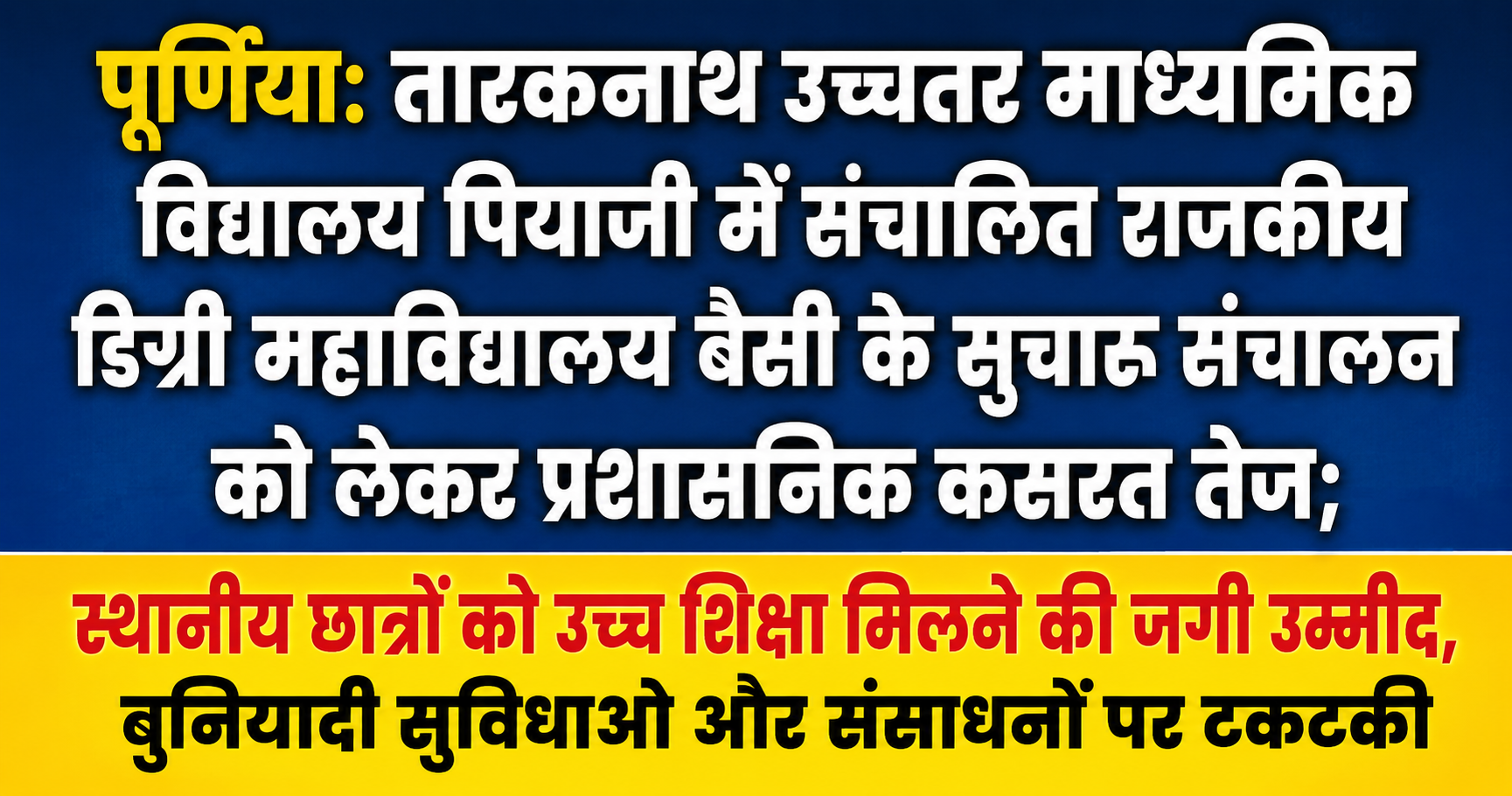
Purnia: Administrative Activity Intensifies for the Smooth Operation of Government Degree College Baisi Operating on the Premises of Taraknath Higher Secondary School Piyaji; Hopes Renewed Among Local Students for Higher Education, Focus Shifts to Basic Amenities and Resources
Purnia (Bihar): A highly significant and positive news story concerning the expansion of higher education and the operation of colleges in rural areas has emerged from the Seemanchal region of Purnia district in Bihar. Administrative activity has intensified regarding the smooth operation and strengthening of the basic infrastructure of Government Degree College Baisi, operating on the premises of Taraknath Higher Secondary School Piyaji in the Baisi block of Purnia district. Tremendous enthusiasm has been observed among local students and their parents due to these steps being taken by the government and local administration to spread higher education in this rural and educationally backward region of Seemanchal. For local students who have long endured the compulsion of traveling to distant cities or the district headquarters for higher education, getting this college on track is nothing short of a boon. However, major challenges still loom large over the smooth functioning of the college, including seamless classroom operations, the posting of adequate teachers, the construction of laboratories, and the availability of essential learning resources. The education department and local administration are preparing frameworks on a war footing to overcome these hurdles.
Let us understand a detailed, analytical, and point-by-point description of the objectives behind establishing government degree colleges in rural Seemanchal, the educational needs of the Baisi region, the current status of resources, and future prospects for the college's development.
Historical Background and Objective of Establishing the College: Why Was a Degree College Needed in Baisi?
The Baisi block of Purnia district is a geographically and socially vital region, yet students here have struggled intensely for years when it comes to higher education.
Lack of Access to Higher Education: Poor and middle-class students hailing from rural backgrounds, especially daughters, were unable to continue their further degree studies after completing intermediate education due to financial constraints or distance.
Welfare Initiative of the Government: Under the objective of making higher education accessible in every sub-division and selected block of the state by the Government of Bihar, Government Degree College Baisi was established so that rural talents could secure higher education opportunities within their own region.
Utilization of Taraknath Higher Secondary School Premises: Initially, to bridge infrastructural gaps, a plan was formulated to coordinate the operation of this college using the buildings and premises of Taraknath Higher Secondary School Piyaji, ensuring optimal resource utilization.
Current Administrative Preparations and Resource Mapping
Several crucial administrative-level meetings and inspections have been conducted recently for the smooth operation of the college, emphasizing the following points:
Allocation of Rooms and Buildings: Clear time tables are being formulated regarding the allocation of classrooms for the shared operation of the high school and degree college, ensuring that the studies of school children and college students do not disrupt one another.
Posting of Teachers and Staff: Consideration is underway for the deputation or regular recruitment of professors, assistants, and office staff across various subjects to bring teaching back on track at the college.
Development of Libraries and Laboratories: Proposals are being prepared to ensure the availability of laboratory equipment for practical classes and books for the library, catering to students of science and arts streams.
Reactions of Students and Parents: Hopes Coupled With Certain Concerns
While the acceleration of processes to operate Government Degree College Baisi has sparked a wave of joy locally, several practical problems have also surfaced.
Paving the Way for Daughters' Higher Education: Local parents state that with a degree college opening close to home, it will become significantly easier, especially for daughters from rural areas who could not be sent to the city due to security and distance constraints, to pursue higher education.
Expectation of Regular Sessions: Students believe that if the college begins operating at full capacity, they will not have to make rounds of Purnia University or other constituent colleges, and their sessions will be completed on time.
Demand for Basic Amenities: Students have demanded that basic facilities such as drinking water, toilets, power backup, and playgrounds be developed on the college premises on a priority basis.
Major Challenges Confronting the College
Although the operation of a government degree college is a historic step, multiple administrative and practical hurdles stand in the way of its full development.
Running Two Institutions on a Single Campus: Running both a high school and a degree college within the same campus poses a major management challenge, requiring careful coordination regarding space and discipline.
Transportation and Commuting Means: Being located in a rural area necessitates improving public transportation systems to facilitate commuting for students coming from remote villages.
The smooth advancement of Government Degree College Baisi, operating on the premises of Taraknath Higher Secondary School Piyaji, can prove to be a milestone in banishing the darkness of educational backwardness in the Seemanchal region. This college will not only offer higher education opportunities to the youth of the Baisi region but will also play a pivotal role in the social and economic development of this area. It is imperative that the education department and local administration strengthen its infrastructure with absolute commitment, enabling this institution to soon transform into a center of excellence and secure a bright future for its students.