
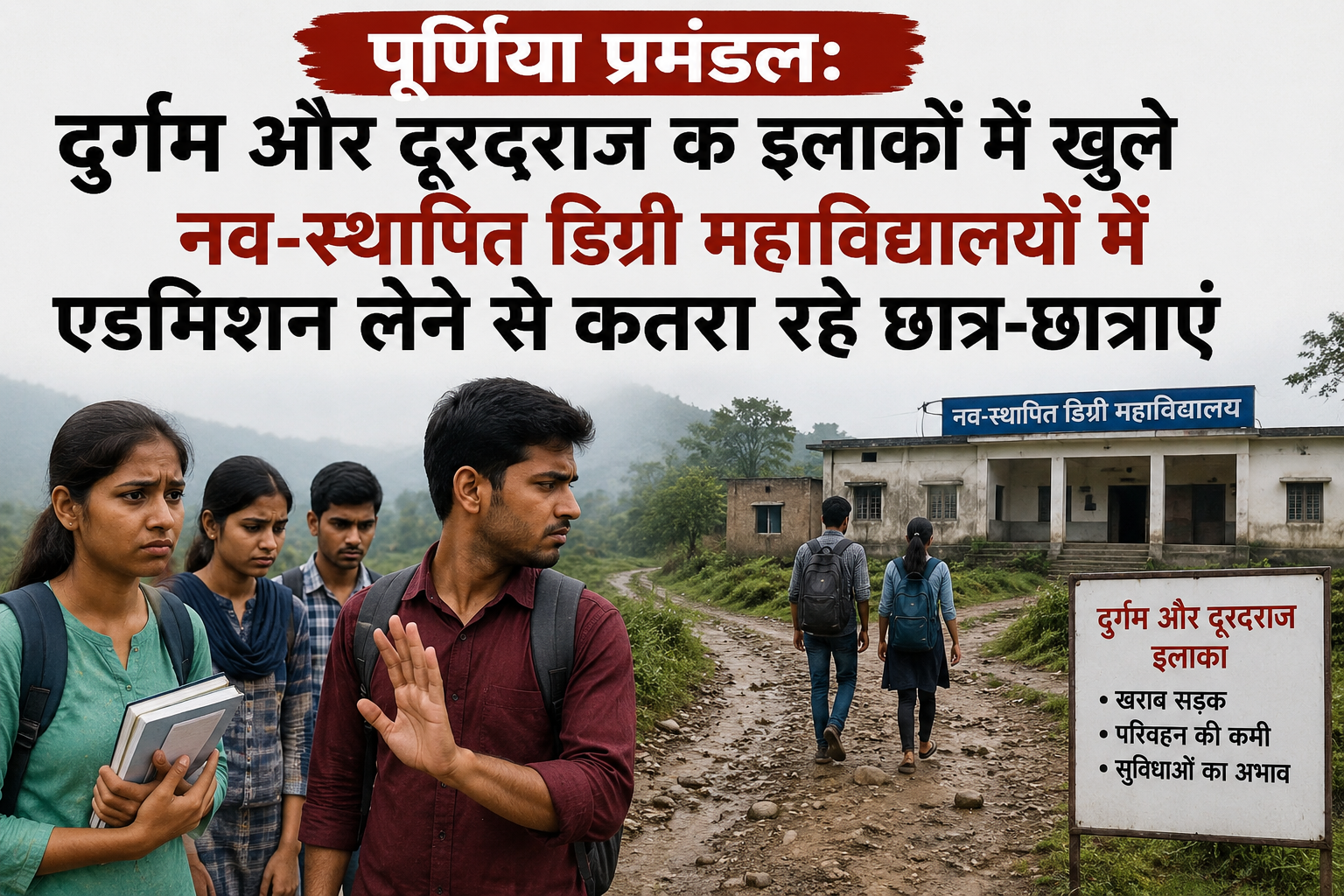
Purnia Division: Students Shying Away From Taking Admission in Newly Established Degree Colleges Opened in Remote and Outlying Areas; New Colleges Deserted Due to Massive Lack of Basic Facilities and Administrative Apathy, Rural Youth Anxious About Their Future
Purnia (Bihar): An extremely serious, concerning, and thought-provoking news story regarding the higher education sector of the Seemanchal and Purnia divisions of Bihar is coming to light. Students are shying away from taking admission in newly established degree colleges opened by the government in remote, rural, and outlying areas of the Purnia division (Purnia, Araria, Katihar, and Kishanganj) with the objective of making higher education accessible. The situation is such that youth interest in enrollment in these newly constructed colleges is observed to be extremely low, as a result of which these educational institutions built at the cost of crores of rupees remain deserted and showpieces today. The primary reasons cited behind avoiding admission in these colleges include a massive lack of infrastructure, the absence of qualified and regular teachers, dilapidated laboratories, the lack of transport and hostel facilities, and difficult routes for commuting.
Let us understand a detailed, analytical, and point-by-point description of the ground reality of these colleges—opened to realize the dreams of higher education for poor and meritorious students of rural regions—and why students are shying away from them.
Objective of Establishing Newly Minted Degree Colleges and Current Reality
The primary objective of the government was that children in remote areas of an educationally backward and rural-heavy division like Seemanchal should not have to depend on big colleges in cities and could receive higher education within their own region.
Announcement and Construction: Over the past few years, new degree colleges were established in several rural and outlying areas under the jurisdiction of Purnia University, buildings were constructed, and academic sessions were initiated on paper.
Zero or Minimal Enrollment: The reality is that when the admission process begins, the majority of students head toward district headquarters or prestigious city colleges (such as Purnia College, Purnia Women's College, M.I.T., etc.) rather than these new colleges. Seats in the new colleges remain vacant.
Lack of Basic Facilities: Basic amenities such as electricity, water, paved roads, libraries, playgrounds, and Wi-Fi remain absent in these colleges opened in rural areas, causing students to avoid taking admission there.
Main Reasons for Confusion and Anxiety Among Students and Parents
When youth and their parents from rural areas observe the condition of these new colleges, their confidence wavers. Let us look at the primary reasons why students are not taking admission:
Severe Shortage of Teachers: The biggest crisis is the lack of qualified and permanent professors. Guest faculty members in most new colleges either do not show up or their classes are not conducted regularly. Consequently, students consider their future bleak and do not enroll in these colleges.
Transport and Commuting Problems: Situated in remote areas, direct bus or auto services are not available to reach these colleges. In the absence of proper roads and transport modes, daily commuting is extremely difficult and risky for students (especially female students).
Absence of Laboratories and Libraries: Necessary labs and modern books for practical subjects in science and arts streams are not available in these colleges. The fear of completing a degree without practical experience drives students toward city colleges.
Lack of Security and Hostels: There are no hostel arrangements for students coming from afar, particularly female students, which keeps them constantly worried about safety.
Impact on Higher Education and Administrative Apathy
This condition of rural colleges appears to expose the hollowness of government claims regarding the expansion of higher education in Seemanchal.
Waste of Lakhs and Crores in Costs: The government and university administration poured money like water into building constructions, but launching colleges without resources or planning is proving to be a waste of public tax money.
Increase in Dropout Rate: Due to financial hardship, many children from poor families cannot afford the expense of living in the city and studying in expensive colleges, and when study arrangements are unavailable in village colleges, they are forced to drop out of education right after intermediate (12th grade).
Silence of University Administration: No concrete action plan has been brought to the ground by Purnia University and the Higher Education Department to improve the condition of these colleges, generating resentment among local intellectuals.
Necessary Steps Toward Solution and Experts' Suggestions
If the government and university administration genuinely want to educate the children of rural India, they must immediately take stern steps to improve the condition of these dilapidated colleges.
Development of Resources: First, regular teachers must be appointed in these colleges, paved roads constructed, and science laboratories fully equipped.
Student Vans and Transport Facilities: Bus services at subsidized rates should be initiated by the district administration or college management for student convenience.
Awareness Campaigns and Counseling: Camps must be organized at the rural level to educate students and parents about the facilities and scholarship schemes available in these colleges to restore their confidence.
The failure of students to take admission in newly established degree colleges opened in remote areas of the Purnia division proves that educational standards cannot be elevated merely by erecting brick-and-mortar buildings. Unless a better academic environment, qualified teachers, and modern basic facilities are provided in these educational institutions, rural youth will continue to shy away from these colleges. The need of the hour is for the education department and Purnia University to take cognizance of this serious problem and make war-footing efforts to transform these deserted colleges into vibrant centers of knowledge, only then can the dream of a progressive and educated Bihar come true.