Religious Processions Are a Constitutionally Protected Right, But Not Absolute: Patna High Court
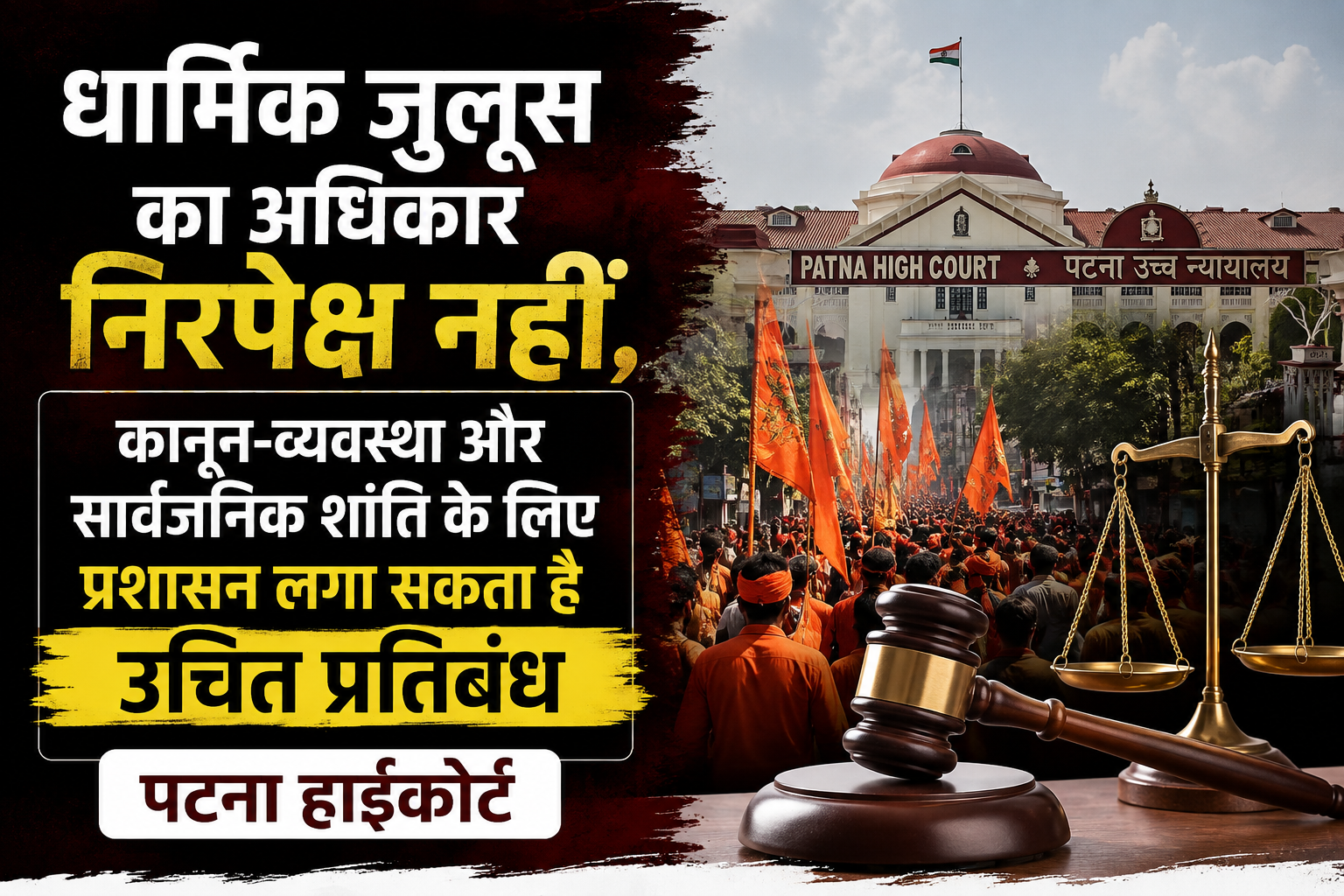
The Patna High Court has made an important observation regarding the right to organize religious processions, stating that while religious freedom and the right to peaceful assembly are protected under the Constitution, these rights are not absolute. The administration can impose reasonable and necessary restrictions on religious processions in the interest of public peace, law and order, and public health.
The court made the observation while hearing a petition concerning the Mahaviri procession of Akhara No. 1 in Hathoura village of Siwan district. The petitioner had sought permission for 300 devotees to participate in the procession and for it to follow its traditional route. The court, however, rejected the demand.
Justice Alok Kumar, who heard the matter as a single-judge bench, emphasized that the rights guaranteed under Articles 19(1)(b) and 25 of the Constitution are subject to reasonable restrictions.
Right to Religious Processions Subject to Reasonable Restrictions
Article 19(1)(b) of the Constitution grants citizens the right to assemble peacefully and without arms. Similarly, Article 25 guarantees freedom of conscience and the right to freely profess, practice and propagate religion.
However, these rights are subject to certain constitutional limitations. The court noted that religious freedom cannot be exercised in a manner that adversely affects public order, morality or health. Likewise, the right to peaceful assembly can be reasonably restricted by law in the interest of maintaining public order.
In the present case, the court considered the administration's decision to limit the number of participants and alter the procession route in the context of law-and-order concerns. The court therefore did not accept the argument that because permission had been granted in a particular manner in previous years, the same arrangement had to continue indefinitely.
Mahaviri Procession Has Been Held Since 1958
The case relates to the Mahaviri procession of Akhara No. 1 in Hathoura village, Siwan. Bhadai Chaudhary, a resident of Hathoura, had approached the High Court seeking restoration of the earlier arrangements for the procession.
The petitioner told the court that Akhara No. 1 had been receiving permission to conduct the Mahaviri procession since 1958. According to the petition, the procession had traditionally been taken out along a particular route, with a significant number of devotees participating.
The petitioner stated that in 2012 and 2013, the administration had permitted 200 devotees to participate in the procession. The number was subsequently reduced. In 2014, permission was granted for 150 devotees, while in 2015 the number was reduced to 100.
According to the petitioner, from 2023 onward, the permitted number was reduced further to only five devotees. At the same time, the traditional route of the procession was also changed.
The petitioner therefore requested the High Court to allow at least 300 devotees to participate and permit the procession to pass through its traditional route.
Government Cited Law-and-Order Concerns
The state government defended the restrictions imposed on the procession, stating that the decision was not intended to prevent any religious activity. Instead, it was based primarily on concerns relating to law and order.
The government informed the court that between 2015 and 2022, despite permission being granted for only five participants, large crowds repeatedly gathered during the procession. According to the government's submission, crowds of approximately 1,700 to 2,000 people gathered on several occasions.
The government further stated that several cases had been registered because the number of people attending the procession was far higher than the permitted limit. Authorities therefore faced the challenge of managing large crowds and preventing any untoward incident during the religious event.
The state argued that, based on previous experiences, the administration had to take preventive measures to avoid tension and maintain public order during the procession.
Managing Large Crowds Is a Major Administrative Challenge
Religious processions involving large numbers of people create several challenges for the administration. Traffic management, crowd control, security arrangements and immediate response to any dispute are among the major responsibilities of the authorities.
If the number of people participating in an event repeatedly exceeds the officially permitted limit and previous incidents have resulted in legal cases, the administration may take additional precautions for future events.
The High Court considered the issue in this broader context and recognized the administration's responsibility to maintain law and order.
The court's decision makes it clear that the fact that a religious procession has historically been conducted in a particular manner does not automatically create an absolute right to continue the same arrangement in the future. If circumstances change, the administration can modify the conditions of an event in the interest of public safety and order.
Dispute Also Involved the Traditional Route
The number of devotees was not the only issue in the case. The petitioner also objected to the change in the traditional route of the procession.
The petitioner argued that since the Mahaviri procession had traditionally followed a particular route for decades, it should be allowed to continue using the same route.
However, the administration had changed the route from a security and law-and-order perspective. The High Court, considering the authority of the administration in such matters, did not accept the petitioner's demand to restore the old route.
This indicates that the route of a religious procession cannot be determined solely on the basis of tradition. If there are genuine concerns relating to public safety, traffic management, crowd control or public order, the administration can choose an alternative route.
Balancing Fundamental Rights and Public Order
The High Court's observation is significant because religious processions are an important part of public and cultural life in India. People from different communities organize religious events and processions throughout the year, often attracting large crowds.
In such situations, the responsibility of the administration is not simply to grant permission for an event. Authorities must also ensure that the rights and safety of other members of the public are not affected and that peace is maintained.
Religious freedom does not mean that all rules relating to public order can be ignored during a religious event. At the same time, the administration cannot impose arbitrary restrictions merely on the basis of speculation or apprehension. Any restriction should be reasonable, necessary and based on the circumstances.
The Patna High Court's decision highlights this constitutional balance. The court recognized the importance of the rights guaranteed under the Constitution while also emphasizing that these rights must be exercised within the framework of public order and law.
Importance of Administrative Guidelines
Before religious processions, authorities generally coordinate with organizers regarding security and crowd-management arrangements. The number of participants, route, timing and other conditions can form part of the administrative guidelines for the event.
If organizers follow these conditions, religious events can generally be conducted peacefully. However, if previous arrangements have resulted in repeated violations or difficulties in controlling crowds, authorities may impose stricter conditions for future events.
In the Hathoura village case, the government relied on previous incidents and the gathering of crowds far beyond the permitted limit to justify the restrictions. The High Court took these circumstances into consideration while rejecting the petitioner's demand.
What the Judgment Means
The Patna High Court's observation sends an important message to both religious organizers and administrative authorities.
The right to organize a religious procession is constitutionally protected, but it must be exercised within the limits of public peace, law and order and public health.
For organizers, the decision highlights the importance of complying with conditions imposed by the administration regarding the number of participants, route and other arrangements.
For the administration, the judgment reinforces the need to ensure that restrictions imposed on religious events are reasonable, justified and based on actual circumstances.
The judgment also makes it clear that while longstanding religious traditions deserve respect, public safety cannot be ignored when circumstances create genuine law-and-order concerns.
Religious Freedom Must Be Accompanied by Social Responsibility
Religious freedom is an important part of India's democratic and constitutional framework. Citizens have the right to organize religious activities and follow their traditions.
However, when such events take place in public spaces, their impact can extend beyond the organizers and participants. Large processions can affect traffic, public movement and security arrangements. Therefore, the exercise of religious rights also carries a degree of social responsibility.
In the Hathoura Mahaviri procession case, the Patna High Court has emphasized this constitutional balance. The court made it clear that the rights guaranteed under Articles 19(1)(b) and 25 are important but remain subject to reasonable restrictions.
Thus, while the demand to conduct the Mahaviri procession with 300 devotees along the traditional route was rejected, the case has established an important legal principle: religious freedom is constitutionally protected, but the administration can impose reasonable restrictions when necessary to protect public peace, law and order, and public health.