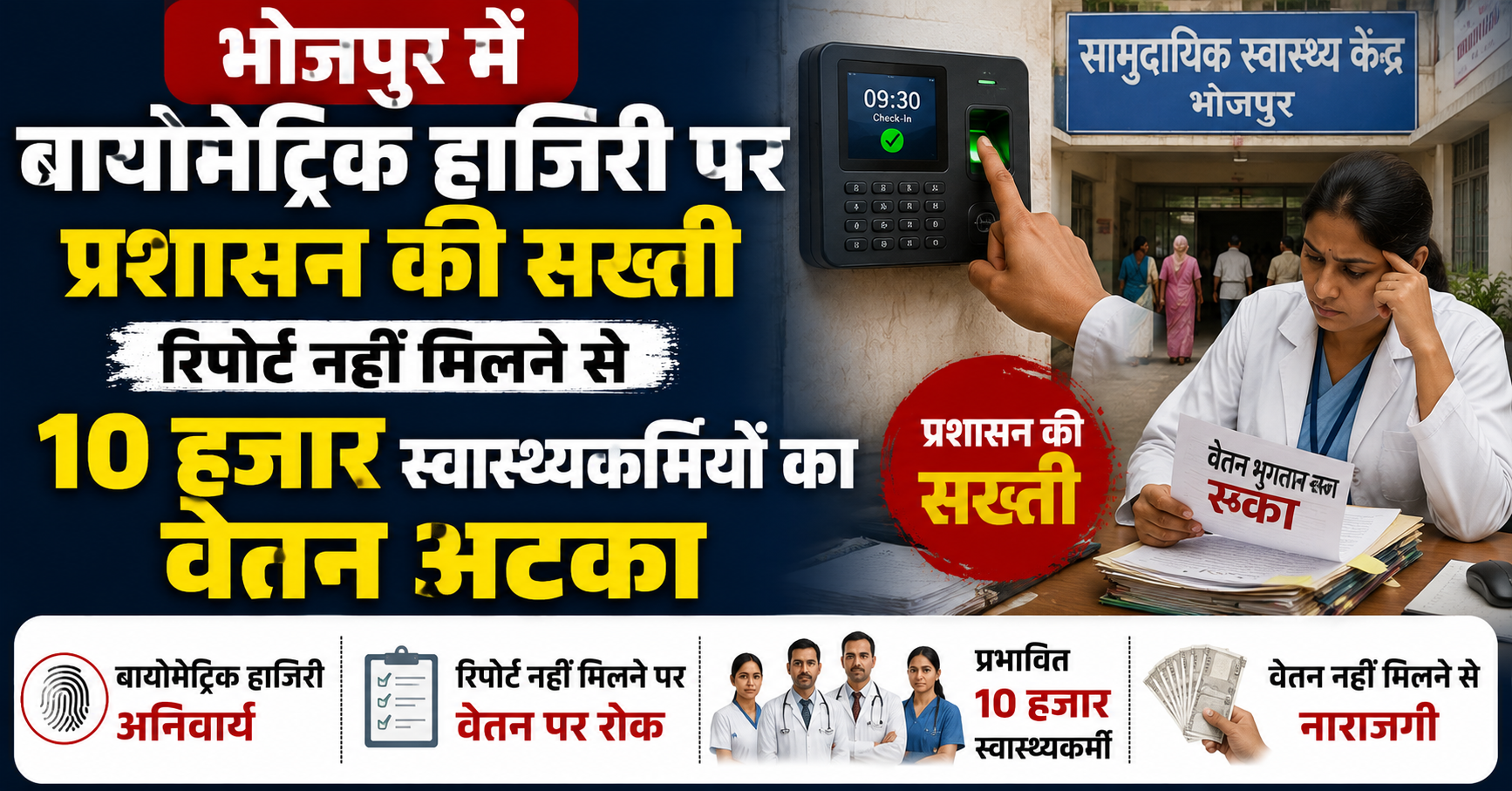
Salaries of 10,000 Health Workers Held Up Due to Missing Attendance Report
Ara: The Bhojpur district administration's strict approach toward biometric attendance in government offices is now having a visible impact on the health department. Around 10,000 doctors, healthcare workers and other employees working under the health department are reportedly facing delays in salary payments because the required biometric attendance report has not yet been made available.
Meanwhile, officials and employees of more than three dozen other departments in the district have reportedly completed their biometric attendance requirements and received their salaries. The situation in the health department has therefore become a matter of administrative attention.
Impact of the DM's Strict Instructions
The district administration had already issued clear instructions regarding employee attendance.
Bhojpur District Magistrate Tanay Sultanian directed all departments last month that employee attendance would be considered valid only on the basis of the biometric attendance system.
The administration also ordered that salaries could be withheld if an employee's biometric attendance was not recorded.
Following the directive, most departments adopted the biometric system and regularized their attendance and salary-payment processes.
Why Are Health Department Salaries Delayed?
The health department employs a large number of doctors, nurses, technical staff, healthcare workers and other personnel across hospitals and health centres.
Unlike ordinary government offices, many health workers perform duties in different shifts and at different healthcare facilities. This makes the collection and verification of biometric attendance records a relatively complex process.
According to the information available, the required biometric attendance report from the health department has not yet been submitted to the administration. As a result, the salary-payment process has not moved forward.
The exact reason for the delay has not yet been clearly established. It could involve administrative or technical issues, although the matter would need to be clarified by the concerned department.
Around 10,000 Employees Affected
The salary delay is reportedly affecting around 10,000 employees of the health department, including doctors, healthcare workers and other staff.
For government employees, monthly salaries are the primary source of income for meeting household expenses, children's education, loan repayments, medicines and other essential needs.
Therefore, a delay in salary payments can create financial difficulties, particularly for employees whose families depend entirely on their monthly income.
Other Departments Have Completed the Process
The biometric attendance system has reportedly been implemented successfully in more than three dozen other departments in Bhojpur.
Officials and employees in these departments have recorded their attendance according to the prescribed system, after which salary payments were processed.
This indicates that the district administration's biometric attendance mechanism has largely been adopted across government departments.
The health department's pending attendance report has now become a key issue that needs to be resolved so that salary payments can be processed without further delay.
Purpose of Biometric Attendance
The primary objective of biometric attendance is to ensure that the physical presence of government employees is accurately recorded.
Under traditional attendance registers, employees generally marked their presence manually. Such systems can sometimes create difficulties in monitoring attendance accurately.
Biometric systems use digital identification to record attendance and create a more organized record.
This can help administrators determine whether employees are attending their workplaces regularly and whether they are reporting for duty at the prescribed time.
Health Department Faces a Different Challenge
Implementing biometric attendance in the health department can be more challenging than in regular administrative offices.
Doctors, nurses and other healthcare workers often work in shifts. Some are assigned emergency duties, while others may work at different health centres or medical institutions.
As a result, biometric attendance data from different locations and shifts needs to be properly recorded, consolidated and verified.
If an employee is assigned to another facility or if there is a technical problem with the biometric system, the attendance record may not accurately reflect the person's actual duty.
Possibility of Technical Problems
Biometric attendance systems depend on digital infrastructure.
Problems involving internet connectivity, biometric machines, servers, electricity supply or employee data can affect the recording of attendance.
If a biometric device is not functioning properly or a health centre has connectivity problems, employees may be unable to record their attendance on time.
In such situations, the administration needs a reliable mechanism for verifying the attendance of employees who were actually performing their duties.
Alternative verification procedures and technical support systems can help minimize such difficulties.
Concern Among Employees
The delay in salary payments is naturally a concern for health department employees.
Workers are likely to expect the biometric attendance report to be completed and submitted as soon as possible so that pending salaries can be released.
At the same time, the administration's objective is to ensure that government salaries are paid on the basis of verified attendance.
Maintaining a balance between these two requirements will be important.
Health Services Should Not Be Affected
The salary issue in the health department should not be viewed merely as an administrative matter.
Doctors, nurses and other healthcare workers are directly responsible for providing medical services to patients at hospitals and health centres.
Therefore, resolving the salary issue quickly is important so that employee morale does not suffer and regular healthcare services are not affected.
Any prolonged administrative problem involving healthcare workers could indirectly affect patients if it leads to disruptions in staffing or services.
Biometric System Can Improve Transparency
One of the major advantages of biometric attendance is that it can improve administrative transparency.
If digital attendance records are maintained regularly, authorities can monitor the attendance status of different departments more efficiently.
The system can help distinguish between employees who regularly report for duty and those whose attendance is irregular.
It can also make it easier to link salary payments with verified attendance records.
Effort to Increase Accountability
The administration's strict approach can also be viewed as an attempt to increase accountability within government departments.
Ensuring that government employees are present at their offices or duty locations and that citizens receive services on time is an important part of effective administration.
Biometric attendance can help establish clearer accountability by providing a digital record of employee presence.
However, the system must also take into account genuine field duties, emergency assignments and shift-based work.
Salary Payments Expected to Move Forward After Report
Once the health department's biometric attendance report becomes available, the pending salary-payment process is expected to move forward.
The relevant data will need to be verified and the necessary administrative procedures completed.
If discrepancies or technical issues are found in an employee's attendance record, those cases may need to be reviewed separately.
This will help ensure that salary payments are made on the basis of verified attendance.
Need to Prevent Similar Problems in Future
For biometric attendance to work effectively, departments need to develop a reliable mechanism for preparing and submitting attendance reports on time.
Large departments such as the health department, where thousands of employees work across multiple facilities, require adequate technical resources and trained personnel to manage attendance data.
Regular monitoring of biometric machines, internet connectivity and data systems at healthcare facilities can also help reduce delays.
A dedicated technical support mechanism could further ensure that attendance-related problems are resolved quickly.
The Bhojpur district administration's strict enforcement of biometric attendance has had a significant impact on the health department. Around 10,000 doctors, healthcare workers and other employees are reportedly facing salary delays because the required biometric attendance report has not yet been made available.
In contrast, officials and employees of more than three dozen other departments have reportedly completed their biometric attendance requirements and received their salaries.
District Magistrate Tanay Sultanian had instructed all departments last month that employee attendance would be recognized on the basis of the biometric system. The administration had also directed that salaries could be withheld if biometric attendance was not recorded.
The initiative could help improve discipline, transparency and accountability across government departments. However, given the sensitive nature of healthcare services, the pending attendance report should be processed promptly so that employees who have performed their duties can receive their salaries without unnecessary delay.
With adequate technical support, proper data management and regular monitoring, biometric attendance can become an effective tool for making government attendance and salary-payment systems more transparent, organized and accountable.