

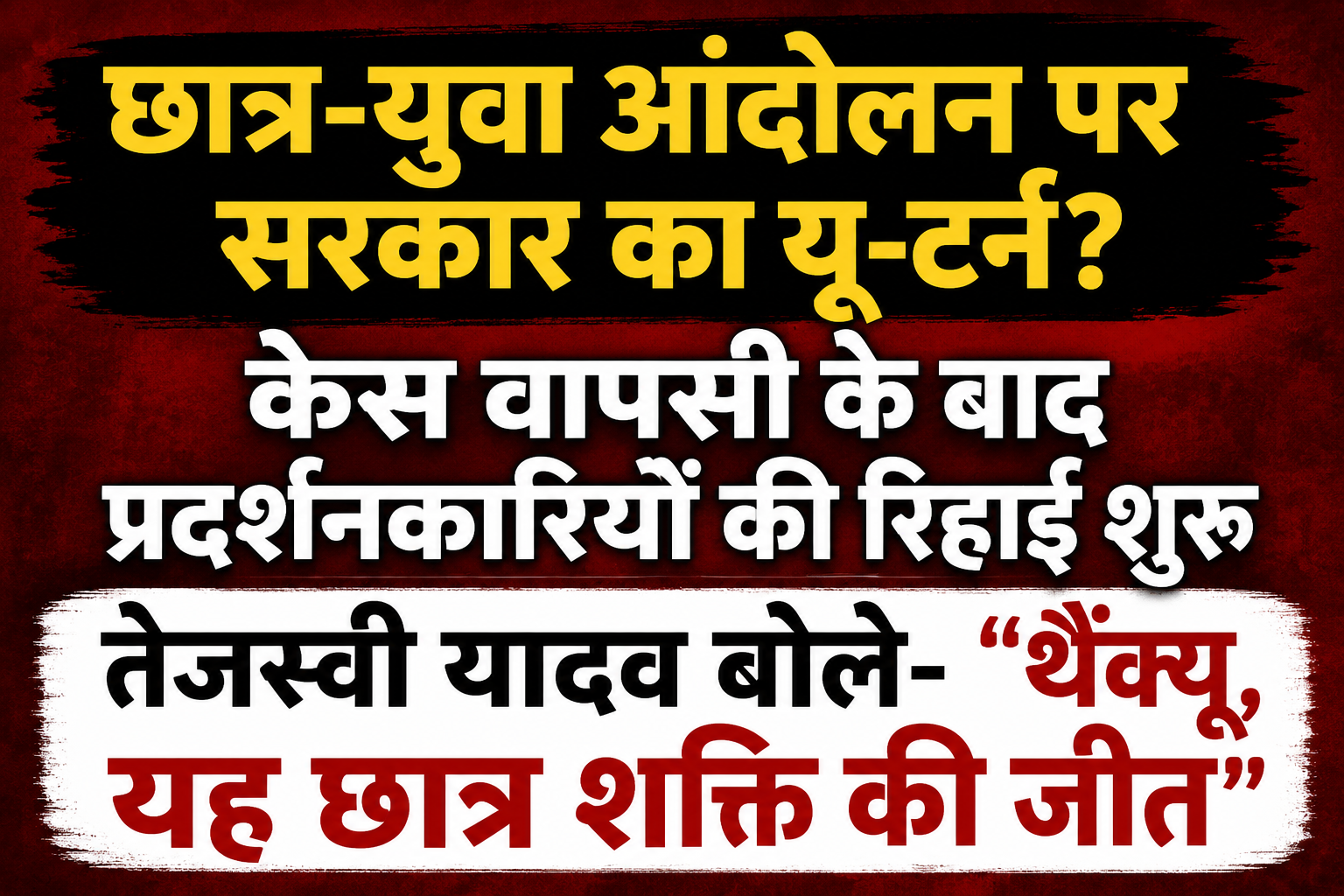
Student Protesters Begin to Be Released After Bihar Government Withdraws Cases; Tejashwi Yadav Says "Thank You," Calls It a Victory for Youth Power
Patna: Politics in Bihar has once again intensified over the recent student movement. Following the Samrat Choudhary government's decision to withdraw cases registered during the student protests, the process of releasing arrested protesters has begun. Reacting to the development, Rashtriya Janata Dal (RJD) leader and Leader of the Opposition in the Bihar Assembly, Tejashwi Yadav, thanked the government and described the move as a major victory for the strength of students and youth. He said that the government's attempt to suppress the voices of students through legal action had ultimately failed, forcing it to reverse its decision.
Tejashwi Yadav stated that the courage, patience, and unity displayed by Bihar's students and youth during the movement compelled the government to withdraw the cases. According to him, in a democracy, the voice of the people is supreme, and when young citizens peacefully fight for their rights, no government can afford to ignore them.
The RJD leader said that during the student movement, criminal cases were registered against a large number of students and young protesters. Many demonstrators were arrested and sent to jail, while others faced legal proceedings. He accused the government of responding with police action instead of listening to the concerns of the students. However, he claimed that continuous public pressure, widespread support, and persistent opposition forced the government to step back.
Sharing his reaction on social media, Tejashwi Yadav wrote, "Thank you, Samrat government. Finally, the power of students and youth has won." He emphasized that the decision was not a victory for any political party but for the thousands of students and young people who peacefully exercised their democratic right to protest. He also said that if the government had engaged in dialogue with students from the very beginning, the confrontation could have been avoided.
It is worth mentioning that student protests had recently gained momentum across several districts of Bihar. Students took to the streets over various issues, organizing demonstrations in different parts of the state. In some places, clashes broke out between protesters and the police, after which the administration registered numerous First Information Reports (FIRs) and arrested several participants. Opposition parties consistently demanded the withdrawal of these cases and the immediate release of the detained students.
With the government's announcement to withdraw the cases, the release of arrested protesters has now begun. Students who have been released, along with their families, expressed relief, stating that they were only participating in peaceful demonstrations and that the cases against them were unjustified. In several places, the released students received a warm welcome from supporters and local residents. Student organizations described the development as the result of their long and determined struggle.
Political analysts believe that the government's decision carries not only administrative significance but also considerable political importance. Bihar has a large population of young and student voters, and the recent protests have made this section of society increasingly politically active. As a result, the withdrawal of the cases is also being viewed as an attempt by the government to send a positive message to the youth.
The RJD has described the government's decision as a moral victory for the opposition, claiming that the party consistently stood with the students throughout the movement. Party leaders argued that if the government had taken the students' concerns seriously from the beginning, the protests would not have escalated. The party also reaffirmed its commitment to raising issues related to education, employment, and the welfare of young people in the future.
Meanwhile, the state government has maintained that the decision to withdraw the cases was taken after reviewing the situation and considering the broader public interest. According to the government, its intention was never to harass innocent students. While maintaining law and order remains the administration's responsibility, it decided to adopt a humanitarian approach wherever relief could be provided.
Leaders of the ruling alliance have defended the decision, saying that the government has always believed in dialogue and peaceful resolution. They argued that after reviewing the circumstances, the administration made the decision it considered appropriate. The opposition, however, insists that the government acted only because of growing public pressure and that the move represents a clear victory for the student movement.
The entire episode has once again brought student and youth issues to the center of Bihar's political discourse. Matters such as the quality of education, employment opportunities, transparency in competitive examinations, and the future of young people have become key political issues. Political parties are now formulating strategies around these concerns, recognizing that young voters are expected to play a decisive role in the state's political landscape.
Experts believe that student participation has always been an essential part of a healthy democracy. When students raise their voices on issues affecting their rights and future, governments must address their concerns seriously. At the same time, they stress that protests should remain peaceful and within the framework of the law. Maintaining this balance is essential for strengthening democratic institutions.
For now, the release of the arrested protesters has brought relief to student organizations and their families. Meanwhile, Tejashwi Yadav's "Thank You" remark has become a major topic of political discussion in Bihar. He reiterated that the government's decision represents not the victory of any political party but the triumph of student and youth power. Political observers are now watching closely to see how the government responds to the remaining demands of the students and how the opposition continues to build its campaign around the issue.
The developments are expected to have a significant impact on Bihar's political environment, student organizations, and the voting preferences of young people in the coming months. For now, it is clear that the government's decision has reshaped the political narrative, placing the student movement once again at the center of Bihar's politics.