

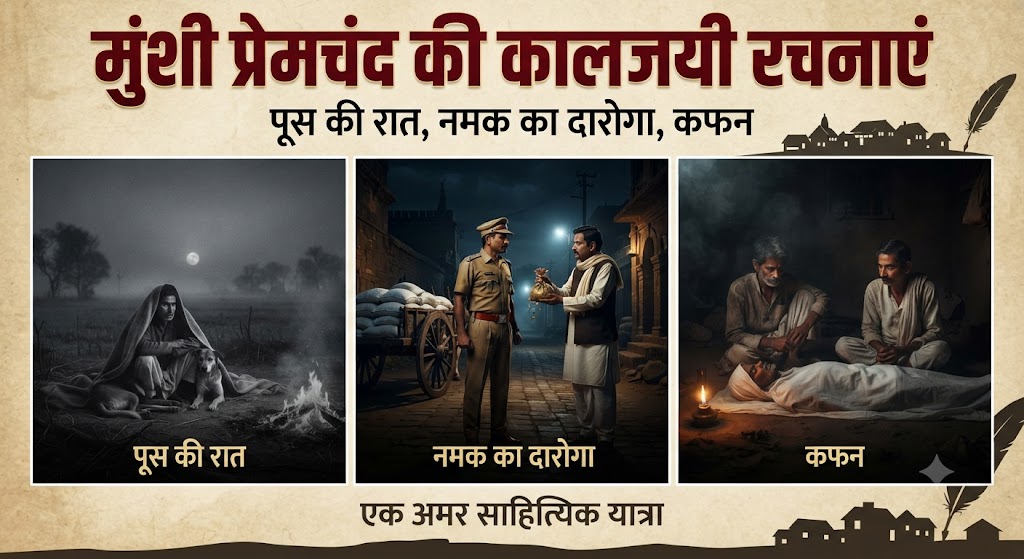
Surat of Indian Narrative Literature: Munshi Premchand's Timeless Masterpieces ('Poos ki Raat', 'Namak ka Daroga', and 'Kafan')
Introduction: In the history of Hindi and Urdu literature, the name of "Kalam-e-Premchand"—or appropriately, the "Soldier of the Pen"—Munshi Premchand (Dhanpat Rai Shrivastava) needs no introduction. The vividness with which he etched Indian society, the rural environment, farmers, the exploited, the Dalits, and the ironies of the middle class in his stories and novels is unparalleled in world literature. The stories he authored are not merely sources of entertainment; rather, they serve as living documents of Indian society during that era. 'Poos ki Raat' (A Winter's Night), 'Namak ka Daroga' (The Salt Inspector), and 'Kafan' (The Shroud) are three such immortal creations of his that unmask human sensitivities, social inconsistencies, and the realities of the system.
1. Namak ka Daroga: A Unique Blend of Idealism and Realism
Published in the year 1914, 'Namak ka Daroga' is a widely acclaimed early-period story by Premchand that presents a prime example of idealistic realism. It is a tale of the struggle between honesty, a sense of duty, and the corruption prevalent in society.
Plot and Characters: The protagonist of the story, Munshi Vanshidhar, is a young and honest man who, upon securing a job, brushes aside his father's advice that "supplementary income" (bribes) is the real earning. Vanshidhar is appointed to the post of an inspector in the salt department. Within a few months, through his hard work and integrity, he wins the trust of his superiors.
Clash Between Dharma and Wealth: One night, a convoy of carts illegally transporting salt is intercepted at the bridge over the Yamuna River. This convoy belongs to the most prestigious and wealthy merchant of the area, Pandit Alopideen. Pandit Alopideen attempts to purchase the law with the power of his wealth and offers a bribe, but Vanshidhar does not waver from his path of duty and arrests him.
The Ideological Aspect of the Story: The story realistically depicts how the power of wealth bends the judiciary and administration. However, the story takes an idealistic turn at the end when Pandit Alopideen becomes so deeply impressed by Vanshidhar's honesty that he appoints him as the manager of all his properties. This story teaches us that ultimately, even enemies respect truth and integrity.
2. Poos ki Raat: The Helplessness of the Indian Farmer and the Tragedy of Economic Exploitation
Ranked among Premchand's finest and most touching stories, 'Poos ki Raat' is the tale of a poor farmer named Halku and his wife Munni. The story offers a deeply vivid depiction of the Indian agricultural system, the trap of debt, and the pain of a farmer shivering through cold winter nights.
Summary of the Plot: Halku had somehow managed to save enough money to buy a blanket so he could guard his fields during the biting cold of the month of Poos (Pausa / December–January). However, the moneylender, Sahna, arrives and collects all the money as payment for overdue land revenue. A helpless Halku is forced to go out to the field at night to guard it wrapped in his old, tattered shawl, without any blanket.
The Struggle Between Nature and Man: In the dark and freezing winter night, Halku's sole companion is his dog, 'Jabra'. The cold is so intense that frost seems to flow through Halku's veins instead of blood. To escape the chill, he brings dry leaves from the pigeon pea (arhar) field to light a bonfire and feels warmth for a brief moment.
A Scathing Satire on the System: In the dead of night, a herd of nilgai (blue bulls) devastates his field. Halku watches it all, but due to the freezing cold and sheer apathy, he lacks the will to get up. He comforts himself with the thought that at least this spares him the torment of guarding the field in the biting cold. The next morning, when his wife Munni arrives, sees the ruined field, and expresses her grief, a strange sense of relief appears on Halku's face. This story illustrates how exploitation and poverty have broken the farmer to such an extent that crop destruction no longer bothers him.
3. Kafan: Premchand's Final, Most Realistic, and Piercing Creation
Written in 1936, 'Kafan' is considered Munshi Premchand's final story. It is one of the most controversial and deeply unsettling pieces of Hindi literature. It bears no trace of idealism; instead, it is entirely rooted in stark, naked realism.
Characters and Background: The main characters of the story are Ghisu and his son, Madhav. Both are extremely poor and lazy characters who, weary of the exploitative social system, have given up working. Madhav's wife, Budhiya, is writhing in labor pain, and there is not a single grain of food in the house.
Sequence of Events: Deprived of any medical help and suffering in agony, Budhiya dies during the night. The question then arises as to where the fabric for her shroud (kafan) will come from for her funeral. The father and son go around asking for donations from the village landlords and other people, managing to collect some money.
Climax and Human Degradation: After acquiring the money, a thought crosses Ghisu and Madhav's minds: what good will this ordinary piece of cloth of a shroud do for a dead body? They spend that money on liquor, eat their fill of kebabs, and sing songs while swaying in intoxication. The ending of the story jolts the reader's conscience. Premchand intends to show how extreme poverty, starvation, and an inhumane system strip a human being of their sensitivities and morality, driving them to become completely desensitized out of sheer helplessness.
These works by Munshi Premchand—'Namak ka Daroga', 'Poos ki Raat', and 'Kafan'—stand as milestones in Hindi literature. If 'Namak ka Daroga' inspires us to hold fast to moral values and the path of duty, 'Poos ki Raat' makes us realize the plight of the Indian farmer and the helplessness of the system. Meanwhile, 'Kafan' confronts us with the bitter reality of the exploited class standing at the lowest rung of society, where hunger strips a person of everything. Premchand's stories remain as relevant today as they were during his lifetime because the human sentiments embedded within them are eternal.