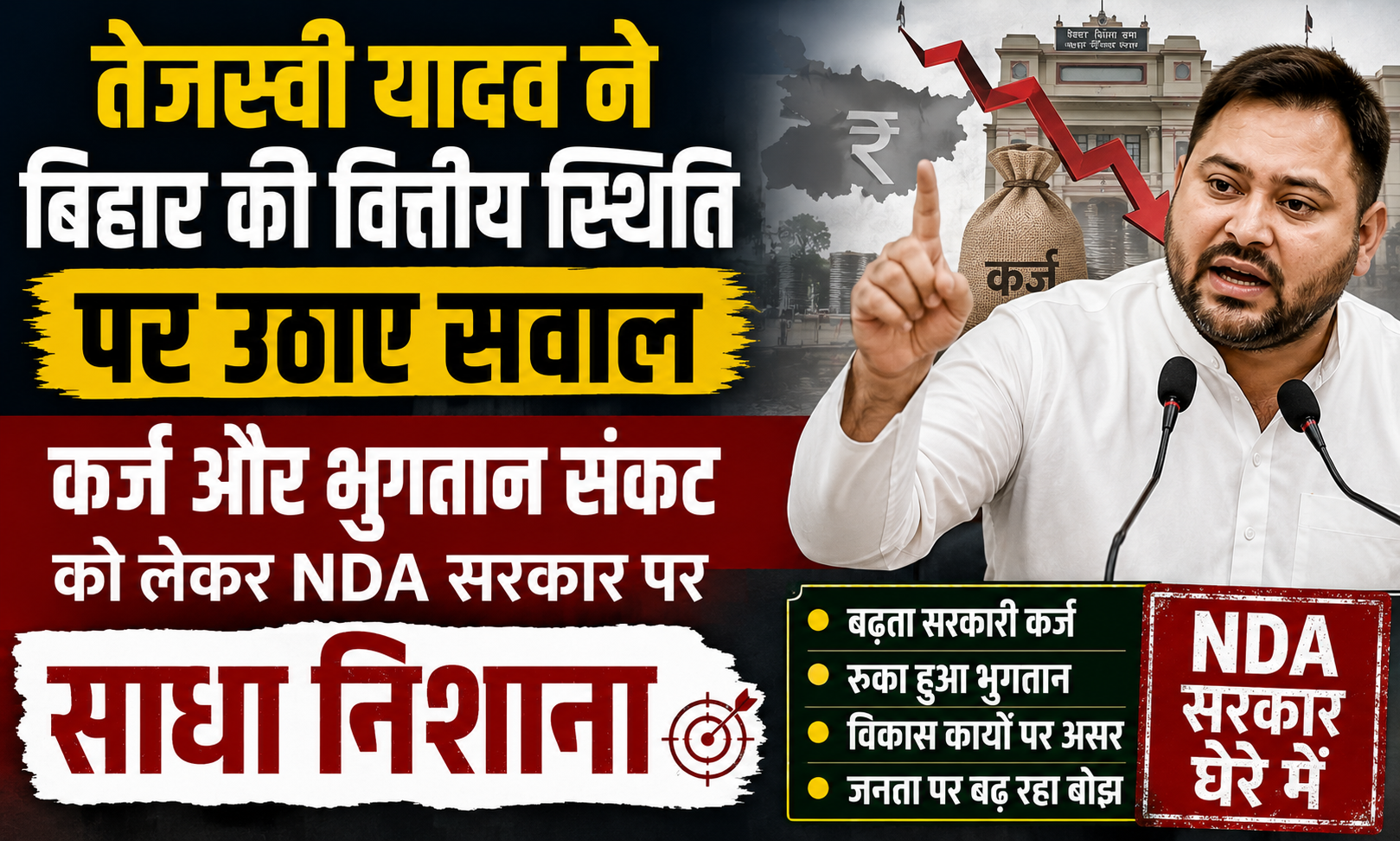
Tejashwi Yadav Questions Bihar’s Financial Position, Targets NDA Government Over Debt and Payment Issues
Patna: Bihar Leader of Opposition Tejashwi Yadav has once again targeted the NDA government led by Chief Minister Samrat Choudhary over the state’s financial condition. Describing Bihar’s fiscal situation as extremely concerning, Tejashwi Yadav alleged that the state is increasingly coming under a heavy debt burden.
He questioned how the government could continue taking on debt while, at the same time, there were concerns about sufficient funds for payments to government employees, pensioners, contractors and various development projects.
Tejashwi also linked the reported reduction in the education loan amount under the Student Credit Card Scheme to the government’s financial position. He questioned why the amount available to students through the scheme had been reduced and raised concerns over the alleged discontinuation of scholarships.
Tejashwi Raises Questions Over State Finances
Tejashwi Yadav raised serious questions about Bihar’s fiscal position and demanded greater clarity from the government regarding its financial management.
He alleged that the state’s dependence on borrowing is increasing and questioned how the government plans to manage its growing financial obligations.
According to Tejashwi, the government must explain the state’s debt position and clarify how it intends to maintain development spending while meeting its regular financial commitments.
For a state like Bihar, government resources are required for roads, bridges, education, healthcare, electricity, irrigation and other infrastructure projects. Managing these expenditures while maintaining fiscal discipline is therefore an important challenge.
Concerns Over Debt Burden
Tejashwi Yadav’s criticism has focused particularly on the growing debt burden of the state.
Borrowing is not unusual for governments, especially when funds are required for infrastructure and development projects. However, the amount of debt, interest payments and the state’s ability to generate revenue are important factors in determining whether borrowing remains sustainable.
Tejashwi has questioned whether Bihar’s current financial management is maintaining an appropriate balance between borrowing and expenditure.
Issue of Payments to Employees and Pensioners
The Leader of Opposition also raised the issue of payments to government employees and pensioners.
Salaries and pensions are among the government’s regular financial obligations. Any delay or difficulty in meeting such payments can affect thousands of families.
Government employees depend on timely salaries for their household expenses, while pensioners often rely heavily on regular pension payments for their day-to-day needs.
Tejashwi has therefore questioned the government’s financial capacity and priorities in this regard.
Contractors’ Payments Also Under Discussion
Payments to contractors involved in government development projects were also mentioned.
Bihar has numerous projects involving roads, bridges, government buildings, irrigation facilities and other infrastructure. Contractors and agencies working on these projects require timely payments to maintain construction activities and meet their obligations to workers and suppliers.
Delays in government payments can affect the pace of construction and may also have a wider impact on local businesses and workers associated with these projects.
Possible Impact on Development Projects
Tejashwi has also linked the state’s financial condition with development expenditure.
Bihar is undertaking a range of infrastructure and social-sector programmes. Adequate financial allocation and timely release of funds are necessary to ensure that such projects continue according to schedule.
If funds are not released on time, projects can face delays, and their costs may increase.
The opposition argues that the government should ensure that financial constraints do not adversely affect development programmes that directly benefit the public.
Questions Over Student Credit Card Scheme
Tejashwi Yadav has also questioned changes reportedly made to the Student Credit Card Scheme.
He alleged that the amount available to students as an education loan under the scheme has been reduced.
The Student Credit Card Scheme was designed to provide financial assistance to students pursuing higher education. For families with limited financial resources, such assistance can play an important role in enabling students to continue their studies.
If the loan limit is reduced, students and their families may have to arrange additional funds to cover tuition fees, accommodation and other educational expenses.
Concerns Over Scholarships
Tejashwi also raised the issue of scholarships, alleging that scholarships are being discontinued.
Scholarship programmes are particularly important for students from economically weaker backgrounds. Financial assistance can help them meet expenses related to tuition, books, accommodation, transportation and other educational requirements.
The opposition has argued that instead of reducing educational support, the government should expand opportunities for students.
Education and Employment Remain Key Issues
Education and employment have remained major issues in Bihar’s political and social discussions.
A large number of young people in the state seek higher education and employment opportunities. Financial assistance for higher education can help students access professional courses and institutions outside their immediate locality.
Changes to education-loan or scholarship schemes could therefore influence the ability of students to pursue higher education.
The government faces the challenge of maintaining fiscal discipline while continuing investment in education and youth development.
Need for Fiscal Discipline
Fiscal discipline is essential for maintaining the financial health of any state.
The government has to balance revenue and expenditure while meeting its responsibilities towards employees, pensioners and development programmes.
For a developing state such as Bihar, substantial expenditure is required for infrastructure and social-sector programmes. At the same time, the government must focus on increasing revenue, making efficient use of available resources and managing debt prudently.
Balancing Debt and Development
Borrowing to finance development projects can be part of a government’s financial strategy. If borrowed funds are invested in productive infrastructure and projects that contribute to future economic growth, they can potentially generate long-term benefits.
However, continuously increasing debt can also increase interest obligations and place pressure on future budgets.
Therefore, maintaining a balance between borrowing, development spending and repayment capacity is important for Bihar’s long-term financial stability.
Government Expected to Clarify Position
Following Tejashwi Yadav’s allegations, the government may be expected to provide a detailed explanation of the state’s financial position.
Official figures relating to state revenue, total debt, interest payments, development expenditure and payments to different categories can help establish the actual situation.
The government could also clarify the reasons behind any changes to the Student Credit Card Scheme and scholarship programmes.
Such information would help ensure that the political debate remains based on verified financial data.
Impact on Students and Families
Any reduction in education loans or scholarships can directly affect students and their families.
For many Bihar families, the cost of higher education can be a significant financial burden. Professional courses such as engineering, medicine, management and law can involve substantial tuition and living expenses.
Government-backed financial support can therefore be important in helping students continue their education.
Any changes to these schemes need to take into account the financial circumstances and educational needs of students.
Transparency Important Amid Political Debate
The debate over Bihar’s finances is likely to continue between the ruling NDA and the opposition.
However, the state’s economic condition should ideally be assessed using official budget documents, fiscal data and verified information regarding government expenditure and liabilities.
Figures relating to debt, revenue collection, interest payments, development expenditure and allocations for welfare and education programmes can provide citizens with a clearer picture.
Tejashwi Yadav has once again targeted the NDA government led by Chief Minister Samrat Choudhary over Bihar’s financial condition. He has alleged that the state is coming under an increasing debt burden while concerns remain over payments to government employees, pensioners, contractors and development projects.
He has also questioned the reported reduction in the education loan amount under the Student Credit Card Scheme and raised concerns about scholarships.
The actual financial condition of the state, however, needs to be assessed on the basis of official budget documents, fiscal indicators and verified government data.
The major challenge for Bihar will be to balance borrowing with development expenditure, meet its financial obligations to employees and pensioners, ensure timely payments for development projects and continue providing financial support for students.
Greater transparency regarding debt, revenue, expenditure and changes in education schemes would help citizens understand the state’s financial position more clearly.