551 Officers to Be Assigned Responsibility for One Model Saraswati Vidya Niketan Each, CM Gives Directions
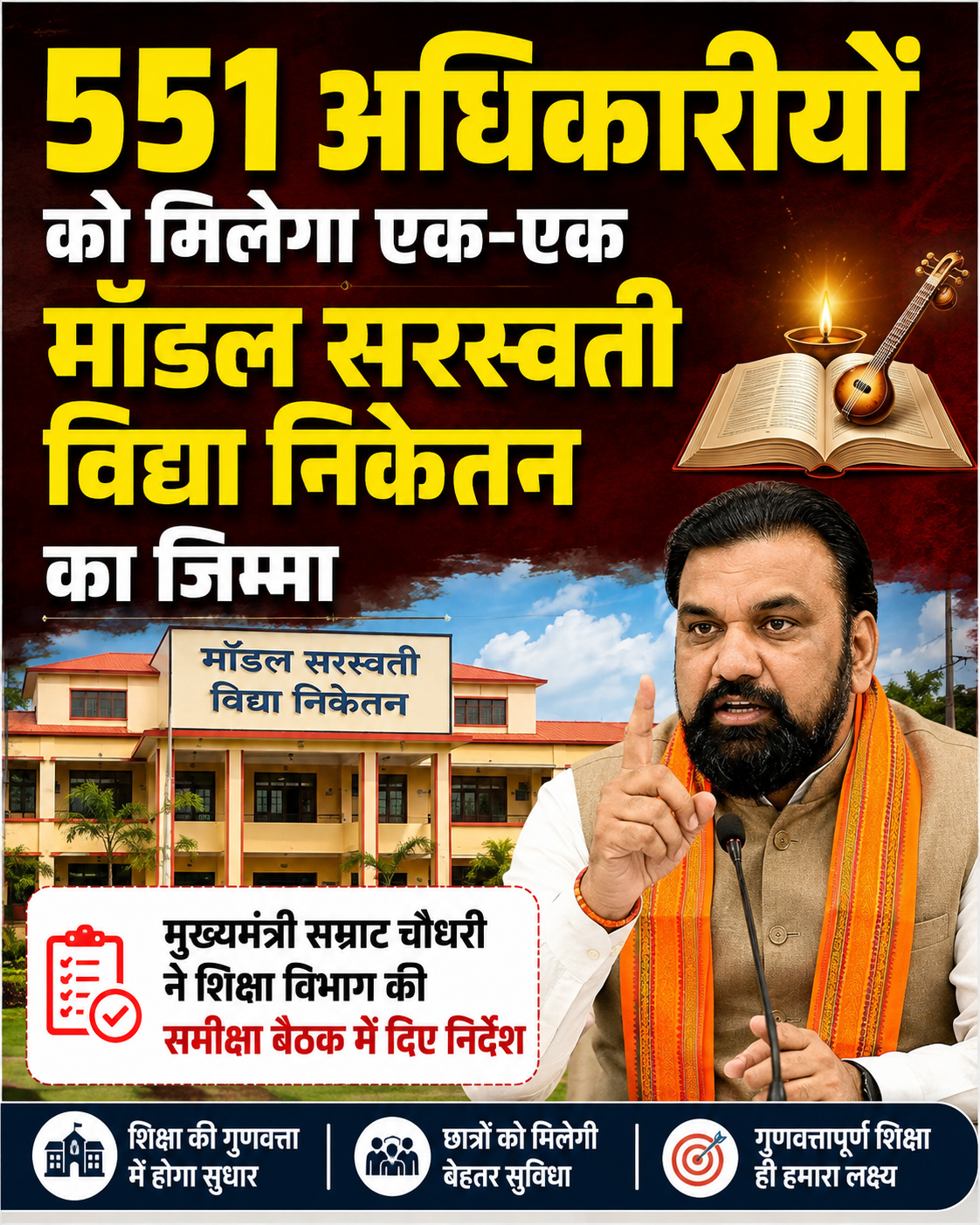
Patna: The Bihar government has decided to assign 551 officers the responsibility of one Saraswati Vidya Niketan (Model) each. Chief Minister Samrat Choudhary issued the directions during a review meeting of the Education Department held on Thursday at the Sankalp Hall located at Lok Sevak Awas.
The initiative is aimed at strengthening monitoring of model schools, improving the quality of education and ensuring that problems related to schools are resolved promptly. By linking individual officers with specific schools, the government expects to establish a stronger connection between educational institutions and the administration.
During the review meeting, several aspects of Bihar’s education system were discussed. The Chief Minister also issued necessary directions regarding school management, availability of teachers, facilities for students, academic activities and administrative arrangements.
551 Officers to Be Given School Responsibility
Under the government’s plan, 551 officers will each be assigned responsibility for one Saraswati Vidya Niketan (Model). The move is expected to make the monitoring system for these schools more structured.
Once an officer is assigned to a particular school, they can regularly monitor its functioning and report the actual situation to the concerned authorities. They can also identify problems related to infrastructure, resources, students and academic activities.
The arrangement is expected to strengthen direct communication between schools and the administration.
Focus on Reviewing the Education System
Chief Minister Samrat Choudhary discussed various aspects of the state’s education system during the Education Department review meeting.
The meeting focused on assessing the progress of departmental programmes and understanding the situation at the school level.
Improving the quality of education, creating a better learning environment and providing necessary facilities to students are among the government’s priorities.
Simply having school buildings and resources is not enough. Students also need quality teaching, regular classes and a supportive academic environment. The government is therefore focusing on strengthening monitoring mechanisms.
Special Attention to Model Schools
The government is emphasizing the development of model schools as examples of better educational management.
Such schools need not only adequate infrastructure but also effective teaching and academic systems. Assigning officers to these institutions could allow their functioning to be reviewed more regularly.
Officers can report issues related to teachers, buildings, drinking water, toilets, electricity, libraries and other facilities to the concerned authorities.
Monitoring Student Facilities
Facilities available to students are an important part of educational quality. The assignment of officers could improve monitoring of these facilities.
Schools need clean drinking water, toilets, electricity, proper seating arrangements, cleanliness and a safe environment. Facilities for sports, libraries and other activities are also important for students’ overall development.
Regular monitoring could help assess the condition of these facilities and identify areas requiring improvement.
Important Role of Teachers
Teachers remain the most important component of any school system. Adequate staffing and regular attendance are essential for developing a successful model school.
The monitoring system could also focus on teacher availability, classroom activities and academic performance. Assigning officers to schools would create an additional mechanism for bringing school-level problems to the attention of the administration.
However, the success of the initiative will also depend on providing teachers with adequate resources, training and support.
Faster Resolution of School Problems Expected
Minor problems at schools sometimes remain unresolved for long periods because information does not reach the appropriate authorities on time.
If one officer is assigned to each model school, the process of identifying and reporting problems could become faster. Officers could assess the situation and raise issues with the relevant departments.
This could increase administrative accountability at the school level.
Stronger Administrative Monitoring
A key objective of the decision is to strengthen administrative supervision. Connecting officers directly with schools could improve coordination between the Education Department and the administration.
Officers could monitor not only problems but also the implementation of government schemes at the school level. This could help authorities determine whether students are actually receiving the intended benefits.
Regular Review of School Development
Regular review is necessary for the continued development of model schools. Providing facilities once is not enough to maintain a school’s quality over the long term.
Resources need to be maintained, teachers need to be available and new facilities may need to be introduced according to changing student requirements.
Assigning officers to schools could create a system for continuous monitoring and assessment.
Attention to Rural and Remote Schools
Many schools in Bihar are located in rural and remote areas, where challenges related to infrastructure and human resources can sometimes be greater.
Assigning officers to model schools could help bring greater attention to problems in such areas. This could contribute to reducing regional disparities in educational facilities.
However, officers will be able to perform their responsibilities effectively only if they have proper coordination mechanisms with the departments responsible for resolving school-related problems.
Improving Educational Quality Is the Main Goal
The government’s objective is not limited to monitoring schools. Improving the actual quality of education will remain equally important.
Students need regular and quality teaching, better learning materials, digital resources and activity-based education. Model schools can potentially become institutions demonstrating improved educational practices.
Administrative monitoring can support this goal, but active participation from teachers, parents and school management will also be essential.
Parents’ Participation Also Important
Parents can play an important role in the development of schools. Regular communication with parents regarding attendance, academic progress and student activities can improve the overall learning environment.
If feedback and complaints from parents are also incorporated into the monitoring process, authorities could gain a better understanding of the actual problems faced by schools.
This could further strengthen accountability and transparency.
Model Schools Could Become Centres of Change
If the government simultaneously focuses on monitoring, infrastructure, teacher availability and educational quality, model schools could become centres of positive change in Bihar’s education sector.
The plan to assign 551 officers to individual model schools is being viewed as an administrative initiative in this direction.
Its success will depend largely on how regularly officers monitor their assigned schools and how effectively identified problems are addressed.
Greater Accountability Expected
Assigning one officer to each school could also make it easier to establish accountability for the condition of individual institutions.
If problems are regularly reported to higher authorities, responsibility for resolving them can be determined more easily. This could strengthen administrative discipline and monitoring in schools.
Overall, the Bihar government’s decision to assign 551 officers responsibility for one Saraswati Vidya Niketan (Model) each is being seen as an important step towards strengthening monitoring and accountability in the state’s education system.
Chief Minister Samrat Choudhary issued the directions during the Education Department review meeting at the Sankalp Hall at Lok Sevak Awas. The initiative aims to monitor the actual condition of model schools, improve facilities for students and ensure timely resolution of school-related problems.
If effective coordination is established among officers, teachers, school management and parents, the initiative could contribute to improving educational quality. It will be important to observe how the responsibility assigned to the 551 officers is implemented and how much impact the initiative has on students’ education and the overall functioning of schools.