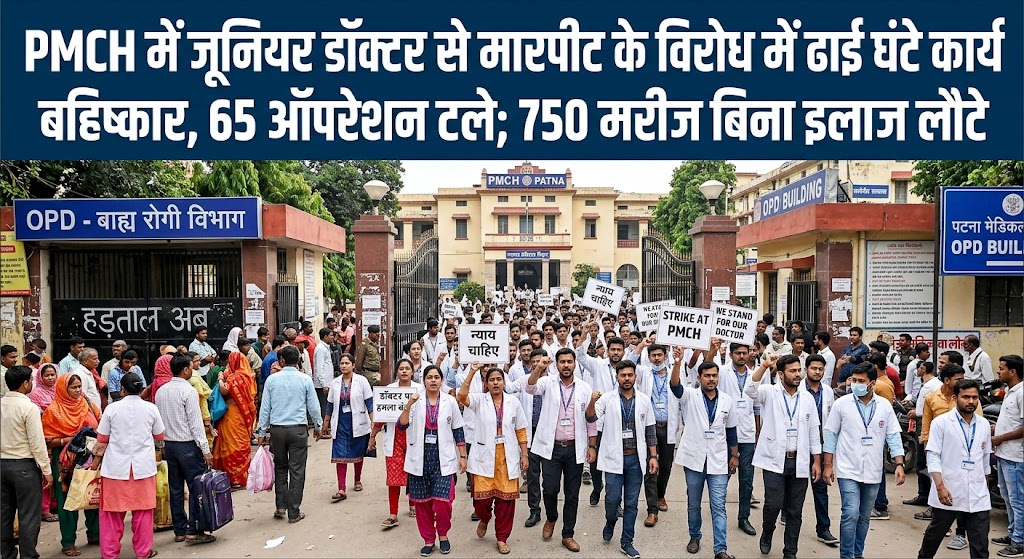
Junior Doctors Stage 2.5-Hour Work Boycott at PMCH Over Assault on Doctor; 65 Surgeries Postponed, 750 Patients Turned Away
Patna: Junior doctors at Patna Medical College and Hospital (PMCH) staged a work boycott for around two and a half hours on Thursday in protest against an alleged assault on a junior doctor. The work boycott continued from approximately 9:00 am to 11:30 am, affecting services in the emergency department, outpatient department (OPD) and operation theatres.
During the protest, 65 of the 112 scheduled surgeries had to be postponed, while around 750 patients had to return without receiving treatment because the registration counter remained closed. Registration was resumed later, allowing some patients to receive treatment. According to the hospital, a total of 1,325 patients were treated during the day.
The disruption particularly affected patients admitted to the emergency department, intensive care units (ICUs), paediatrics and obstetrics and gynaecology departments. Treatment of critically ill patients, including those suffering from heart attacks, was also affected for a period. Considering the condition of serious patients, senior doctors had to personally carry medicines and injections to patients.
Protest Followed Alleged Assault on Intern Doctor
According to reports, the incident occurred late Wednesday night when relatives of an elderly patient arrived at the hospital for admission. Junior doctors alleged that an intern doctor was assaulted during a dispute with the patient's relatives.
The doctor reportedly suffered a serious head injury in the incident. Following the alleged assault, junior doctors decided to stop work in protest.
The protesting doctors demanded action against those responsible and raised concerns regarding the safety of doctors and healthcare workers working inside the hospital.
Emergency and OPD Services Affected
The work boycott affected several important medical services at PMCH. From 9 am to 11:30 am, emergency, OPD and operation theatre services were disrupted.
The registration counter remained closed during the protest, creating difficulties for patients who had arrived at the hospital for consultations. Around 750 patients reportedly had to return without receiving treatment at that time.
PMCH receives patients from various parts of Bihar, including people travelling long distances for specialized medical care. For such patients, disruption of registration and treatment services can create additional difficulties.
Once registration services resumed, some patients were able to continue with the treatment process.
65 Scheduled Surgeries Postponed
The operation theatre was also affected by the work boycott. Out of 112 surgeries scheduled for the day, 65 had to be postponed.
Patients scheduled for surgery often undergo several examinations and preparations before being admitted for an operation. Postponement can therefore cause additional inconvenience for patients and their families, who may have to wait for a new date.
The hospital administration subsequently worked towards restoring normal medical services and managing the postponed procedures.
Critically Ill Patients Faced the Greatest Difficulty
The impact of the work boycott was particularly significant in emergency and ICU areas, where patients require continuous medical attention and timely medication.
Treatment of patients suffering from heart attacks and other serious medical conditions was also affected for a period. Given the critical condition of some patients, senior doctors stepped in and personally carried medicines and injections to the patients.
The situation presented a challenge for the hospital administration because even short disruptions in emergency medical care can be serious for critically ill patients.
Paediatrics and Obstetrics Services Also Affected
Services in the paediatrics and obstetrics and gynaecology departments were also affected by the junior doctors’ protest.
Children and pregnant patients often require regular monitoring and timely medical attention. Any disruption in services can therefore cause considerable anxiety among patients and their families.
Senior doctors and hospital officials attempted to manage the situation using the available medical staff and resources.
Meeting Held with Hospital Administration and Police
Following the work boycott, hospital authorities and police officials held discussions with the junior doctors.
A meeting involving PMCH Superintendent Dr Rajiv Kumar Singh and police officials continued for around two hours. During the meeting, junior doctors expressed their concern over the alleged assault and demanded action against those responsible.
The doctors also sought adequate security measures to ensure that medical staff could work in a safe environment.
Hospital authorities and police officials assured the doctors that action would be taken in the matter.
Protest Ends After Arrest of One Suspect
Following assurances from the authorities, police initiated action in connection with the incident. After one accused person was reportedly arrested, the junior doctors ended their work boycott.
Following the withdrawal of the protest, efforts were made to restore normal medical services at the hospital. OPD and registration services were resumed, while the hospital administration also began working towards restoring regular operation theatre services.
FIR Registered Against Four Unidentified People
According to the Pirbahore police station SHO, an FIR was registered against four unidentified people based on a statement provided by the hospital superintendent.
Police are investigating the incident and attempting to establish the identities and roles of those involved. Statements from people connected with the incident may also be recorded as part of the investigation.
CCTV footage from the hospital premises could also be examined to establish what happened during the alleged assault.
Questions Over Security at Hospital
The alleged assault on a junior doctor has once again raised questions regarding security arrangements at a major government hospital such as PMCH.
Thousands of patients and relatives visit the hospital, and disputes can sometimes arise because of overcrowding, delays or misunderstandings regarding medical procedures.
Doctors and healthcare workers have emphasized that violence inside hospitals cannot be accepted. Medical professionals need a safe working environment so that they can perform their duties effectively.
At the same time, patients and their relatives expect timely and quality medical treatment. Hospital authorities therefore face the challenge of maintaining security while ensuring uninterrupted healthcare services.
Patients Faced Significant Inconvenience
The work boycott caused considerable inconvenience to patients and their families. Many patients had to return because registration services were temporarily unavailable. Others waited for the registration process to resume.
Patients travelling from distant areas faced additional difficulties because they had already spent time and money reaching the hospital.
The postponement of scheduled surgeries also caused concern among patients who had prepared for their procedures.
However, junior doctors maintained that their protest was not intended to inconvenience patients but to demand action over the alleged assault and draw attention to the safety of medical professionals.
Need to Prevent Similar Incidents
The incident highlights the need for measures to prevent similar confrontations in the future. Better communication between doctors and patients, adequate security arrangements and timely intervention during disputes could help reduce the risk of violence inside hospitals.
Effective deployment of security personnel, monitoring of entry points and additional security in sensitive areas could also be considered.
At the same time, patients and their relatives need clear information about hospital procedures so that misunderstandings can be reduced.
Restoring Normal Services
After the junior doctors ended their work boycott, the hospital administration focused on restoring medical services. Patients who could not register during the disruption were allowed to continue with treatment once registration resumed.
The surgeries that had been postponed will need to be rescheduled according to medical requirements and available resources.
For the hospital administration, an important priority will be ensuring that emergency and critical-care services remain operational even if disputes or protests occur in the future.
Overall, the approximately two-and-a-half-hour work boycott by junior doctors at PMCH significantly affected hospital services. Between 9:00 am and 11:30 am, 65 of 112 scheduled surgeries were postponed, while around 750 patients reportedly had to return without treatment because the registration counter was closed. However, a total of 1,325 patients were treated.
Patients in the emergency department, ICU, paediatrics and obstetrics and gynaecology departments faced some of the greatest difficulties. Treatment of critically ill patients, including those suffering from heart attacks, was temporarily affected, prompting senior doctors to personally carry medicines and injections to patients.
After a meeting lasting around two hours with hospital authorities and police, assurances of action were given. Following the reported arrest of one accused person, the junior doctors ended their protest. According to the Pirbahore police station SHO, an FIR has been registered against four unidentified people based on the hospital superintendent’s statement.
The incident has once again highlighted the need to balance the safety of doctors and healthcare workers with the uninterrupted delivery of medical services to patients at major government hospitals.