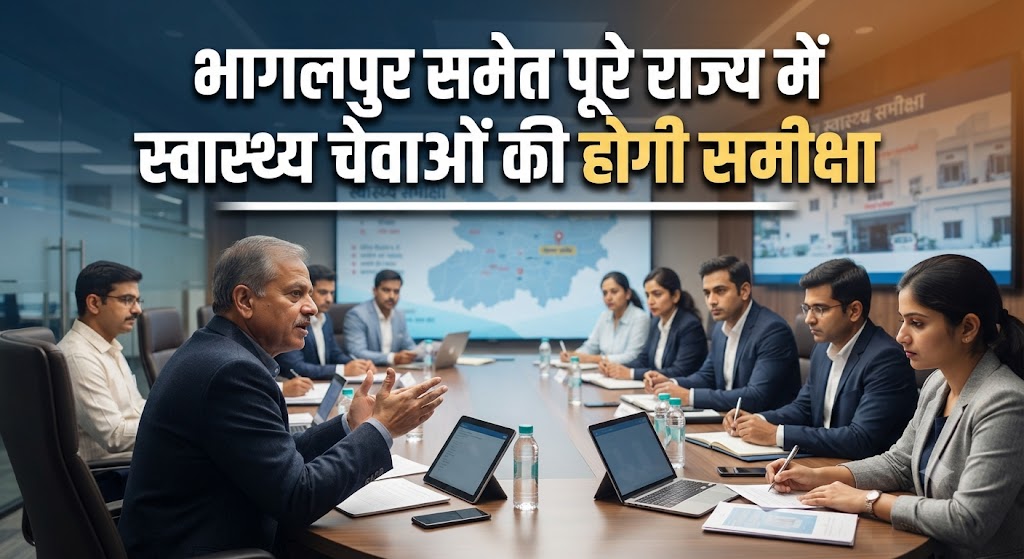
Administrative Rigor Intensifies to Improve Healthcare Services High-Level Review via Video Conferencing Led by the Health Minister; Officials from Bhagalpur and All Districts to Participate
Bhagalpur: Administrative oversight within Bihar’s health department has intensified significantly to streamline grassroots medical services, extend the benefits of public health schemes to the most marginalized citizens, and enforce rigorous financial discipline. In this sequence, a high-level review of all vital initiatives operating under the Health Department and the National Health Mission (NHM) across Bhagalpur and every district statewide is set to commence. Under the direct leadership and guidance of the state's Health Minister, a comprehensive high-level review meeting is being organized via video conferencing (VC). Bhagalpur’s Civil Surgeon, district health managers, nodal officers for diverse programs, and top health authorities from all alternate districts will join this critical virtual session to submit progress reports for their respective jurisdictions.
Core Agenda and Priorities of the Review Meeting
The primary objective of this high-level virtual assembly is to eliminate practical and administrative bottlenecks plaguing the healthcare sector while instituting absolute operational transparency:
Ledger of National Health Mission (NHM) Operations: During the proceedings, a point-by-point evaluation will be conducted regarding district-wise budgets allocated under the NHM, their optimal utilization, expenditure utilization certificates, reproductive and child health (RCH) programs, and the ground-level status of routine immunization drives.
Scrutiny of Infrastructure within Hospitals: Specific assessments will focus on healthcare delivery, the availability of essential life-saving medications, the presence of physicians and paramedical staff, and sanitation benchmarks across Bhagalpur’s Jawaharlal Nehru Medical College and Hospital (Mayaganj Hospital), Sadar Hospital, and peripheral sub-divisional hospitals.
Zero Tolerance for Corruption and Laxity: Accountability will be firmly established for any officers or personnel exhibiting negligence, fiscal irregularities, or bureaucratic foot-dragging in the execution of welfare programs, ensuring strict deterrence against poor performance.
Stir Within the Bhagalpur District Administration and Health Apparatus
Word of this high-level review led by the Health Minister has triggered a wave of activity and administrative urgency within the Bhagalpur district health office:
Officials Rush to Finalize Data and Dossiers: For days, officers within the Civil Surgeon’s office have been auditing records concerning diverse health initiatives, institutional delivery statistics, and ongoing infrastructural undertakings to ensure they are fully prepared to answer incisive, data-driven queries from the minister.
Efforts to Rectify Past Lapses: Preemptive administrative paperwork is being rushed to address recent complaints and shortcomings regarding local healthcare delivery, ensuring Bhagalpur's performance metrics and compliance reports appear fully satisfactory during the video conference.
Public Expectations and Ground Realities
Across a densely populated state like Bihar, health department programs serve as the primary lifeline for millions of impoverished and needy citizens:
Timely Access to Treatment and Pharmaceuticals: The general public and patients have consistently complained that regardless of how stellar paper statistics appear, life-saving medicines and hospital amenities frequently fail to materialize in a timely fashion on the ground.
Impact of Ministerial Strictness: Continuous reviews of this caliber, driven by the direct intervention of the Health Minister via video conferencing, foster hope that sluggish public health initiatives will regain momentum and compel negligent personnel to face accountability.
This upcoming high-level review meeting spearheaded by the Health Minister via video conferencing could serve as a decisive turning point for the healthcare landscape across Bhagalpur and the wider state of Bihar. If this initiative—designed to pierce through paper claims, evaluate ground realities, and instill transparency into National Health Mission schemes—is enforced with unwavering strictness, ordinary patients will undoubtedly secure superior, accessible, and high-quality medical care. The directives emerging in the wake of this conference will play a pivotal role in dictating the future trajectory and operational health of hospitals statewide.