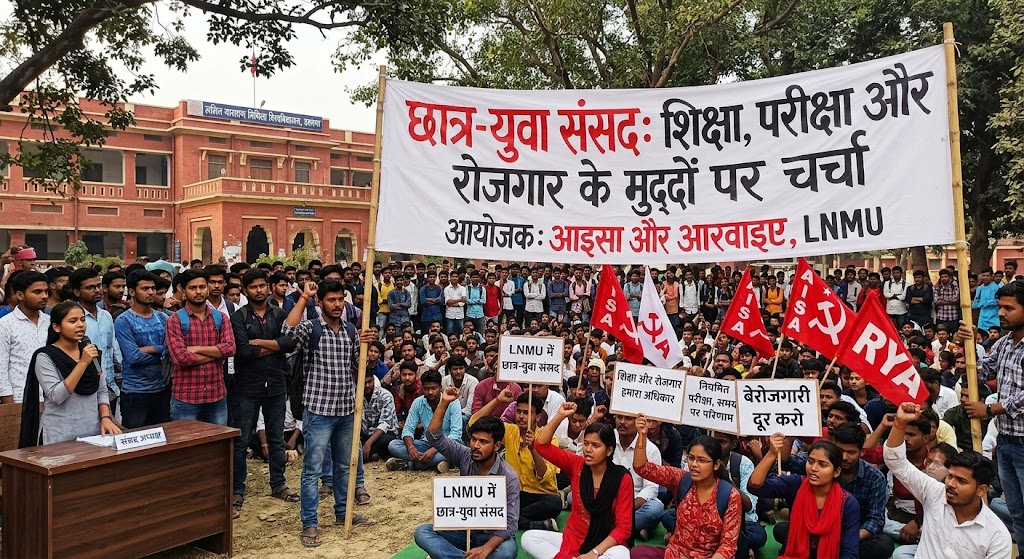
AISA and RYA Organize Student-Youth Parliament at LNMU, Discuss Education, Exams and Employment Issues
Darbhanga: A student-youth parliament was organized at Lalit Narayan Mithila University (LNMU) by the All India Students’ Association (AISA) and Revolutionary Youth Association (RYA). A large number of students and young people participated in the programme and discussed various issues related to education, examinations, employment and the condition of government schools. During the event, speakers emphasized the need for democratic movements to strengthen the voice of young people on issues concerning education and employment.
Participants discussed the need to improve the education system in universities and educational institutions, ensure transparency in examinations and increase employment opportunities for young people. Speakers said that the future of students and youth is closely linked to the availability of quality education and employment opportunities. Therefore, issues related to these sectors need to be addressed not only administratively but also through broader social and democratic discussions.
Students Raise Concerns Over Education System
Several issues related to the education system were discussed during the student-youth parliament. Students said that higher education institutions need quality education, adequate resources and a better academic environment. They also emphasized the need to update academic curricula and introduce necessary reforms.
Students said the purpose of education should not be limited to simply passing examinations. Courses should provide adequate opportunities for developing logical thinking, practical knowledge and employment-related skills.
Speakers said that curricula need to be updated regularly in view of rapidly changing technology and employment patterns. Universities should also continuously review their academic systems to provide students with modern knowledge and skills.
Demand for Reforms in Examination System
The examination system was another major topic of discussion. Students demanded greater transparency and timely completion of examinations. They said that uncertainty related to examinations can directly affect the future of students.
Students said there should be clarity regarding examination dates, results, evaluation and other procedures. Unnecessary delays in examinations or results can affect students' plans for higher education and employment.
Speakers emphasized the need to make the examination system more reliable and transparent. They also called for an effective mechanism to address student grievances so that problems can be resolved promptly.
Demand to Abolish NTA
The demand to abolish the National Testing Agency (NTA) was also prominently raised during the event. Speakers referred to problems associated with various national-level examinations and said that maintaining students' confidence in the examination system is essential.
Student leaders said that trust in examination agencies and examination procedures is important for a transparent and accountable system. They demanded that technical and administrative problems associated with examinations be addressed.
AISA and RYA representatives said that a large number of young people appear for national-level competitive examinations. Therefore, any irregularity or administrative problem can affect a very large number of students. They called for greater transparency and accountability in the examination system.
Employment Becomes a Major Issue
Employment was another major issue discussed during the student-youth parliament. Young participants said that finding employment after completing education remains one of the biggest challenges facing them. They demanded that the government create sufficient employment opportunities and complete recruitment processes within a fixed timeframe.
Speakers said that vacant posts in government departments should be filled quickly. Young people preparing for competitive examinations face increasing mental and financial pressure when recruitment processes remain pending for long periods.
Student leaders said employment is not merely a source of individual income. It is also linked to the economic independence of young people and the strengthening of the wider economy. Therefore, employment should be treated as a priority issue.
Concerns Over Condition of Government Schools
The condition of government schools was also discussed during the programme. Students and speakers said that adequate resources, sufficient teachers and better infrastructure must be ensured in government schools.
They pointed out that a large section of children in society studies in government schools. Therefore, improving the quality of these institutions would directly benefit children from economically weaker and middle-income families.
Speakers emphasized the need to improve school buildings, classrooms, laboratories, libraries, toilets and other essential facilities. They also called for adequate recruitment of teachers and steps to ensure quality education.
Emphasis on Curriculum Reform
Students also described curriculum reform as an important issue. They said several courses should be regularly updated according to modern requirements. Students need to be provided with practical and employment-oriented education rather than being limited to theoretical knowledge.
Students said that during higher education, learners should receive opportunities to develop research skills, technical knowledge, digital skills and other practical abilities. Such skills can help them in both further education and employment.
Emphasis on the Need for Movements
Speakers at the student-youth parliament emphasized the need for movements on issues related to education, examinations and employment. They said students and young people have the democratic right to present their demands before the government and administration.
Speakers appealed to students and young people to organize around issues concerning their rights and future. They said dialogue is essential for resolving problems, but if demands continue to be ignored, democratic movements may also become necessary.
Student leaders emphasized taking forward such movements through peaceful and democratic means. They also stressed the need to connect issues concerning education and employment with a broader student-youth movement.
Demand for Reforms at University Level
Students also raised concerns regarding the internal functioning of universities. They said students should receive academic facilities and administrative services on time.
There should be no unnecessary delays in examination, results, admission, certificates and other student-related services. Students said university administrations should take their grievances seriously and develop effective mechanisms for resolving them.
Objective of Student-Youth Parliament
According to the organizers, the objective of the student-youth parliament was to provide students and young people with a platform to discuss education, employment and social issues. The programme gave participants an opportunity to express their views and collectively discuss their concerns.
Speakers said youth participation strengthens democratic institutions. Students should not view themselves only as recipients of education but also understand their role as important members of society.
Discussion on Future Strategy
The programme also included discussions on future strategies concerning education, examinations and employment. Student leaders said there is a need for continued dialogue and campaigns at both university and state levels on these issues.
Organizers appealed to more students to join such initiatives and raise their concerns in an organized manner. They said issues related to education and employment can have a long-term impact on the future of young people and therefore require sustained efforts.
Overall, the student-youth parliament organized by AISA and RYA at Lalit Narayan Mithila University brought several important issues concerning education, examinations and employment into focus. Students emphasized the need to reform the examination system, modernize curricula, improve the condition of government schools and increase employment opportunities. The demand to abolish the NTA was also raised during the event.
Speakers said democratic movements and organized efforts are necessary to effectively communicate the concerns of young people to the government and administration. The student-youth parliament provided students with a platform to collectively discuss their concerns and demands while highlighting the need to continue raising their voices on issues related to education and employment.