

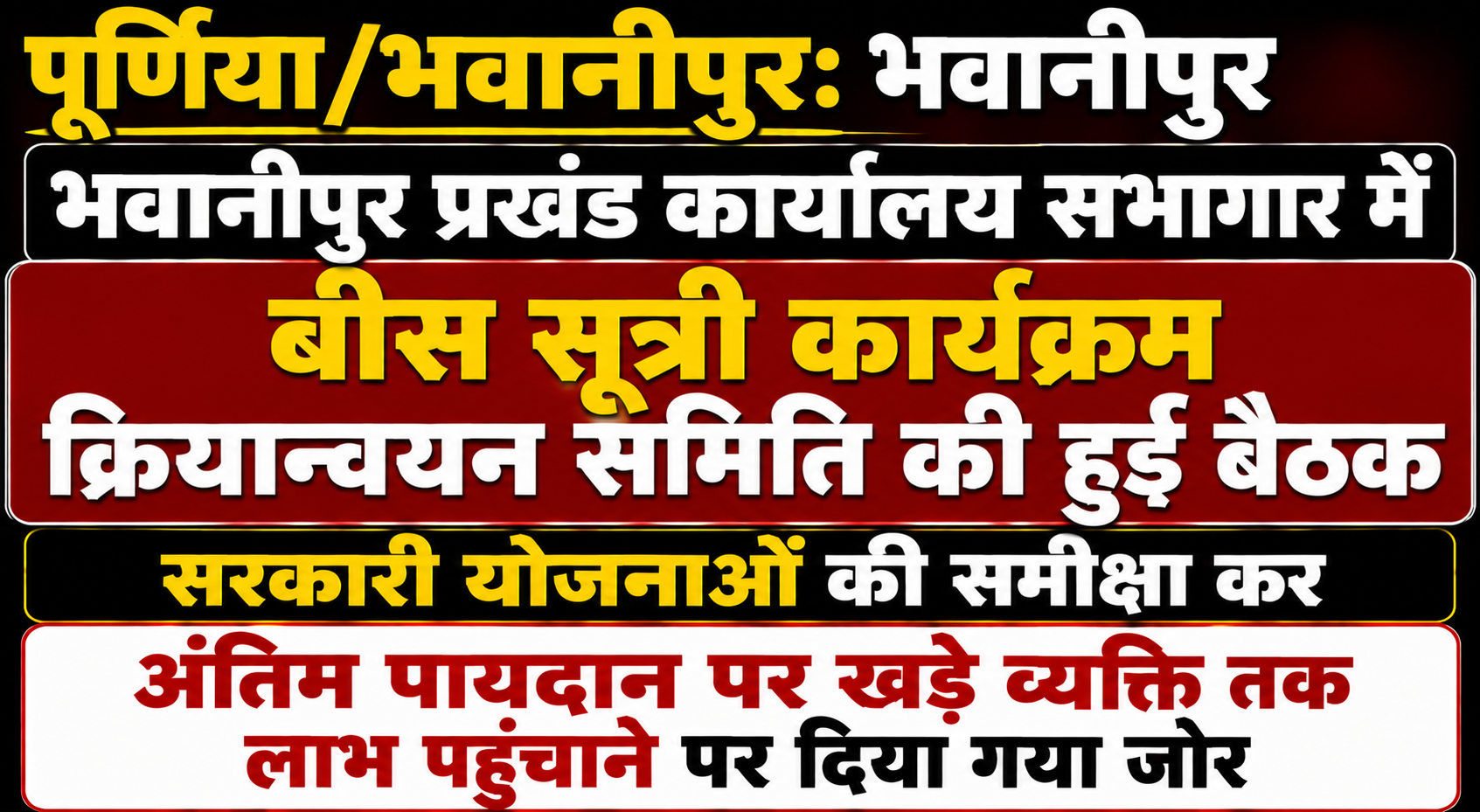
Bhawanipur: Twenty-Point Committee Meeting Held in Bhawanipur Block, Government Schemes Discussed; Members Emphasize Resolving Problems and Delivering Scheme Benefits to the Last Person
Purnia/Bhawanipur (Bihar): A very significant and important news story has emerged from the administrative and developmental corridors of Purnia district, Bihar. A high-level and immensely important meeting of the Twenty-Point Programme Implementation Committee was organized on Wednesday in the auditorium located at the Bhawanipur block headquarters in Purnia district. This meeting was jointly chaired by the committee chairman and local public representatives, with the Block Development Officer (BDO), Circle Officer (CO), heads of various departments, and all honored members of the committee in attendance. The main agenda of the meeting was to thoroughly review the progress of public-welfare and beneficiary schemes operated by the government and to find prompt solutions to administrative and grassroots problems arising in rural areas. During the meeting, members unanimously emphasized that the benefits of government schemes must reach the last person in society without any discrimination.
The role of twenty-point committees is considered extremely vital in accelerating development work and redressing public grievances within a democratic system. Let us understand a detailed, analytical, and point-by-point description of this entire meeting, the key points of discussion, and the decisions taken.
Main Agenda of the Meeting and Administrative Participation
Coordination between the three-tier Panchayati Raj system and administrative officials is essential for bringing transparency and speed to the execution of government schemes.
Organization in Bhawanipur Block Auditorium: In this meeting held in the conference hall of the Bhawanipur block office, twenty-point committee members from various panchayats strongly raised the grassroots problems of their respective regions.
Presence of Officials: The Block Development Officer, Circle Officer, Child Development Project Officer (CDPO), Health Manager, and MGNREGA Program Officer, along with officials from other departments, were present at the meeting.
Objective of the Review Meeting: Aligning with government priorities, reviewing the ground-level execution of schemes such as education, health, drinking water, roads, housing, and social security pensions formed the primary objective of this meeting.
Review of Schemes and Emphasis on 'Delivering Benefits to the Last Person'
Works of various departments were reviewed one by one during the meeting, yielding several important suggestions.
Pradhan Mantri Awas Yojana and Nal-Jal Yojana: Members demanded transparency in the selection of beneficiaries under the Pradhan Mantri Awas Yojana in rural areas and the prompt repair of non-functional ward taps under the Mukhyamantri Gramin Peyajal Nishchay Yojana.
Health and Educational Services: Serious discussions were also held concerning regular doctor attendance and medicine availability in block hospitals along with teaching-learning conditions in schools. Committee members stated in stern terms that any sort of laxity in foundational sectors like health and education will not be tolerated.
Social Security Pensions: Instructions were issued to quickly approve new applications of eligible beneficiaries deprived of old-age, widow, and disability pensions and to execute pending payments immediately.
Resolution of Public Grievances and Emphasis on Weekly Meetings
To ensure prompt solutions to complaints and problems continuously received from villagers, the committee emphasized improvements in the working system.
Prompt Redressal of Problems: It was decided in the meeting that complaints related to electricity, roads, irrigation, and ration cards arriving from various villages will be resolved within a prescribed time limit.
Proposal for Weekly Reviews: The committee emphasized organizing review meetings at regular intervals every week in coordination with administrative officials to monitor progress reports of decisions taken in previous meetings.
Curbing Corruption: Recommendations were made to take strict disciplinary action against concerned personnel if middlemen's involvement or negligence is found at any level in public-welfare works.
Better Coordination Between Public Representatives and Officials
Mutual synergy between local public representatives and the administrative machinery is extremely necessary for the successful operation of development schemes.
Transparent Work Culture: At the conclusion of the meeting, all officials and members resolved that they will work together for the comprehensive development of Bhawanipur block and live up to public expectations.
Appeal to the General Public: Committee members also appealed to general citizens to stay informed about schemes operated by the government and immediately report any irregularities to the block administration or committee members.
This meeting of the Twenty-Point Programme Implementation Committee organized at the Bhawanipur block headquarters in Purnia district serves as an extremely positive step toward bringing rural development and public welfare schemes to the ground. The resolution to 'deliver benefits to the last person' while reviewing schemes and the decision to hold weekly review meetings make it clear that the local administration and public representatives are fully serious about becoming accountable to the public. If these decisions are strictly followed, Bhawanipur block can set an exemplary standard in development.