

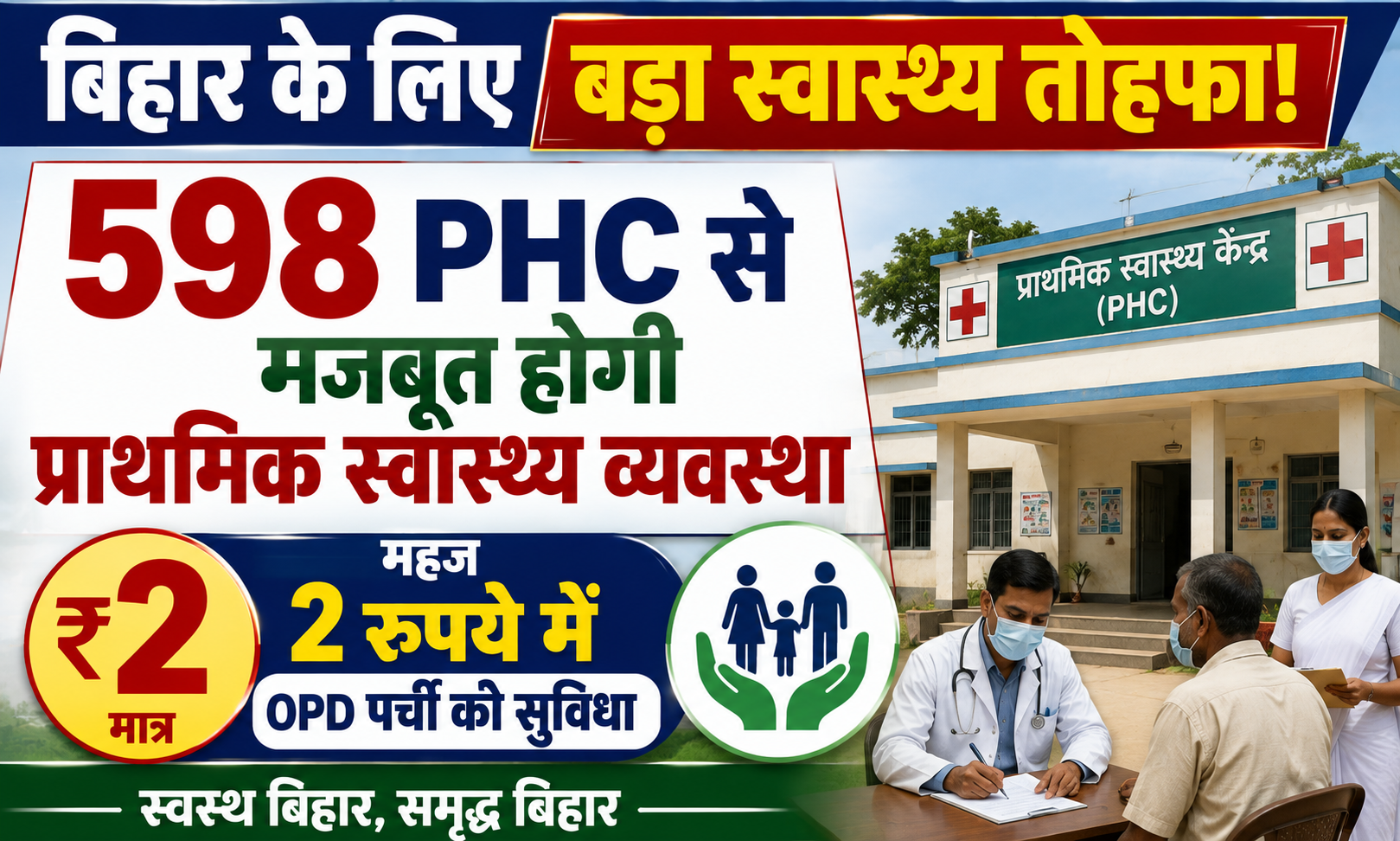
Big Health Boost for Bihar! 598 PHCs to Strengthen Primary Healthcare, OPD Slip Reportedly Available for Just ₹2
Patna: The Central Government is focusing on strengthening healthcare infrastructure in Bihar by expanding and improving primary healthcare facilities. Primary Health Centres (PHCs) play an important role in providing basic medical services to people in rural and remote areas. The expansion and strengthening of Bihar's primary healthcare network could therefore provide significant relief to residents, particularly those living in rural areas.
According to the information provided, Bihar is set to benefit from 598 Primary Health Centres (PHCs), while patients have been reported to be able to obtain an OPD registration slip for only ₹2 at government health facilities. However, the specific claim regarding 598 PHCs and the ₹2 fee should be verified against an official notification from the Bihar Health Department before publication.
The Central Government has stated that states receive technical and financial assistance under the National Health Mission to strengthen public healthcare infrastructure, including PHCs and Community Health Centres (CHCs).
Focus on Taking Healthcare Services to Villages
Primary Health Centres are particularly important in a large state like Bihar, where a significant portion of the population lives in rural areas.
For villagers, travelling to district hospitals or major hospitals in cities for every health problem can be difficult and expensive.
If PHCs provide doctors' consultations, basic examinations, essential medicines and other primary healthcare services locally, patients can receive treatment closer to home. This can also reduce unnecessary pressure on larger hospitals.
If adequate doctors, nurses, medicines, diagnostic facilities and equipment are made available at these centres, Bihar's rural healthcare system could see considerable improvement.
What Does a ₹2 OPD Slip Mean?
The information provided states that patients will need to pay only ₹2 for an OPD registration slip to consult a doctor.
If such a fee applies at a particular government healthcare facility, it would make basic medical consultation highly affordable.
However, it is important to understand that a ₹2 OPD registration fee does not necessarily mean that every type of treatment, diagnostic test, medicine or hospital service will cost only ₹2. Charges and available services can vary between different government healthcare institutions.
Patients should therefore check the applicable rules and services at their local PHC or with the health authorities.
Major Relief for Poor and Rural Families
A large number of families in Bihar live in rural areas, and medical expenses can become a significant financial burden for low-income households.
If primary healthcare centres provide affordable consultations, basic treatment and necessary medicines, families may not have to depend as heavily on private clinics.
Low-cost government healthcare can make it easier for poor families to seek treatment at an early stage. Early diagnosis can also help prevent minor illnesses from developing into more serious conditions.
Pressure on Large Hospitals Could Decline
PHCs form an important part of the primary level of the public healthcare system.
If common illnesses and basic medical cases can be treated at PHC level, district hospitals and medical colleges may face less pressure.
Large hospitals are generally expected to handle serious cases and referrals. However, when patients with minor illnesses also directly visit major hospitals, overcrowding becomes a problem.
A stronger PHC network could help ensure that patients receive appropriate treatment and advice at the first level of the healthcare system.
Availability of Doctors and Staff Is Essential
Increasing the number of PHCs alone will not be enough. These centres need sufficient doctors, nurses, pharmacists, laboratory technicians and other healthcare workers to function effectively.
Regular supplies of medicines and proper maintenance of diagnostic equipment are equally important.
The Central Government has stated that states receive technical and financial support to strengthen public healthcare infrastructure. Under the National Health Mission, proposals related to strengthening PHCs and CHCs are considered based on applicable guidelines and available resources.
Digital Healthcare Services Also Changing the System
Bihar has also been moving towards greater use of digital healthcare services.
Government data has indicated significant progress in online OPD registration at public healthcare facilities in the state.
Under the Ayushman Bharat Digital Mission, services such as QR-based registration can help patients complete registration procedures more conveniently.
Digital systems can reduce queues and paperwork while also helping healthcare institutions maintain more organised patient records.
Expansion of Ayushman Arogya Mandirs
The Central Government has also been expanding primary healthcare services through Ayushman Arogya Mandirs across the country.
These centres are intended to provide a broad range of primary healthcare services, including preventive care, screening, essential medicines, diagnostic services and teleconsultation.
Such facilities are particularly important for rural communities because they can bring basic healthcare closer to people's homes.
The expansion of this network could complement the existing PHC and CHC infrastructure in Bihar.
Women and Children Could Also Benefit
Stronger primary healthcare facilities can be particularly useful for women and children.
Regular antenatal check-ups, child immunisation, nutrition counselling and basic health examinations can be provided closer to rural communities.
Early health screening can help identify diseases at an initial stage. Patients requiring specialised treatment can then be referred from PHCs to CHCs, district hospitals or medical colleges.
This creates a more organised chain of healthcare services.
Greater Focus on Early Disease Detection
Primary healthcare is not limited to treating illnesses after they occur. Prevention and early detection are also important functions.
Screening for high blood pressure, diabetes and other non-communicable diseases at the primary level can help identify health problems before they become severe.
Primary healthcare centres can therefore play an important role in preventive healthcare as well as treatment.
Could Healthcare Access Improve in Remote Bihar?
Bihar has long faced challenges related to access to healthcare, particularly in rural and remote areas.
While Patna and other major cities have larger hospitals and specialised medical facilities, travelling to these centres can be difficult for people living in distant villages.
A stronger local PHC network could therefore make a significant difference.
If doctors, medicines, diagnostic facilities and essential equipment are consistently available, rural families may not have to travel long distances for basic medical care.
Quality of Services Will Be Crucial
Increasing the number of healthcare centres is important, but the real success of the programme will depend on the quality of services provided.
Regular availability of doctors, medicines, diagnostic facilities, electricity, clean water, sanitation and proper patient care will be essential.
The government will need to ensure that healthcare centres function effectively on the ground and that facilities are not merely available on paper.
What Could Change for Patients?
If the primary healthcare network is strengthened and affordable OPD services are available, patients could benefit in several ways.
First, people could consult doctors locally for common illnesses. Second, the initial cost of treatment could be reduced. Third, serious cases could be identified early and referred to larger hospitals in time.
This could make the overall healthcare system more efficient.
Strengthening Bihar's primary healthcare network could be an important step towards making medical services more accessible to rural and economically weaker sections.
The Central Government has stated that states receive technical and financial assistance under the National Health Mission to strengthen public healthcare infrastructure, including PHCs and CHCs.
The information provided for this report mentions 598 PHCs in Bihar and an OPD registration slip costing ₹2, but a specific official document confirming both figures was not available in the information reviewed. These figures should therefore be verified through an official Bihar Health Department notification before being presented as confirmed facts.
Nevertheless, the broader policy direction is clear: strengthening primary healthcare, expanding digital OPD services and increasing the reach of Ayushman Arogya Mandirs are aimed at bringing healthcare services closer to citizens.
If these facilities are supported by adequate doctors, healthcare workers, medicines, diagnostic services and equipment, they could significantly improve access to healthcare for rural and low-income families in Bihar.
Such improvements could not only reduce the initial financial burden on patients but also help reduce unnecessary pressure on major government hospitals by ensuring that common health problems are addressed at the primary level.