

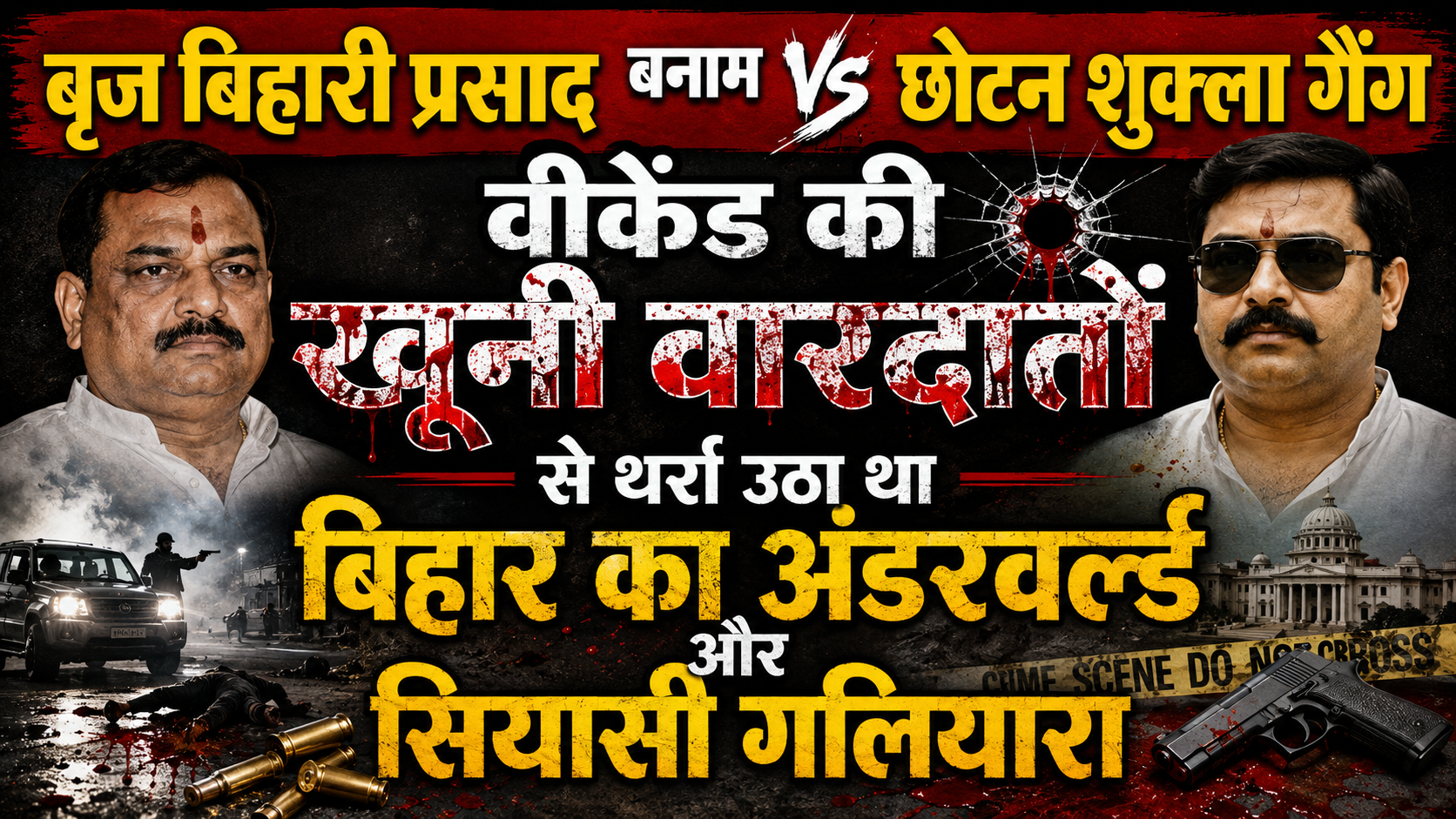
Brij Bihari Prasad vs. Chhotan Shukla Gang; Bihar's Underworld and Political Corridors Shaken by Weekend Bloodbaths
In Indian political and criminal history, the 1990s is considered an era when the lines between state power, muscle power, and the underworld had completely blurred. During this decade, a new and terrifying chapter of crime was written in states like Uttar Pradesh and Bihar, known as 'gangwars'. At the center of this bloody game was Bihar, and regions ranging from the state capital Patna to North Bihar's Muzaffarpur, Vaishali, and Motihari had become arenas of this bloody battle for supremacy.
The most discussed, spine-chilling rivalry that shook the foundations of Bihar's politics was the bloody feud between politician-cum-strongman Brij Bihari Prasad and crime syndicate boss Chhotan Shukla's gang. The battle for supremacy between these two factions was so intense that the underworld and administrative machinery of Bihar were frequently shaken to their core by rapid-fire murders committed mostly on weekends (Saturdays and Sundays). Let us analyze in detail that terrifying era of the nineties, the conflict between Brij Bihari Prasad and the Chhotan Shukla gang, the sensational weekend murders, and the political-criminal nexus of that period.
Background: Bihar in the Nineties and the Rise of Muscle Power
At the beginning of the nineties, a massive upheaval was underway in the socio-political system of Bihar. Caste equations were shifting, and during this very era, the open use of weapons began in order to establish economic and political dominance within the state.
Nexus of Power and Gun: To capture government contracts, tenders, coal, sand, and sawmills, petty gangs had now transformed into organized criminal syndicates. These gangs were also receiving local political patronage, which boosted their morale to the seventh heaven.
The Emergence of Brij Bihari Prasad and Chhotan Shukla: On one hand, Brij Bihari Prasad rose from student politics to establish a strong grip in politics through cooperatives and contracting, eventually becoming a minister, while on the other hand, Chhotan Shukla and his associates had set up a parallel government in the North Bihar region. Such a fire of ego, contract supremacy, and political dominance ignited between both sides that it ruined many happy families.
The Terror of Weekends: When Weekend Evenings Became Death Warrants
The most frightening characteristic of this gangwar was that its protagonists or their hideouts were most active during weekends (Saturdays and Sundays), and several sensational murders were executed during this exact period.
The Frightening Trend of Weekend Murders: When the entire state or city was in a weekend holiday and relaxation mood, the rattle of bullets would echo across Patna's posh areas, Dak Bungalow Chowk, Boring Road, or North Bihar highways. This bloody clash between the Chhotan Shukla gang and associates of Brij Bihari Prasad frequently consumed weekend evenings.
Endless Fire of Revenge: After one faction eliminated a key henchman on a Saturday, a larger incident was executed by the opposing faction on Sunday night or the following weekend in retaliation. This culture of 'tit for tat' created such terror in the minds of ordinary citizens of Bihar that people locked themselves inside their homes as soon as the sun set.
Chhotan Shukla's Assassination and Its Far-Reaching Consequences
The biggest earthquake in this battle for supremacy came when Chhotan Shukla was murdered, bringing this gangwar to an entirely new and politically sensitive turning point.
That Dark Day of Murder: Following the assassination of Chhotan Shukla, who had emerged as a powerful and terrifying figure in North Bihar, an earthquake hit state politics. Chhotan Shukla's supporters and his gang believed that Brij Bihari Prasad and his syndicate were behind this assassination.
Massive Crowds and Violence During the Funeral Procession: The kind of chaos and violence that erupted on the streets of Patna during Chhotan Shukla's final journey made it clear that this fight was no longer merely between two gangs, but had assumed the proportions of an open civil war. Following Chhotan Shukla's death, his brother Bhuar Shukla and other gang members (such as Bhupendranath Dubey or other sharpshooters) swore to avenge this blood.
Brij Bihari Prasad's Assassination: That Bloody Carnage at Indira Gandhi Institute of Medical Sciences (IGIMS)
The conspiracy hatched to avenge Chhotan Shukla's murder culminated in an incident that shook the entire country.
From Jail to Hospital and Then an Ambush: Due to being an accused in a case, Brij Bihari Prasad was lodged in Patna's Beur Jail and was admitted for treatment at the Indira Gandhi Institute of Medical Sciences (IGIMS - Sheikhpura) hospital in Patna due to failing health. Despite heavy police security, the attackers had tracked precisely when and how they would strike.
A Hail of Bullets: On the evening of June 13, 1998 (which was once again close to the weekend), when Brij Bihari Prasad was walking in the hospital premises or was with security personnel, criminals equipped with automatic weapons showered rapid-fire bullets, killing him and one of his bodyguards. This sensational assassination proved that law and police security held no meaning in Bihar's underworld.
Administrative Failure and Questions on Governance
These bloody weekends and gangwars of the nineties raised serious questions on the functioning of the governments and police machinery of that time.
Machinery Helpless Before Criminals: When indiscriminate firing was taking place openly on streets, hospitals, and crossings, the police and intelligence agencies were either completely failing or acting as mute spectators due to political pressure.
Judiciary and Lengthy Legal Battle: In the lengthy court battle that ensued following Brij Bihari Prasad's assassination, several names came to light, including strongman MLA Anand Mohan and others. However, this entire era established Bihar's image across the country and the world as a 'crime capital'.
The battle for supremacy between Brij Bihari Prasad and the Chhotan Shukla gang in the nineties and the incidents of weekend murders are a dark page in Bihar's history that no one would want to forget. This era was not merely about mutual enmity between two gangs, but the collapse of a system where the rule of law had weakened and the smell of gunpowder had poisoned the atmosphere of democracy. Although Bihar has moved far ahead of that era today, and modern policing and development have changed the state's image, those bloody weekends and scars of gangwars from the nineties still survive as a warning in people's minds that the union of power and muscle can prove to be immensely destructive for society.