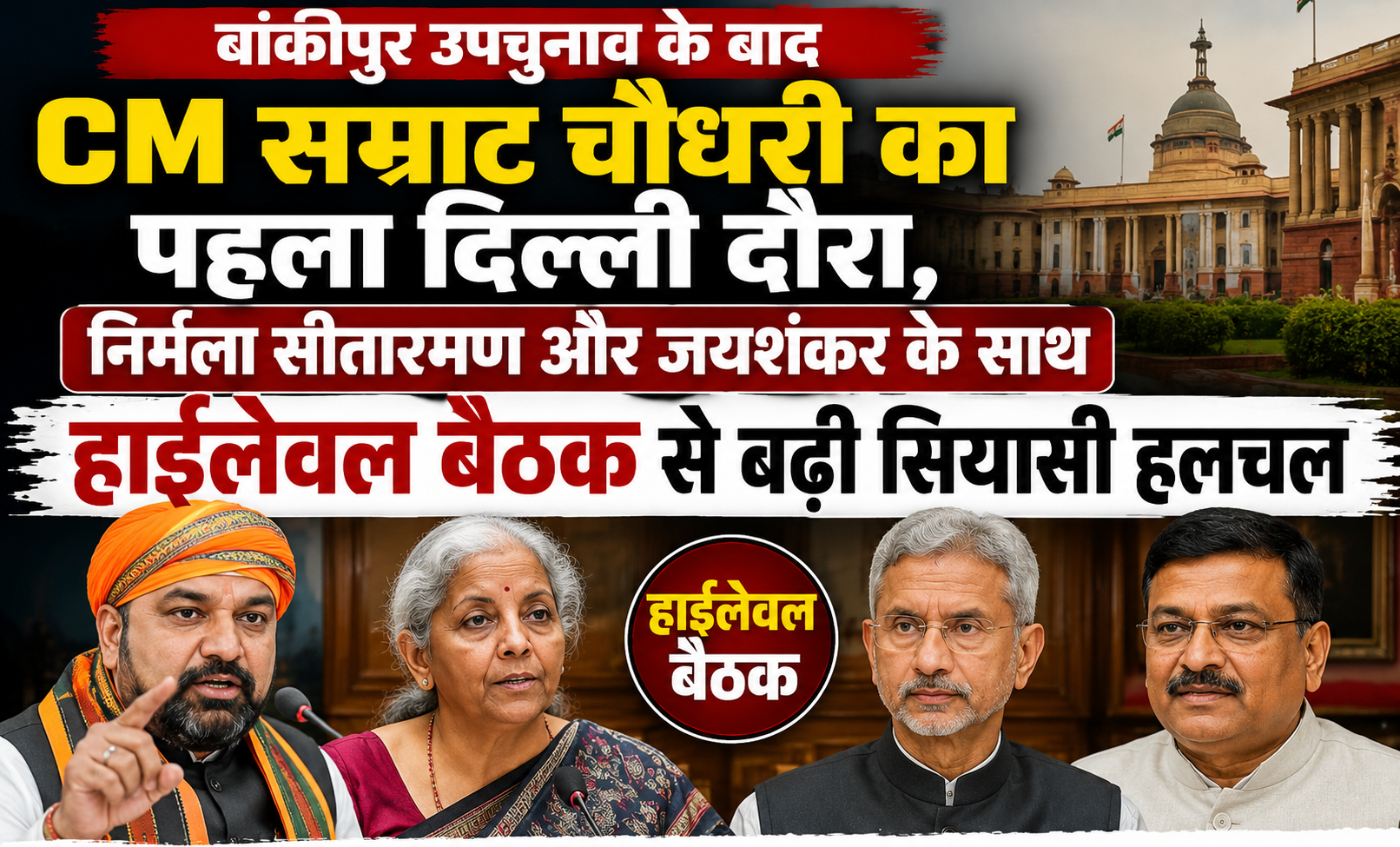
CM Samrat Choudhary on First Two-Day Delhi Visit After Bankipur Bypoll, High-Level Meeting With Nirmala Sitharaman and S. Jaishankar Draws Attention
Patna/New Delhi: Bihar Chief Minister Samrat Choudhary is on his first two-day visit to Delhi following the Bankipur bypoll. His visit has attracted considerable attention in both political and administrative circles. A high-level meeting held at Kartavya Bhavan on Friday was particularly significant, with several senior leaders and officials from the central and Bihar governments in attendance.
The meeting was attended by Union Finance Minister Nirmala Sitharaman, External Affairs Minister S. Jaishankar, Bihar Deputy Chief Minister Vijay Kumar Choudhary, and JDU National Working President Sanjay Kumar Jha. Bihar Chief Secretary Pratyaya Amrit, along with several senior state government officials, was also present.
The presence of senior political leaders as well as top bureaucrats indicates that the Chief Minister's Delhi visit is not limited to political meetings. Several important issues related to Bihar's development, finances, administration and coordination with the central government are expected to have been discussed.
First Delhi Visit After Bankipur Bypoll
Samrat Choudhary's Delhi visit is his first major trip to the national capital after the Bankipur bypoll.
For this reason, the visit is also being viewed from a political perspective. The Chief Minister's meetings with senior Union ministers have generated discussion about the state's political and administrative priorities.
However, the exact details of all the issues discussed during the meeting have not been officially disclosed. The participation of the Finance Minister, External Affairs Minister, Bihar's Deputy Chief Minister, JDU leadership and senior bureaucrats suggests that the discussions covered a broad range of issues.
Nirmala Sitharaman's Presence Considered Important
The participation of Union Finance Minister Nirmala Sitharaman is particularly significant.
Financial assistance from the Centre, implementation of various government schemes and Bihar's economic requirements are important areas of coordination between the state and central governments.
Bihar has been focusing on infrastructure, roads, education, healthcare, employment and industrial development. In this context, discussions with the Union Finance Ministry can be important for securing financial resources and accelerating development projects.
However, based on the available information, it is not clear whether any specific financial package or major project was formally approved during the meeting.
S. Jaishankar's Presence Adds Significance
The presence of External Affairs Minister S. Jaishankar also added another dimension to the meeting.
Bihar's development potential in areas such as international investment, tourism, education, agriculture and industry could benefit from stronger international engagement.
Attracting global investment and creating opportunities for Bihar-based businesses and entrepreneurs can require coordination with various central institutions.
However, there is no detailed official information available about whether a specific foreign policy or international investment issue was discussed at the meeting.
Vijay Kumar Choudhary and Sanjay Jha Also Present
Bihar Deputy Chief Minister Vijay Kumar Choudhary and JDU National Working President Sanjay Jha were also present at the high-level meeting.
Vijay Kumar Choudhary holds an important position in the Bihar government, while Sanjay Jha plays a significant role in the organizational and political affairs of the JDU.
Their presence alongside Chief Minister Samrat Choudhary indicates the importance of political and administrative coordination during the Delhi visit.
Presence of Senior Bihar Officials
The participation of Bihar Chief Secretary Pratyaya Amrit and other senior officials highlighted the administrative importance of the meeting.
Meetings involving senior bureaucrats generally focus on issues such as implementation of government schemes, inter-departmental coordination, financial requirements and progress of development projects.
Therefore, the Chief Minister's Delhi visit appears to have included both political discussions and administrative consultations.
Focus on Bihar's Development Priorities
The Bihar government has several major development priorities, including expansion of roads and transportation infrastructure, attracting industrial investment, generating employment, improving education and healthcare, and strengthening rural and urban infrastructure.
The Centre's cooperation can be important for implementing many of these projects.
The Delhi visit is therefore being viewed as an opportunity for the Bihar government to coordinate its development agenda with the central government.
Importance of Centre-State Coordination
Effective coordination between the Centre and the state is important for Bihar because several large infrastructure and development projects require cooperation between both levels of government.
High-level meetings in Delhi provide the state government with an opportunity to directly communicate its priorities to central ministries and seek cooperation on pending issues.
Such meetings can also help improve coordination in the implementation of centrally sponsored schemes and major infrastructure projects.
Political Importance of the Visit
Samrat Choudhary's Delhi visit is also significant from a political perspective.
His arrival in the national capital after the Bankipur bypoll and meetings with senior Union ministers have generated considerable discussion in Bihar's political circles.
However, it would not be appropriate to draw conclusions about any major political decision solely from the meeting.
The visit can nevertheless be seen as part of regular coordination between the Bihar government, the JDU leadership and the central government.
Development Projects Could Gain Momentum
If important development and administrative proposals were discussed positively during the meeting, several projects could receive greater momentum in the coming months.
Bihar is currently witnessing activity in areas including roads, bridges, expressways, industrial projects, urban development and employment generation.
Financial approvals, administrative clearances and coordination with central ministries are often essential for moving such projects forward.
Any announcement by the Bihar government following the Delhi visit could provide a clearer picture of the outcomes of the discussions.
Presence of Bureaucrats Provides Important Signal
One of the notable features of the meeting was the presence of senior Bihar government officials alongside political leaders.
This suggests that the discussions were not limited to political matters but also included practical and administrative aspects of various government initiatives.
The presence of senior officials allows discussions to focus on project status, financial requirements, implementation challenges and the assistance expected from the Centre.
Attention on Further Meetings
Samrat Choudhary's two-day Delhi visit remains under close observation in both political and administrative circles.
Attention will now focus on whether the Chief Minister holds additional meetings with Union ministers and senior officials and which Bihar-related issues are taken forward.
If concrete announcements regarding financial assistance, development projects or administrative decisions emerge from the visit, the significance of the Delhi trip could increase further.
For now, the high-level meeting at Kartavya Bhavan indicates that the Chief Minister's Delhi visit has a broad agenda.
Chief Minister Samrat Choudhary's first two-day Delhi visit after the Bankipur bypoll has emerged as an important political and administrative development for Bihar.
The high-level meeting at Kartavya Bhavan on Friday was attended by Union Finance Minister Nirmala Sitharaman, External Affairs Minister S. Jaishankar, Bihar Deputy Chief Minister Vijay Kumar Choudhary, JDU National Working President Sanjay Jha, Bihar Chief Secretary Pratyaya Amrit, and several senior state government officials.
Their presence indicates that the visit is not limited to political discussions. Issues related to Bihar's development, financial requirements, administrative coordination and major projects appear to be important aspects of the visit.
The coming days will reveal what concrete decisions or announcements emerge from the meetings.
If the discussions lead to greater financial support, faster approvals or progress on major development projects, the Delhi visit could prove significant for Bihar's development agenda.