

Lack of Drainage and Land Disputes Force Villagers in Bhagalpur to Live a Hellish Existence for Four to Five Months; Questions Raised on Administrative Apathy
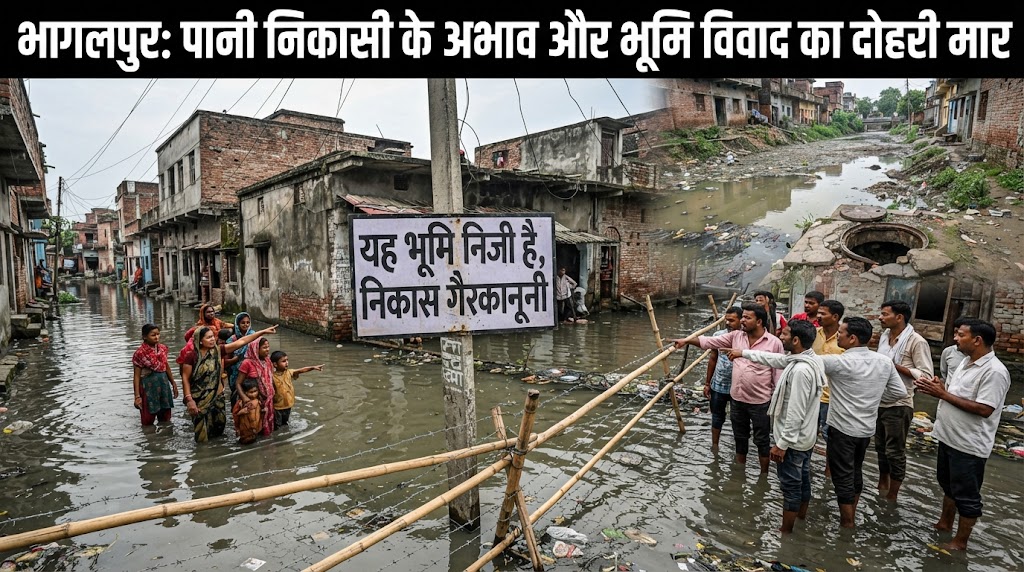
Bhagalpur (Special Correspondent): Amidst a million claims of development and modern Smart City projects, a bitter reality emerges from the rural and semi-urban areas of Bhagalpur that shatters administrative assertions. In several regions of the district, sluggish water drainage systems and recurring land disputes have completely derailed ordinary life. The reality is that due to these two major problems, residents in these areas are forced to live a thoroughly hellish and pathetic existence for four to five months every year. From light showers to the monsoon months, fields, farmlands, and streets turn into ponds, and whenever villagers attempt to carve out a drainage route on their own, mutual land disputes or local high-handedness stand in the way.
What Is the Core Problem and Why Is It Escalating?
The geographical and administrative layout of many villages connected to Bhagalpur's rural hinterland and blocks lacks any systematic drains or channels for water drainage:
Encroachment on Natural Waterways: The natural drains or slopes that once allowed water to drain away from fields and villages decades ago have fallen prey to rampant, illegal encroachments. People have constructed houses, boundary walls, or shops right over water flow paths, bringing drainage to a complete standstill.
The Knot of Land Disputes: Whenever local residents or the panchayat-level administration attempt to construct a new drain or clear water through traditional routes, the specter of a 'land dispute' rears its head. No raiyat (landholder) or landowner is willing to let water pass through their property, and the issue gets shelved indefinitely amid mutual grudges and legal loopholes.
Four to Five Months a Year: Life Spent Amid Waterlogging and Sludge
The most terrifying manifestation of these issues unfolds with the arrival of the monsoon season, persisting for four to five months annually:
Rainwater Accumulation and House Incursions: From June through October-November (spanning the monsoon and its aftermath), waterlogging persists. Filthy water stands two to three feet deep in streets and roads, frequently breaching the thresholds of residential homes.
Threat of Epidemics: The stench and decay rising from stagnant water over months breed severe waterborne and vector-borne ailments like malaria, dengue, diarrhea, and skin diseases, threatening to assume epidemic proportions. Venturing out of the house becomes an arduous ordeal for children and the elderly.
Blow to Agriculture and Livelihoods: With fields submerged under water, farmers are unable to sow or harvest subsequent crops on time. Transporting fodder for livestock also turns problematic, inflicting massive economic losses on the rural economy.
Schemes Entangled in Administrative Red Tape
When villagers take their plight to the block office and district headquarters seeking redress, they are met with little more than hollow assurances:
Apathy of Officials: Circle Officers (COs) and Block Development Officers (BDOs) frequently lament that unless land disputes are resolved through the courts or via mutual consensus, they cannot execute drain construction or establish drainage pathways.
Lack of Inter-Departmental Coordination: Owing to poor coordination among the circle office, police administration, and rural development department, the crisis remains unaddressed. In the absence of police force deployment or mere paper compliance, land disputes fail to find any permanent resolution.
Grief and Outrage Among the General Public
Villagers from the affected areas express that they cast votes every election, change representatives, and listen to grand promises, yet their fundamental problems are never addressed:
"We Are Forced to Live in Hell": Local women and youth point out that even sending children to school requires wading through contaminated water. Bicyclists and motorcyclists frequently slip and injure themselves in water-filled potholes.
Demand for Immediate Administrative Intervention: Villagers have warned the district administration that if a permanent drainage channel is not established soon and land disputes are not settled to clear the pathways, they will be compelled to launch large-scale agitations.
What Steps Should Be Taken Toward a Resolution?
Experts and local intellectuals believe that the administration must execute prompt and concrete measures to combat this grave crisis:
Survey of Government Land: Deploying revenue department teams to clear traditional village waterways (ahars, pains, and public pathways) of encroachments.
Master Drainage Plan: Constructing robust, pucca drainage systems under MGNREGA or other rural development schemes to facilitate smooth water runoff.
Strict Legal Action: Dealing sternly with elements obstructing natural water flows or artificially engineering disputes.
The compulsion to endure a hellish existence for four to five months due to inadequate drainage and land disputes in rural Bhagalpur casts a heavy shadow of doubt on administrative sensitivity. Until the administration steps out of paper-bound deliberations and implements rigorous on-ground action, the hardships faced by the residents of these regions will not abate. It is the need of the hour for the government and district administration to pay focused attention here, ensuring that our food providers and ordinary villagers can lead a dignified and secure life.