

No CIBIL Score Requirement for Loans Up to Rs 2 Lakh; More Families Could Benefit
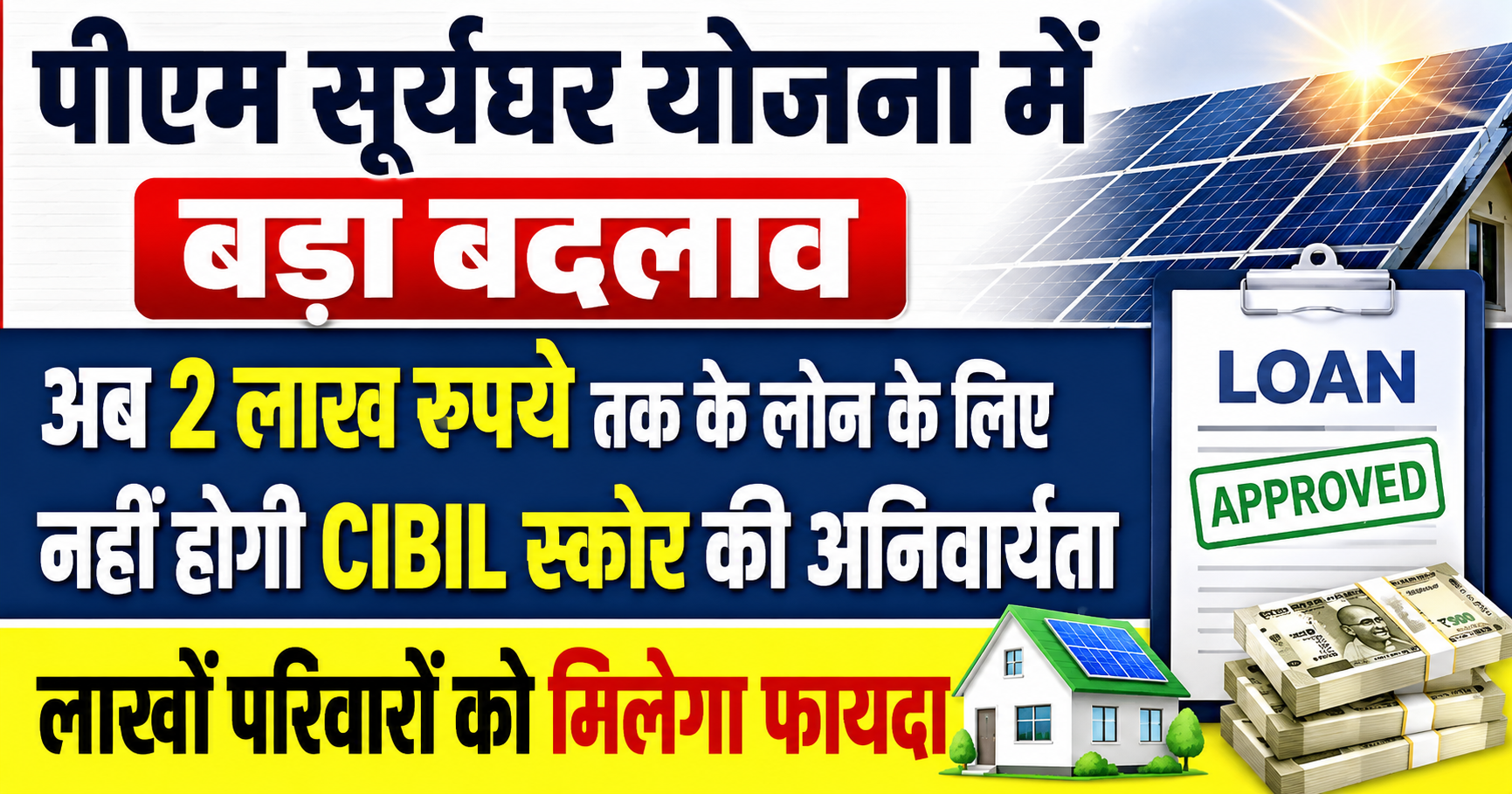
New Delhi/Patna: Families planning to install rooftop solar systems under the Pradhan Mantri Surya Ghar: Muft Bijli Yojana could soon get major relief. The process of obtaining bank loans for installing rooftop solar panels is being simplified. Under the proposed arrangement, the requirement of a minimum CIBIL score for loans of up to Rs 2 lakh may be removed. This could make it easier for families with little or no credit history to obtain loans for rooftop solar installations.
However, it is important to note that this facility is not entirely new. The State Bank of India (SBI) already offers PM Surya Ghar loans of up to Rs 2 lakh without requiring a minimum CIBIL score. Other banks may have different eligibility and credit-score requirements. Therefore, beneficiaries will need to wait for the official guidelines before assuming that the same conditions will apply uniformly across all banks.
Easier Access for People Without a CIBIL Score
A CIBIL score is an important factor considered by banks while processing loan applications. People who have never taken a loan or used formal credit facilities often have limited or no credit history. As a result, they can sometimes face difficulties while applying for loans.
The proposed relaxation under the PM Surya Ghar scheme could help address this issue. If the minimum CIBIL score requirement is removed more broadly for loans up to Rs 2 lakh, first-time borrowers may also find it easier to install rooftop solar systems with bank financing.
The move could particularly benefit middle-income and economically weaker households that may not have enough savings to pay the entire installation cost upfront.
Why Is a Rs 2 Lakh Loan Important?
The PM Surya Ghar scheme provides financial assistance through the banking system for households seeking to install rooftop solar systems. Loans of up to Rs 2 lakh can be particularly useful for families installing small and medium-sized solar systems.
Under the government's model financing framework, loans up to Rs 2 lakh can be provided without collateral. The repayment period is also relatively long, allowing beneficiaries to repay the amount through monthly instalments.
The objective is to ensure that the initial cost of installing a rooftop solar system does not become a major financial barrier for households.
Concessional Interest Rates Available
The Central government's financing framework for the PM Surya Ghar scheme includes concessional-rate, collateral-free loans through nationalised banks. Under the current framework, the interest rate has been linked to the repo rate plus 50 basis points, while the repayment period can extend up to 10 years.
Lower interest rates can reduce the monthly EMI burden on beneficiaries. Families may also use the savings generated from lower electricity bills to help repay the loan.
Once the loan has been fully repaid, the savings generated through solar power can provide households with an additional long-term financial benefit.
SBI Already Offers Loans Without a Minimum CIBIL Requirement
The existing SBI arrangement is important in understanding the proposed change. Under SBI's PM Surya Ghar loan product, loans of up to Rs 2 lakh do not require a minimum CIBIL score.
For higher loan amounts, however, different credit criteria may apply. SBI's existing scheme specifies a minimum CIBIL score of 650 for loans above Rs 2 lakh and up to Rs 6 lakh.
This means that a person without an established credit history may still be eligible for a solar loan of up to Rs 2 lakh, provided other eligibility requirements are satisfied.
At the same time, conditions are not necessarily identical across all banks. Some lenders may continue to apply their own credit-score requirements for solar loans. Beneficiaries should therefore check the latest eligibility criteria with the concerned bank before applying.
Scheme Aims to Expand Rooftop Solar Coverage
The PM Surya Ghar: Muft Bijli Yojana was launched with the objective of providing rooftop solar systems to one crore households across the country. The scheme has a total financial outlay of Rs 75,021 crore and is scheduled to be implemented through the financial year 2026-27.
According to government information, millions of households have already benefited from rooftop solar installations under the scheme. The expansion of affordable financing is expected to play an important role in increasing adoption.
The government's broader objective is to encourage households to generate clean electricity on their own rooftops while reducing their dependence on conventional electricity sources.
Bihar Could Also See Greater Adoption
Bihar is also promoting rooftop solar adoption under the PM Surya Ghar scheme. A large number of households in the state have already adopted rooftop solar systems.
If the process of obtaining solar loans becomes easier, the impact could be particularly visible in both urban and rural areas of Bihar. Families that cannot afford to pay the entire installation cost upfront could combine government subsidy with bank financing to install solar systems.
This could help accelerate the adoption of renewable energy across the state.
Government Subsidy Provides Additional Support
The PM Surya Ghar scheme also provides central financial assistance depending on the capacity of the rooftop solar system.
Under the current subsidy structure, households can receive central financial assistance of Rs 30,000 for a 1-kilowatt system, Rs 60,000 for a 2-kilowatt system and up to Rs 78,000 for systems of 3 kilowatts or more.
The combination of government subsidy and bank financing can significantly reduce the upfront financial burden on households.
It can also make rooftop solar more attractive for families looking for long-term ways to reduce their electricity expenses.
Removal of CIBIL Requirement Does Not Mean Automatic Loan Approval
The removal or relaxation of the minimum CIBIL requirement should not be interpreted as an automatic guarantee of a Rs 2 lakh loan.
Banks may continue to examine other aspects of an applicant's eligibility. These could include ownership or rights related to the property, an active electricity connection, technical feasibility for rooftop solar installation, required documentation and the applicant's ability to repay the loan.
Even where there is no minimum CIBIL requirement, applicants must satisfy the other conditions prescribed by the lending institution.
Different banks may also have different internal procedures and eligibility requirements.
Could Help Reduce Electricity Bills
The PM Surya Ghar scheme is not only aimed at installing solar panels. Its broader objective is to increase household-level renewable electricity generation and reduce dependence on conventional power sources.
When households generate electricity through rooftop solar systems, their dependence on grid electricity can decrease. This can potentially result in substantial savings on monthly electricity bills.
For families using bank financing, the savings on electricity bills can also help offset the monthly EMI burden.
Over time, once the loan has been repaid, the household can continue benefiting from lower electricity expenses while generating clean energy.
Official Guidelines Will Clarify the New Arrangement
The detailed guidelines regarding the proposed removal or relaxation of the minimum CIBIL requirement will determine exactly which banks, loan categories and applicants will be covered.
The guidelines are also expected to clarify what alternative criteria banks may use while assessing loan applications.
Until the formal rules are issued, beneficiaries should rely on official notifications and the latest information provided by their respective banks rather than assuming that every bank will immediately follow the same conditions.
Why the Change Matters for Ordinary Households
If the minimum CIBIL requirement for loans up to Rs 2 lakh is broadly removed, the move could particularly benefit people who have never borrowed from a bank before.
Such individuals may not have a sufficient credit history, making conventional loan applications more difficult. Easier financing could allow them to take advantage of government subsidies and install rooftop solar systems without making a large upfront payment.
The combination of a government subsidy, collateral-free financing and potentially relaxed credit requirements could make rooftop solar more accessible to a much larger section of society.
A Potential Boost for India's Solar Energy Expansion
The PM Surya Ghar scheme is part of the government's broader effort to expand renewable energy at the household level. Making financing easier could accelerate the adoption of rooftop solar across the country.
For states such as Bihar, where rooftop solar adoption is growing, easier access to bank loans could further increase participation in the scheme.
The potential relaxation of CIBIL requirements, therefore, could become an important step in making solar power more accessible to households that previously faced difficulties obtaining formal credit.
Overall, the PM Surya Ghar scheme's combination of government subsidy, affordable financing and simplified loan procedures could encourage more families to shift toward rooftop solar. However, beneficiaries should wait for the official guidelines and verify the latest eligibility conditions with their bank before applying.
The proposed change could ultimately help more households reduce their electricity bills, generate clean energy from their own rooftops and contribute to India's transition toward a more sustainable energy system.