

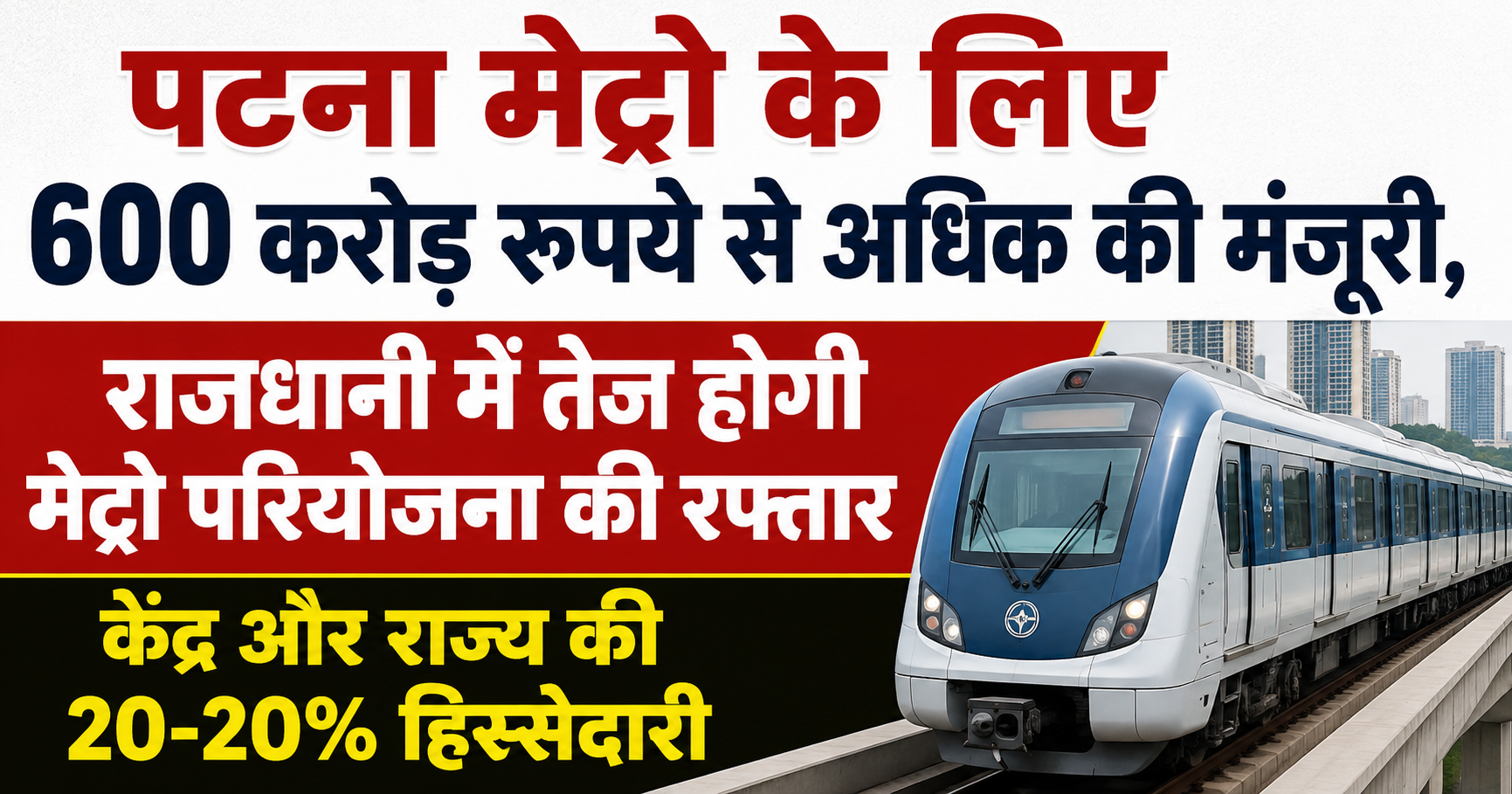
Over Rs 600 Crore Approved for Patna Metro, Project Set to Gain Momentum; Centre and State Governments Hold 20% Stake Each
Patna: The Samrat Choudhary government has approved more than Rs 600 crore for the Patna Metro Rail project, providing a major financial boost to the ambitious urban transport initiative in Bihar's capital. The approval is expected to help accelerate construction and other activities associated with the project.
The Patna Metro project is being implemented through the Patna Metro Rail Corporation Limited (PMRCL), which was established specifically to oversee the development and execution of the metro rail system in the city. The project has been structured with financial participation from both the Central and state governments, with each holding a 20% share.
The latest financial approval is being viewed as an important step toward ensuring that construction and related activities continue smoothly. Patna has been facing growing traffic congestion due to rapid urbanisation, increasing population and a steady rise in the number of private vehicles. The metro project is expected to provide residents with a faster, more reliable and modern public transport option.
Major Transformation Expected in Patna's Transport System
Patna has witnessed a significant increase in traffic pressure over the past several years. Major roads and junctions across the city frequently experience congestion, particularly during peak morning and evening hours. Areas such as Gandhi Maidan, Dak Bungalow Chowk, Bailey Road, Boring Road, Rajabazar and Kankarbagh regularly face heavy traffic.
Against this backdrop, the Patna Metro is being seen as a crucial component of the city's future transportation network. Once operational, the metro will be capable of carrying a large number of passengers at a time and is expected to reduce dependence on private vehicles and conventional road transport.
The project is not merely being viewed as a transportation initiative but also as an important part of Patna's long-term urban development. Improved connectivity between different parts of the city could make commuting easier for residents and support the expansion of commercial and economic activities.
PMRCL Responsible for Project Implementation
The Patna Metro Rail Corporation Limited has been entrusted with the responsibility of implementing the project. The corporation is playing a key role in construction management, financial planning, coordination with various agencies and other activities associated with the development of the metro network.
Large infrastructure projects require continuous coordination among the Central government, state government, financial institutions, contractors and technical agencies. Timely availability of funds is particularly important for maintaining the pace of construction.
The financial structure of the Patna Metro project includes a 20% contribution from the Central government and another 20% from the Bihar government. The remaining financial requirements are being addressed through other components of the project's funding structure.
What Will the Approval of More Than Rs 600 Crore Mean?
The approval of more than Rs 600 crore by the state government is expected to strengthen the financial position of the Patna Metro project. The funds can support various construction-related requirements and other essential activities needed to move the project forward.
Large-scale infrastructure projects require substantial and continuous expenditure on construction materials, machinery, labour, technical services and payments to various agencies. Timely financial support is therefore crucial to maintaining construction schedules.
The government's latest approval is also expected to contribute to economic activity in areas connected with the project. Construction projects generate both direct and indirect employment opportunities. Local suppliers, transport operators, construction material providers and service businesses can also benefit from increased activity.
Relief Expected from Traffic Congestion
Traffic congestion has remained one of Patna's major urban challenges. The number of vehicles on the city's roads has increased considerably, while the capacity of several major roads remains limited.
The metro will provide residents with an alternative mode of mass public transportation. If a significant number of commuters shift from private vehicles to the metro, the pressure on roads could decrease substantially.
The system is expected to be particularly beneficial for office workers, students, business owners and people who travel regularly across different parts of the city. A faster and more predictable mode of transport could also reduce commuting time.
Lower traffic volumes may also contribute to reduced fuel consumption and vehicle emissions, providing additional environmental benefits.
Economic Development Could Get a Boost
The impact of the Patna Metro is expected to extend beyond transportation. Improved connectivity can play an important role in supporting economic development across the capital.
Commercial activity around metro stations could increase as accessibility improves. Shops, offices, service centres and other businesses may benefit from higher pedestrian movement around stations.
Better transportation connectivity can also make it easier for employees to travel between residential and commercial areas. This could strengthen the overall economic ecosystem of the city.
As Bihar's administrative, educational and commercial hub, Patna has a growing need for modern infrastructure. The metro network could strengthen the city's position as a major urban centre in eastern India.
Environmental Benefits
Expansion of public transportation is also considered important from an environmental perspective. If commuters increasingly use metro services instead of cars and two-wheelers, the number of vehicles on the roads could decline.
This could help reduce fuel consumption, traffic-related emissions and air pollution. For a rapidly expanding city such as Patna, developing efficient mass transportation is increasingly important for ensuring sustainable urban growth.
The metro project could therefore contribute not only to better mobility but also to the development of a more environmentally sustainable transportation system.
Commuting Experience Could Change Significantly
Thousands of people travel across Patna every day for employment, education, business and other purposes. Road congestion often results in unpredictable travel times, especially during peak hours.
The metro is expected to offer passengers a faster and more time-efficient travel option. Daily commuters could particularly benefit from improved connectivity between important residential, commercial and institutional areas.
Once the metro becomes operational, it is likely to work alongside buses, auto-rickshaws and other modes of public transportation. Better integration between these transport systems could further improve mobility across the city.
Urban Infrastructure Remains a Government Priority
The approval of more than Rs 600 crore for the Patna Metro project highlights the government's focus on strengthening urban infrastructure. Bihar has been experiencing rapid urbanisation, and the demand for efficient public transportation is expected to increase further in the coming years.
The metro project is being developed with the future transportation requirements of Patna in mind. However, ensuring timely completion, maintaining construction quality and coordinating different agencies will remain important challenges.
The pace of implementation will be closely watched by residents, particularly those who depend on public transportation for their daily travel.
Metro Could Become a New Symbol of Patna's Development
The Patna Metro project represents a major step toward creating a modern transportation system in Bihar's capital. The approval of more than Rs 600 crore is expected to provide financial support to the project and help maintain the momentum of construction.
The project is being implemented through the Patna Metro Rail Corporation Limited, with the Central and Bihar governments each holding a 20% stake.
If the project progresses according to schedule and the metro network becomes fully operational, it could bring a significant transformation to Patna's transportation system.
The metro could help reduce traffic congestion, strengthen public transportation, lower pollution, improve connectivity, create employment opportunities and encourage economic activity. For these reasons, the Patna Metro is increasingly being regarded as one of the most important urban infrastructure projects shaping the future of Bihar's capital.