

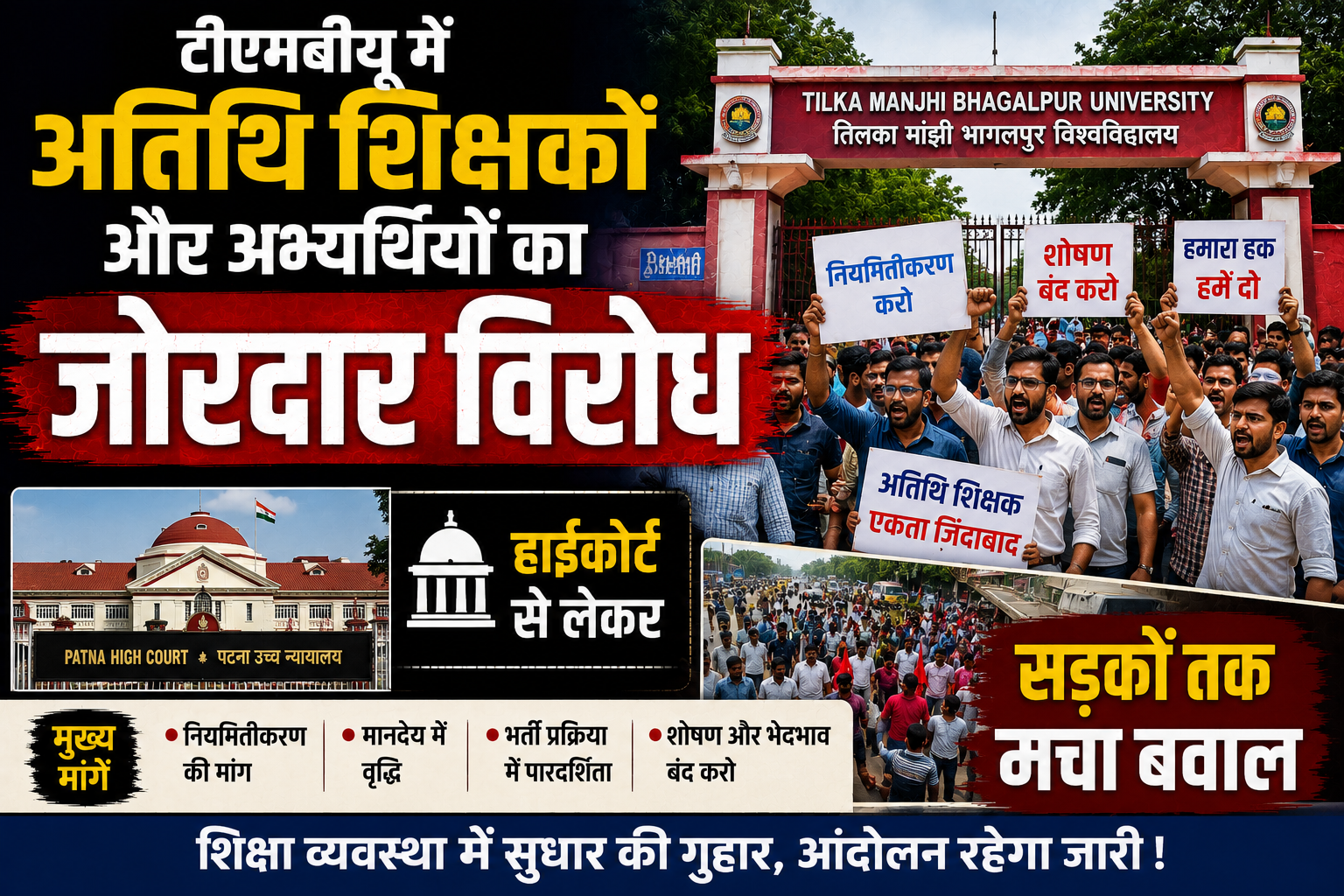
Politics and Academic Circles Heat Up Over New Teacher Recruitment Policy in Bihar Universities; Fierce Protests by Guest Teachers and Candidates at TMBU, Uproar from the Streets to the High Court
Bhagalpur, Senior Correspondent: The new policy introduced for the appointment and selection process of teachers in Bihar's universities has created a stir in the educational and political corridors of the state. Widespread dissatisfaction regarding this new policy is being witnessed particularly at Tilka Manjhi Bhagalpur University (TMBU) in Bhagalpur, along with other universities across the state. Sharp reactions are emerging among the university administration, guest teachers, and meritorious youths preparing for competitive exams. While the government claims that this new system will make the process transparent and time-bound, educational organizations and candidates have launched a front against it, labeling it completely contrary to the standards set by the University Grants Commission (UGC).
What Is the Core Dispute and the Key Points of the New Policy?
Recently, a new policy was introduced for the appointment of permanent and contract-based Assistant Professors in the universities and colleges of Bihar. Under this new system, new guidelines have been established for the selection of teachers in the state's new and old constituent colleges. However, as soon as the provisions of this policy were made public, working university teachers and hopeful youths seeking employment began fiercely protesting against it.
According to the protesting organizations and candidates, several provisions have been added to this new policy that are not only against the interests of older, experienced teachers but also fail to align with the norms of the UGC Regulations.
Major Objections and Demands of Guest Teachers and Candidates
Under the banner of the Guest Teachers Association, teachers staged a massive protest in front of the administrative building at the TMBU campus in Bhagalpur and expressed their outrage by burning copies of the new policy. Their primary objections were centered on the following points:
Allegations of Violating UGC Guidelines: The teachers argue that introducing separate rules for the appointment of permanent and regular Assistant Professors and sidelining the established UGC standards is completely unjust. Appointments should have been conducted in accordance with previously established policies (such as the 2020 provisions).
The Issue of Age Limit: Candidates have raised strong objections to the reduction of the maximum age limit for appointments in the new policy. They argue that due to the lack of regular recruitments over the past several years, thousands of qualified and experienced candidates are already on the verge of becoming overage. The maximum age limit used to be higher in previous recruitments, and they demand this be restored.
Ignoring Experience and Research Scores: There is deep disappointment among teachers as proper weightage is not being given to the teaching experience and research papers of guest teachers—who have been rendering their services for years—during the selection process for contract-based or new posts. Teachers who have been teaching on low honorariums for a long time assert that ignoring their experience is an injustice to them.
Preference to Matriculation and Intermediate Marks: Questions have also been raised regarding the higher priority given to early education marks (Matriculation and Intermediate) under academic records in the selection process, along with a lack of transparency at the UGC-NET/PhD level.
Matter Reaches the High Court, Preparations for a Legal Battle
The protest has not remained confined to the streets and universities; the matter has now reached the doorstep of the Patna High Court. Recently, a writ petition was filed in the High Court by candidates against the new guidelines and the appointment process for contract-based Assistant Professors in the state's newly established government degree colleges. The petitioners' lawyers state that roster rules are being ignored in advertisements and the selection process, violating government resolutions demanding strict adherence to UGC regulations.
Stance of the University Administration and Government
On the other hand, the government and administrative machinery believe that the objective of these new policies is to eliminate the lethargy in higher education and rapidly fill vacant posts. The government argues that adopting a transparent and modern selection process will ensure the availability of qualified faculty in universities, which will ultimately fulfill the educational interests of students. However, amidst growing protests and legal maneuvers, pressure is mounting on the education department and university officials to amend or reconsider this policy.
The dispute arising over the new teacher recruitment policy in universities across Bihar, including Bhagalpur, is evidence of how sensitive the process of reforming the policy framework of higher education truly is. While the government speaks of administrative tightening and rapid recruitment on one hand, teachers who have served for years and youths are anxious and agitated about their future on the other. If this deadlock is not resolved through dialogue in a timely manner, this movement could take a much broader form in the coming days, directly impacting the state's higher education system.