

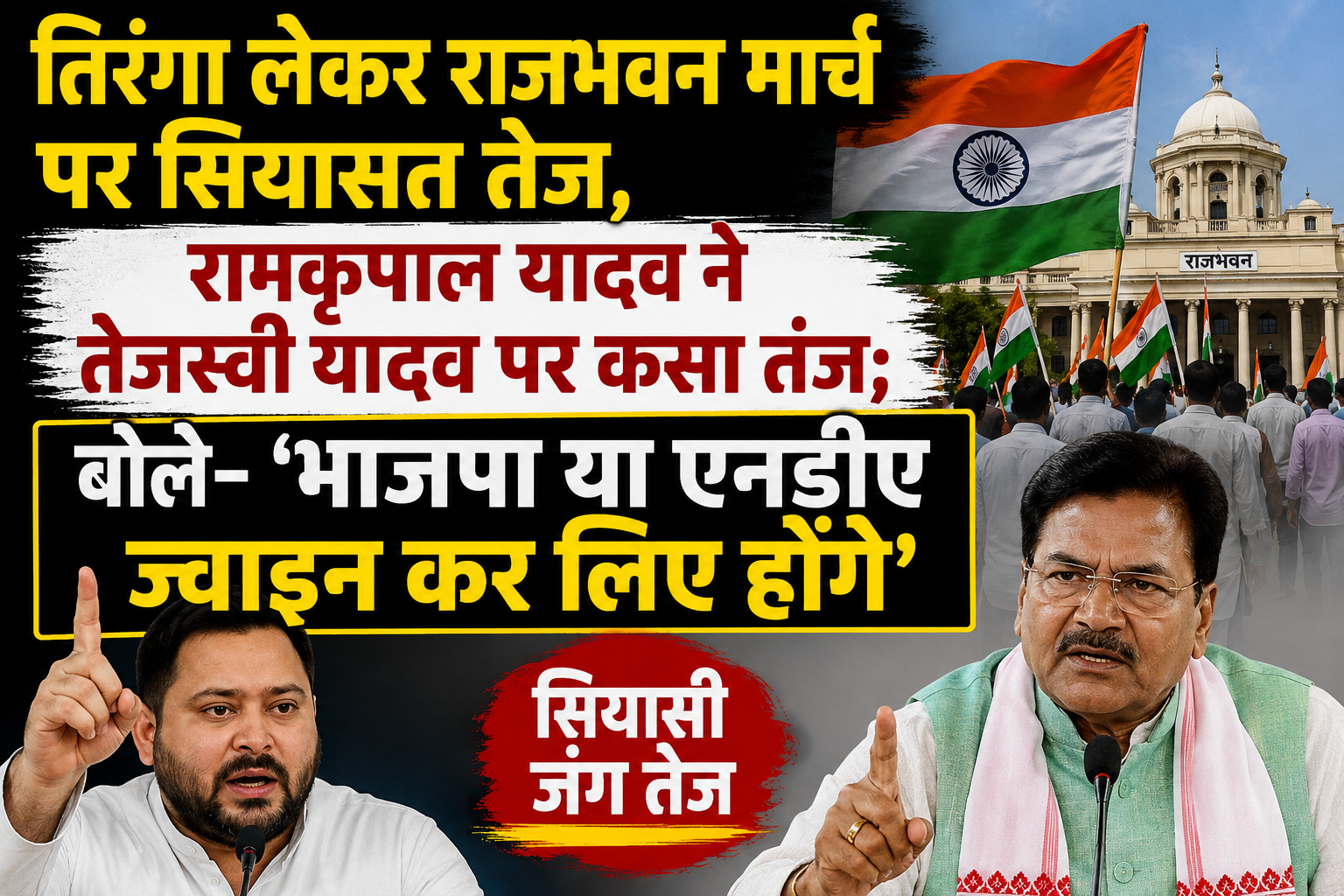
Politics Intensifies Over Tricolour March to Raj Bhavan, Ram Kripal Yadav Takes a Dig at Tejashwi Yadav
Patna: Political exchanges intensified in Bihar on Friday over Leader of the Opposition Tejashwi Yadav's proposed march to Raj Bhavan carrying the Tricolour. The ruling side targeted the RJD leader over the decision. Bihar government minister Ram Kripal Yadav took a sarcastic swipe at Tejashwi, suggesting that he may have joined the Bharatiya Janata Party (BJP) or the National Democratic Alliance (NDA).
Journalists asked Ram Kripal Yadav on Friday about Tejashwi Yadav planning to march to Raj Bhavan carrying the Tricolour instead of the RJD flag. Responding to the question, the minister said that a Tricolour march had already been taking place on their side. In a sarcastic remark, he said that Tejashwi might have joined the BJP or the NDA.
The proposed Tricolour march has triggered a fresh political debate in Bihar. While the ruling side has interpreted the move politically, the opposition is expected to present the march as an expression of its position on issues related to the country, democracy and constitutional values.
Political Exchange Over the Tricolour March
A march to Raj Bhavan is often considered an important political activity in Bihar. When the opposition marches to Raj Bhavan over an issue, it seeks to put forward its demands before the government and the Governor.
The use of the Tricolour in Tejashwi Yadav's proposed march has added another dimension to the political discussion. Political parties generally use their own flags and symbols during party programmes. Therefore, the decision by an RJD leader to carry the national flag during the march has become a subject of commentary among ruling-party leaders.
Ram Kripal Yadav used the opportunity to take a political dig at Tejashwi Yadav, saying that a Tricolour march was already being organised by their side.
Ram Kripal Yadav Targets Tejashwi
Responding to questions from journalists, Ram Kripal Yadav sarcastically suggested that Tejashwi Yadav might have joined the BJP or become part of the NDA.
His remarks are being viewed as a direct political attack on Tejashwi's proposed programme. The statement could further intensify the exchange of allegations and counter-allegations between the ruling alliance and the opposition in Bihar.
The minister's comments indicate that the ruling side is viewing the Tricolour march not merely as a symbolic or social programme but also as a political activity.
Opposition Strategy Under Focus
Tejashwi Yadav has consistently raised issues against the government and questioned its policies and decisions as Leader of the Opposition.
The Raj Bhavan march is also being seen as part of the opposition's broader political strategy. Through such a march, opposition leaders attempt to highlight their demands and register their protest.
Submitting their demands before the Governor is also part of the democratic political process.
The decision to include the Tricolour in the march gives the programme an additional symbolic dimension. Any political event involving the national flag naturally attracts wider public attention.
Political Message Behind the Tricolour
The national flag represents India's unity, sovereignty and national spirit. Political leaders and parties use the Tricolour on various occasions to express respect for the nation and commitment to national values.
Tejashwi Yadav's proposed march to Raj Bhavan carrying the Tricolour can also be viewed in this broader context of political and national symbolism. However, the ruling side has chosen to turn the move into a subject of political satire.
Ram Kripal Yadav's statement indicates that political parties in Bihar are prepared to comment sharply even on the symbols and programmes used by their opponents.
Political Competition Between RJD and NDA
The NDA and the Rashtriya Janata Dal have remained political rivals in Bihar for a considerable period. Both sides frequently criticise each other's policies and political strategies.
Against this backdrop, Ram Kripal Yadav's comments on Tejashwi Yadav's Tricolour march are also being viewed in the context of the wider political competition.
The minister did not make a serious claim that Tejashwi had actually joined the BJP or NDA. Instead, the reference was clearly used as a sarcastic political remark aimed at the RJD leader's decision to carry the Tricolour.
March Becomes a Topic of Political Discussion
News of the proposed Tricolour march to Raj Bhavan has generated discussion in political circles.
Supporters may view the programme as a democratic form of protest using a national symbol, while political opponents may interpret it as a strategy to send a particular political message.
In Bihar politics, symbols are often used to communicate political messages. Party flags, the Tricolour, copies of the Constitution and other symbols can become part of rallies and protest programmes.
In this case, the use of the Tricolour has added further political significance to the proposed march.
Democratic Form of Protest
Raj Bhavan marches are an important part of opposition politics. Political parties often use marches, demonstrations, sit-ins and memoranda to express disagreement with government policies or highlight specific issues.
Tejashwi Yadav's proposed march can similarly be viewed as part of the democratic political process.
Carrying the Tricolour may also be intended to communicate a message centred on national interest, democratic rights and constitutional values.
However, the ruling side's response reflects a different political interpretation of the programme.
Political Temperature May Rise
Political activity in Bihar remains intense, and statements targeting opponents' programmes can further heat up the political environment.
Tejashwi Yadav's decision to carry the Tricolour and Ram Kripal Yadav's subsequent comments could become subjects of further political debate.
The opposition may respond to the minister's remarks and explain the purpose behind the march, while ruling-party leaders could continue to criticise the programme.
Discussion Over Use of the National Flag
The use of the national flag during political programmes is naturally a sensitive matter. The Tricolour is not the symbol of any particular political party; it is the national flag of India.
Therefore, when political parties organise programmes using the Tricolour, the message can extend beyond the boundaries of party politics.
This is one reason why Tejashwi Yadav's proposed march has attracted considerable attention.
Public Attention on the March
Attention will now be focused on how Tejashwi Yadav's Raj Bhavan march is organised and how many people participate in it.
The issues raised during the march and the demands presented before the Governor will also be important.
At the same time, political circles will closely watch the ruling side's further response to the programme.
Tejashwi Yadav's proposed Tricolour march to Raj Bhavan has intensified political debate in Bihar. Government minister Ram Kripal Yadav took a sarcastic dig at the RJD leader, suggesting that he may have joined the BJP or the NDA. He also said that a Tricolour march had already been taking place on their side.
The minister's statement was clearly presented as a political taunt, but it could lead to another round of allegations and counter-allegations between the ruling alliance and the opposition.
Tejashwi Yadav's Tricolour march is being viewed as an opposition programme intended to raise an issue before the government and Raj Bhavan. The use of the national flag has given the march additional symbolic importance.
The political impact of the march and the message it sends to the people of Bihar will become clearer once the programme takes place. For now, the Tricolour march has already become a subject of political debate, with the ruling side and opposition taking different positions over its significance.