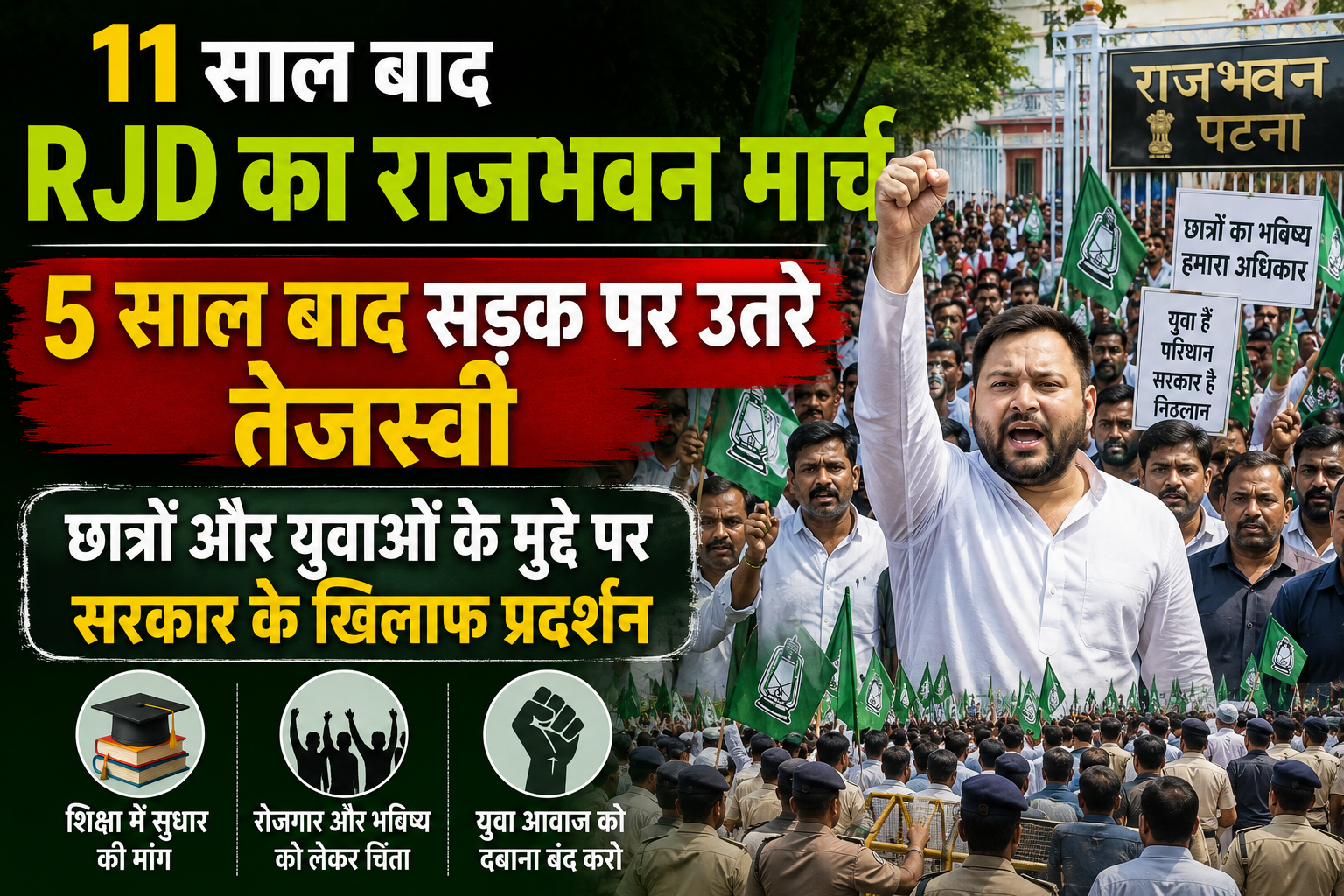
RJD's Raj Bhavan March After 11 Years, Tejashwi Yadav Takes to the Streets After 5 Years; Protest Focuses on Students and Youth
Patna: Bihar's political landscape witnessed a major protest by the Rashtriya Janata Dal (RJD) on Wednesday, August 19, 2026. Lalu Prasad Yadav's party organized a Raj Bhavan march after a gap of nearly 11 years. At the same time, Leader of the Opposition Tejashwi Yadav returned to the streets for a major foot march after around five years. The protest focused on issues concerning students and young people, including unemployment, alleged paper leaks, examination transparency and the alleged firing during a student protest in Siwan.
The march was an attempt by the RJD to put political pressure on the Bihar government. Led by Tejashwi Yadav, a large number of party workers took to the streets of Patna. Security arrangements were tightened across the capital ahead of the march, with barricades installed at several locations.
RJD Demonstrates Strength After 11 Years
The march was particularly significant for the RJD because the party returned to the streets for a major Raj Bhavan march after a long gap.
The party attempted to present the protest not merely as opposition to one incident but as a broader movement concerning students and young people. Tejashwi Yadav raised issues such as alleged paper leaks, unemployment, transparency in examinations, education and healthcare.
Politically, the march was also important for Tejashwi Yadav. In recent years, his electoral and political activities had received more attention than large-scale street protests. His decision to personally participate in a foot march alongside party workers therefore carried a distinct political message.
Tejashwi Returns to Street Protest After Five Years
One of the major features of the march was Tejashwi Yadav's return to the streets for a major foot protest after around five years.
Walking alongside party workers and supporters, he registered his opposition to the government and emphasized issues affecting students and young people.
Tejashwi said the struggle for students' rights, employment opportunities and transparency in examinations would continue.
The development comes at a time when student and youth-related issues have become politically sensitive in Bihar. Complaints and allegations surrounding paper leaks and irregularities in competitive examinations have repeatedly drawn the attention of student organizations and political parties.
Siwan Firing Incident Becomes a Major Issue
The alleged firing during a student protest in Siwan emerged as one of the immediate political triggers for the RJD's march.
The opposition described the incident as serious and demanded answers from the government.
Tejashwi Yadav questioned who allegedly ordered firing with an AK-47 at students and demanded clarity over the entire incident.
However, the exact circumstances surrounding the incident and responsibility for the alleged firing should ultimately be established through an official investigation.
March Began From JP Golambar
The RJD's programme was scheduled to begin from JP Golambar in Patna. Tejashwi Yadav had appealed to party leaders, legislators, MPs and workers to participate in large numbers.
The march proceeded with party workers raising slogans against the government. Many participants carried party flags and posters highlighting various student and youth-related issues.
The large gathering affected traffic movement along several major roads in the capital. The administration had already made preparations for security and traffic management in anticipation of the protest.
Police Used Barricades to Control the March
Police had installed barricades at several points along the route. Security personnel were deployed to prevent protesters from moving beyond designated areas.
Tensions reportedly developed between the protesters and police during the march. Reports said that some barricades were breached, following which police used water cannons to control the crowd.
The use of water cannons further intensified the political confrontation. Tejashwi Yadav criticized the police action and said that the movement would continue.
Tejashwi Yadav Detained
During the march, police detained Tejashwi Yadav along with other protesters.
The march was reportedly stopped near the Income Tax area, following which Tejashwi was taken into custody.
Even after being detained, Tejashwi maintained that his movement would continue. He said he would keep raising issues related to students' rights, unemployment, preventing paper leaks and ensuring transparency in examinations.
The detention further increased the political significance of the protest.
Focus on Student and Youth Issues
Tejashwi Yadav did not limit his speech to the Siwan incident. He also raised several broader issues affecting students and young people.
These included unemployment, alleged paper leaks, transparent examination procedures, education and healthcare.
He accused the government of failing to take the problems faced by young people seriously.
The RJD's strategy appears to be to connect the Siwan incident with a broader student and youth movement. This could provide the party with an opportunity to politically engage a larger section of young voters.
Tejashwi Attacks the Government
During the march, Tejashwi Yadav strongly criticized the government and said that it would have to answer questions concerning students.
Following the police action, he reiterated that the movement would continue.
He also criticized the use of water cannons and maintained that such measures would not stop the opposition from raising student and youth-related concerns.
His position indicates that the RJD could place student and youth issues at the center of its political campaign in the coming days.
NDA Targets the March
While the RJD described the march as a fight for the rights of students and young people, leaders of the ruling alliance viewed it differently.
NDA leaders criticized Tejashwi Yadav's march and described it as a political exercise.
This is likely to intensify the political exchange between the ruling alliance and the opposition in Bihar.
While the RJD is presenting the march as a movement over student issues, the NDA is attempting to portray it as a political demonstration by the opposition.
Impact on Opposition Politics
The RJD's march has also raised questions about the broader strategy of the opposition alliance in Bihar.
The opposition parties face the challenge of developing a coordinated strategy against the government. If the RJD continues to organize large independent movements around student and youth issues, it could also be viewed as an effort to strengthen the party's independent political identity.
For the opposition, maintaining unity while simultaneously expanding individual party support remains an important political challenge.
Possible Political Comeback for Tejashwi?
Tejashwi Yadav's return to the streets after several years is being viewed by some observers as an attempt to increase his political visibility and strengthen his image as an active opposition leader.
Bihar has a large young population, and employment and examination-related issues are particularly important among young voters.
By leading a street movement around these issues, Tejashwi may be attempting to strengthen his connection with students and young people.
Whether this strategy produces long-term political benefits will depend on how consistently the RJD follows up on these issues.
Law and Order Also Under Debate
The alleged firing incident in Siwan has also intensified the political debate over law and order.
The opposition has alleged that excessive force was used against students during the protest.
The administration, meanwhile, deployed police personnel and installed barricades to maintain security and control the crowd during the Patna march.
The use of water cannons and the detention of protesters have now become additional points of political debate.
Challenges Ahead for the RJD
The march has demonstrated the RJD's organizational strength and political activity, but the party's next challenge will be to sustain the movement.
A single-day protest is unlikely to create lasting political support among students and young voters on its own.
The party will also need to clearly explain what concrete measures it wants the government to take regarding paper leaks, unemployment, education and examination systems.
If the RJD continues its campaign around these issues, the movement could develop into a broader political campaign. If it remains limited to an immediate political reaction, its long-term impact could be smaller.
August 19, 2026, proved to be an important day for the RJD and Tejashwi Yadav in Bihar politics. The party's Raj Bhavan march after nearly 11 years and Tejashwi's return to a major foot protest after around five years sent a strong message of opposition activism.
The alleged AK-47 firing during a student protest in Siwan was one of the immediate reasons for the march, but Tejashwi also connected it with broader issues such as unemployment, alleged paper leaks, examination transparency, education and healthcare.
The police barricades, use of water cannons and detention of Tejashwi Yadav and other protesters further intensified the political atmosphere.
The coming days will reveal how much impact the protest has on Bihar's politics and whether the RJD can transform student and youth-related concerns into a sustained political campaign.
For now, Tejashwi Yadav's decision to return to the streets sends a clear political message: issues related to students, young people, employment and examination transparency are likely to remain central to the RJD's political campaign in Bihar.