

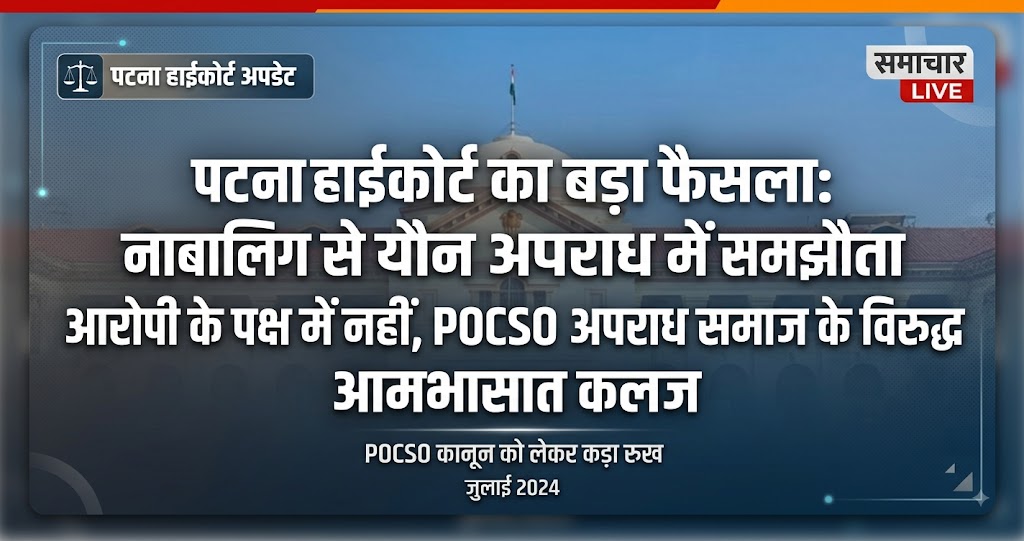
Settlement Cannot Erase Legal Consequences in Sexual Offence Against Minor, POCSO Crime Is Against Society
Patna: The Patna High Court has made it clear that a subsequent settlement between the parties in a sexual offence case involving a minor cannot eliminate the legal implications of the alleged offence or automatically benefit the accused. The court observed that an offence under the Protection of Children from Sexual Offences (POCSO) Act cannot be treated merely as a private dispute between individuals.
The court emphasized that offences covered under the POCSO Act are considered offences against society and their impact extends beyond the victim and the accused. Such serious and non-compoundable offences cannot be diluted merely because the parties have reached an agreement later.
The observation was made by Justice Purnendu Singh while hearing the anticipatory bail petition filed by Mohammad Sartaj Alam, an accused in Araria Women Police Station Case No. 47/2025. The High Court rejected his plea for anticipatory bail.
POCSO Offence Cannot Be Treated as a Private Dispute
During the hearing, the fact that the parties had subsequently reached a settlement was placed before the court. The accused sought relief on the basis of the settlement.
However, the High Court did not accept the argument that such an agreement could reduce the legal seriousness of the alleged offence.
The court observed that a sexual offence against a minor is fundamentally different from an ordinary private dispute. The POCSO Act has been specifically enacted to protect children from sexual abuse and exploitation.
Therefore, treating such an offence as a matter that can simply be resolved through a private agreement would undermine the purpose of the special legislation.
Settlement Does Not Automatically End Criminal Proceedings
The court made it clear that even if the accused and the complainant or their families reach an agreement after the alleged incident, the settlement does not automatically erase the legal nature of the offence.
In serious non-compoundable offences, criminal proceedings cannot be brought to an end merely because the parties have agreed to settle the dispute.
Courts must consider the nature of the offence, the applicable legal provisions and the material available on record before deciding whether any relief can be granted.
Anticipatory Bail Petition Rejected
The case relates to Araria Women Police Station Case No. 47/2025. The accused, Mohammad Sartaj Alam, had approached the Patna High Court seeking anticipatory bail.
Arguments were presented on behalf of the accused seeking protection from arrest. The subsequent settlement between the parties was also cited as an important ground for relief.
However, considering the nature of the allegations and the provisions of the POCSO Act, the High Court refused to grant anticipatory bail.
Justice Purnendu Singh dismissed the petition and made it clear that an offence of this nature cannot be diluted simply because the parties have reached a settlement.
Purpose of the POCSO Act
The POCSO Act is a special law enacted to protect children from sexual offences. It contains provisions dealing with sexual assault, sexual harassment and other forms of sexual abuse involving minors.
The legislation takes into account the vulnerability of children and provides special safeguards during the legal process.
The High Court's observation reinforces the principle that offences against children must be dealt with seriously and cannot be reduced to ordinary disputes between individuals.
Impact Extends Beyond the Victim and Accused
One of the key observations of the court was that a POCSO offence has consequences beyond the individuals directly involved.
Sexual offences against children affect the broader interests of society, including child safety, protection of children's rights and public confidence in the legal system.
If serious cases involving minors could simply be closed on the basis of private settlements, it could weaken the protective purpose of the special legislation.
Question of Legal Presumption
The court also considered the question of whether a subsequent settlement could affect the legal presumption applicable in favour of the accused under the POCSO framework.
The High Court made it clear that a settlement cannot be used to neutralize the effect of statutory provisions applicable to an alleged POCSO offence.
The ruling emphasizes that in serious criminal cases, judicial proceedings cannot be determined solely by private consent between the parties.
POCSO and Protection of Minors
The central objective of the POCSO Act is to protect children from sexual exploitation and abuse.
Minors may not always be in a position to fully understand or protect their legal rights, which is why the law provides additional safeguards for them.
The court's approach sends a clear message that sexual offences against minors will not be treated in the same manner as ordinary personal disputes.
Circumstances Behind a Settlement Can Also Matter
In cases involving minors, the circumstances in which a settlement is reached may also be relevant.
Judicial proceedings may need to consider whether a settlement was entered into voluntarily or whether the victim or family members were subjected to pressure.
While the facts and circumstances differ from case to case, a settlement by itself cannot automatically become a ground for relief in a serious POCSO case.
High Court's Approach to Anticipatory Bail
Anticipatory bail provides protection from arrest in appropriate circumstances. However, courts consider the seriousness and nature of allegations when dealing with such applications.
In the present case, the High Court considered the alleged POCSO offence sufficiently serious to refuse anticipatory bail to the accused.
The decision therefore indicates that a settlement between the parties does not automatically create a right to anticipatory bail in cases involving serious offences against minors.
Investigation and Trial Remain Separate
The rejection of an anticipatory bail petition does not amount to a final determination of whether the accused is guilty or innocent.
The investigation and subsequent judicial proceedings will continue according to law. Evidence will be examined during the appropriate stages of the case, and the final determination of guilt or innocence will be made by the competent court based on the evidence and applicable law.
The High Court's present order is primarily concerned with the anticipatory bail application and the legal effect of the settlement.
Importance of Judicial Sensitivity in POCSO Cases
Courts dealing with POCSO cases have the dual responsibility of protecting children while also ensuring a fair judicial process.
Protecting the identity and dignity of the minor, conducting proceedings sensitively and following the statutory safeguards are important aspects of such cases.
The Patna High Court's observation reflects this broader judicial approach toward offences involving children.
Message for Society
The ruling also sends an important message to society that sexual offences against minors cannot be treated as ordinary disputes that can simply be settled privately.
Families and communities have a responsibility to prioritize the safety and well-being of children. Where allegations of sexual abuse arise, appropriate legal mechanisms should be followed rather than relying solely on private settlements.
The purpose of the law is not only to ensure accountability but also to create a safer environment for children.
The Patna High Court has made an important observation in Araria Women Police Station Case No. 47/2025, stating that a subsequent settlement in a sexual offence case involving a minor cannot eliminate the legal implications of the alleged offence or automatically benefit the accused.
The court emphasized that an offence under the POCSO Act is not merely a private dispute but an offence affecting society. On this basis, Justice Purnendu Singh rejected the anticipatory bail petition filed by accused Mohammad Sartaj Alam.
The ruling highlights the seriousness with which courts view offences against minors and makes clear that serious, non-compoundable offences cannot simply be diluted on the basis of a private settlement.
At the same time, rejection of anticipatory bail should not be interpreted as a final finding of guilt. The investigation and subsequent judicial proceedings will determine the case on the basis of evidence and applicable law.