

Smart City’s Smart Policing and Traffic Management Face Questions
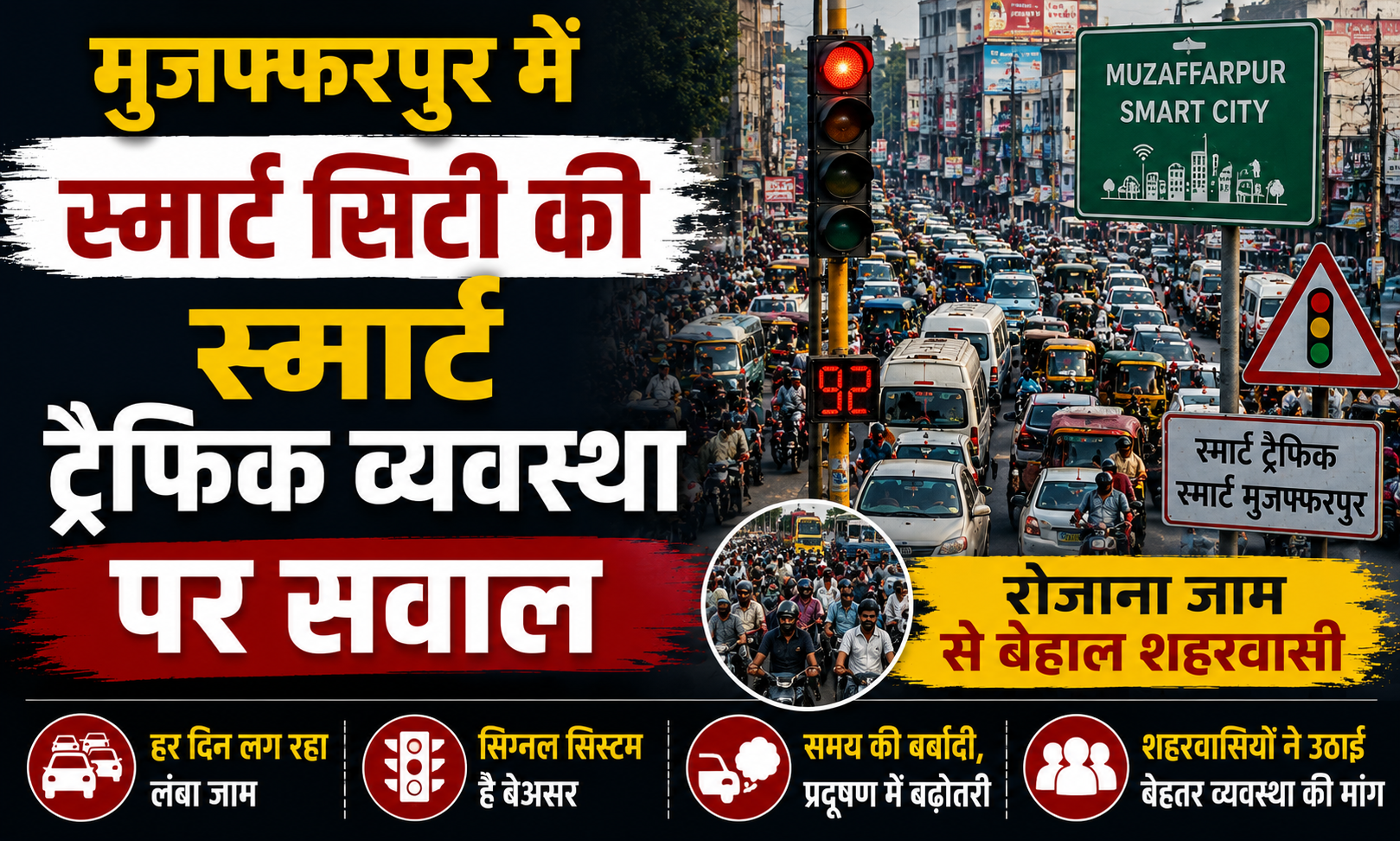
Muzaffarpur: The traffic management system in Muzaffarpur, which is being developed as a Smart City, continues to face serious challenges. Daily traffic congestion has become a major problem for residents, commuters and business owners. On Wednesday too, several major areas of the city witnessed heavy traffic jams, causing considerable inconvenience to thousands of people.
Traffic remained severely affected at Harisabha Chowk, Devi Mandir Road, Amgola Overbridge, Aghoria Bazar, Kalambagh Road, Station Road, Motijheel and several other locations. Long queues of vehicles were seen on important roads, with commuters forced to spend much more time than usual travelling even short distances.
The situation started worsening during the morning hours as the number of office workers, school and college students, shoppers and other commuters increased. As traffic pressure mounted, vehicles began moving at a very slow pace. By afternoon, several roads were heavily congested.
Major Roads Turned Into Traffic Bottlenecks
Harisabha Chowk and the surrounding areas witnessed significant congestion. Once traffic slowed down on the main road, many motorists attempted to take alternative routes. This resulted in additional pressure on smaller roads and lanes.
The situation around Devi Mandir Road was also difficult. The increasing number of vehicles, combined with limited road space, resulted in slow-moving traffic. Pedestrians also faced difficulties crossing the roads because of the continuous movement of vehicles.
Amgola Overbridge was another major congestion point. Traffic pressure on the bridge and connecting roads increased considerably, resulting in long queues. Many motorists remained stuck for extended periods.
Aghoria Bazar and Kalambagh Road also experienced severe congestion. These areas already have considerable pedestrian and commercial activity. The movement of private vehicles, auto-rickshaws, e-rickshaws and delivery vehicles further complicated the situation.
Station Road Also Remained Congested
Station Road witnessed heavy traffic because of the large number of passengers travelling to and from the railway station. Vehicles heading towards the station and those leaving the area created additional pressure on the road.
For passengers with trains to catch, the traffic jam became a serious concern. Many commuters had to leave their homes much earlier than usual to ensure that they reached the railway station on time.
Motijheel, one of the city's major commercial areas, also witnessed traffic congestion. The movement of shoppers, pedestrians, e-rickshaws, auto-rickshaws, private cars and commercial vehicles often leaves limited space for smooth traffic movement.
Smart City Development and Traffic Challenges
Muzaffarpur is being developed under the Smart City initiative, with several projects aimed at improving urban infrastructure and public services. However, the recurring traffic jams indicate that infrastructure development alone may not be enough to solve the city's transportation problems.
With the city's population and number of vehicles increasing, an efficient traffic management system is becoming increasingly important. Better parking facilities, strict enforcement of traffic rules, removal of encroachments and effective deployment of traffic personnel are necessary to improve the situation.
Residents say traffic congestion is no longer an occasional problem. Different parts of the city face traffic jams almost every day. In some cases, congestion becomes so severe that even emergency vehicles can face difficulties getting through.
Illegal and Unplanned Parking Adds to the Problem
Parking along busy roads is another major reason behind congestion. Cars, motorcycles and other vehicles are often parked on roadsides for long periods, reducing the available road space.
Commercial vehicles stopping to load or unload goods can further obstruct traffic, particularly in busy market areas. When road space is already limited, even a small increase in traffic volume can quickly result in a major jam.
Experts believe that improving organized parking facilities and taking regular action against vehicles parked in no-parking zones could significantly reduce congestion.
Need for Better Management of E-Rickshaws and Autos
E-rickshaws and auto-rickshaws play an important role in Muzaffarpur's public transportation system. However, the increasing number of such vehicles has also created additional challenges for traffic management.
At several busy locations, e-rickshaws and autos stop to pick up or drop off passengers. When they stop near intersections or in the middle of busy roads, traffic flow is disrupted.
Designated stopping points and strict enforcement against vehicles stopping at unauthorized locations could help improve traffic movement.
Questions Over Traffic Policing
The continuing traffic congestion has also raised questions about the effectiveness of smart policing in the city. Simply deploying traffic police personnel is not enough. Authorities need to identify congestion-prone locations and position traffic personnel there in advance, particularly during peak hours.
Areas such as Harisabha Chowk, Amgola, Aghoria Bazar, Station Road and Motijheel could benefit from dedicated traffic plans based on traffic volume at different times of the day.
Traffic signals, one-way systems and diversions should also be implemented according to actual traffic conditions.
Citizens Also Have a Role
While the administration has an important responsibility, citizens must also follow traffic rules. Driving on the wrong side of the road, stopping vehicles in the middle of intersections, parking in restricted areas and ignoring traffic signals can all contribute to congestion.
Drivers should maintain discipline at intersections, avoid illegal parking and follow designated lanes. Responsible driving can significantly improve traffic flow.
Technology Can Improve Traffic Management
A genuine smart traffic system can use technology to monitor and control traffic more efficiently. CCTV cameras, real-time traffic monitoring, coordinated traffic signals and digital surveillance can help authorities identify congestion quickly and respond accordingly.
A technology-based system could also help officials determine which roads experience the greatest traffic pressure during different hours. This would allow traffic personnel to be deployed more effectively.
As Muzaffarpur continues to grow, the number of vehicles is also expected to increase. Therefore, authorities need a long-term traffic management strategy rather than temporary measures introduced only after congestion occurs.
Need for Coordination Among Departments
The traffic problem cannot be solved by a single department. The municipal authorities, traffic police, district administration, transport department and citizens all need to work together.
Regular monitoring, scientific traffic planning, better parking facilities, removal of encroachments and technology-based surveillance can collectively improve the city's traffic system.
Wednesday's widespread traffic congestion once again highlighted the gap between the concept of a Smart City and the everyday experience of residents. Modern infrastructure and technology are important, but a city can truly be called smart only when its residents can travel safely and smoothly.
Until a permanent solution is found for traffic congestion on Muzaffarpur's major roads, questions will continue to be raised over the effectiveness of the city's smart policing and smart traffic management system.