


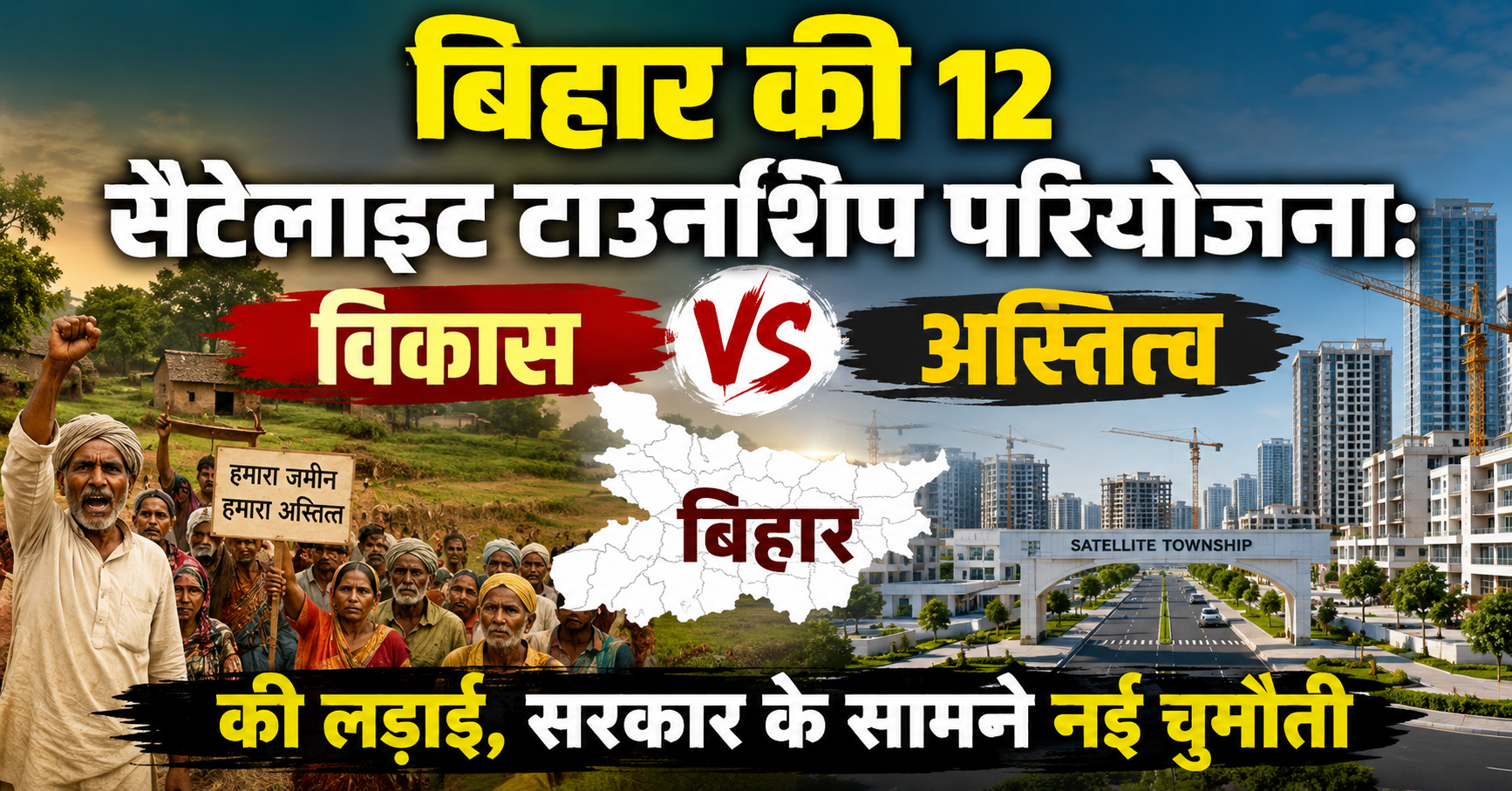
The 12 Satellite Township Project in Bihar: A Struggle Between Development and Existence; New Challenges for the Government
A new conflict has emerged in Bihar between the state’s dreams of urbanization and its agrarian structure. The state government’s ambitious plan to establish 12 satellite townships across various parts of Bihar is currently facing a crisis. Farmers have united in opposition against the acquisition of fertile land for this project, increasing the pressure on the government.
Nature and Objective of the Project
To reduce the demographic pressure on major cities like Patna and promote planned development, the state government decided to develop satellite townships on a large scale. The objective of these 12 townships is to create new industrial and residential hubs. The government argues that this will not only improve infrastructure but also create new employment opportunities.
Farmer Organizations' Outrage and Reasons for Protest
Since the announcement of the project, there has been widespread dissatisfaction among farmer organizations in the state. The main point of contention is the "Land Acquisition Policy." Farmer organizations believe that the land being acquired for this project is primarily multi-crop, fertile agricultural land.
The farmers' key objections are:
Livelihood Crisis: Most farmers depend on their ancestral farmland. The loss of fertile land would eliminate their only means of livelihood.
Lack of Transparency in Compensation: Farmers allege that the compensation proposed by the government does not match market rates. Furthermore, the lack of a clear policy for displacement and rehabilitation is a major issue.
Model of Development: Farmer organizations argue that the destruction of agricultural land in the name of industrial development could be fatal to the state's food security and economy.
The Call of the Samyukt Kisan Morcha (SKM)
The Samyukt Kisan Morcha (SKM) has become the focal point of the farmers' movement in the state. The front has issued a clear warning to the government that if the land acquisition process continues without the consent of the farmers, they will launch a decisive agitation.
As the next phase of the protest, the Morcha has announced a state-wide demonstration on July 22. On this day, farmers from across the state will take to the streets to pressure the government to meet their demands. The leaders of the Morcha state that:
The land acquisition process must be stopped immediately until the consent of the Gram Sabhas is obtained.
A respectful rehabilitation package must be announced for the farmers.
Barren or less fertile land should be selected for industrial corridors.
Challenges Before the Government
For the Samrat government, this situation is like a double-edged sword. On one hand, there is pressure to accelerate development work in the state, while on the other, this farmers' movement has once again highlighted the complexities of the 'Land Acquisition Act.'
Challenges for the government include:
Administrative Deadlock: If the protests continue, projects will not be completed on time, leading to cost overruns.
Political Impact: Farmers are the most significant voting block for any government. If this movement takes on a political tone, it could result in electoral losses for the government.
Image of Governance: The government must prove that their development model is 'inclusive' rather than 'displace-oriented.'
The Path Forward: The Need for Dialogue
The only solution to this deadlock lies in transparent dialogue. Experts suggest that the government should take the following steps:
Meetings with Gram Sabhas: Government officials should hold meetings with Gram Sabhas in all affected areas to understand the farmers' concerns.
Alternative Model of Land Acquisition: Can farmers be made partners in the project through 'Land Pooling'? If farmers receive shares or flats in the developed township in exchange for their land, the opposition might decrease.
Formation of an Expert Committee: An independent committee should be formed to assess the quality and necessity of the land to be acquired, ensuring that fertile land is not used unnecessarily.
The plan for satellite townships in Bihar is an attempt to lay the foundation for a modern Bihar, but its success will depend on whether the government takes the farmers along or leaves them behind. The demonstration on July 22 will determine whether the path ahead will be one of conflict or compromise. The pace of development must be fast, but it is the government's responsibility to ensure that this development does not come at the cost of anyone's home and livelihood.
This report is based on the current situation in the state and the objections raised by farmer organizations. The future of this project will become clear only after the talks between the government and the farmer organizations in the coming days.