

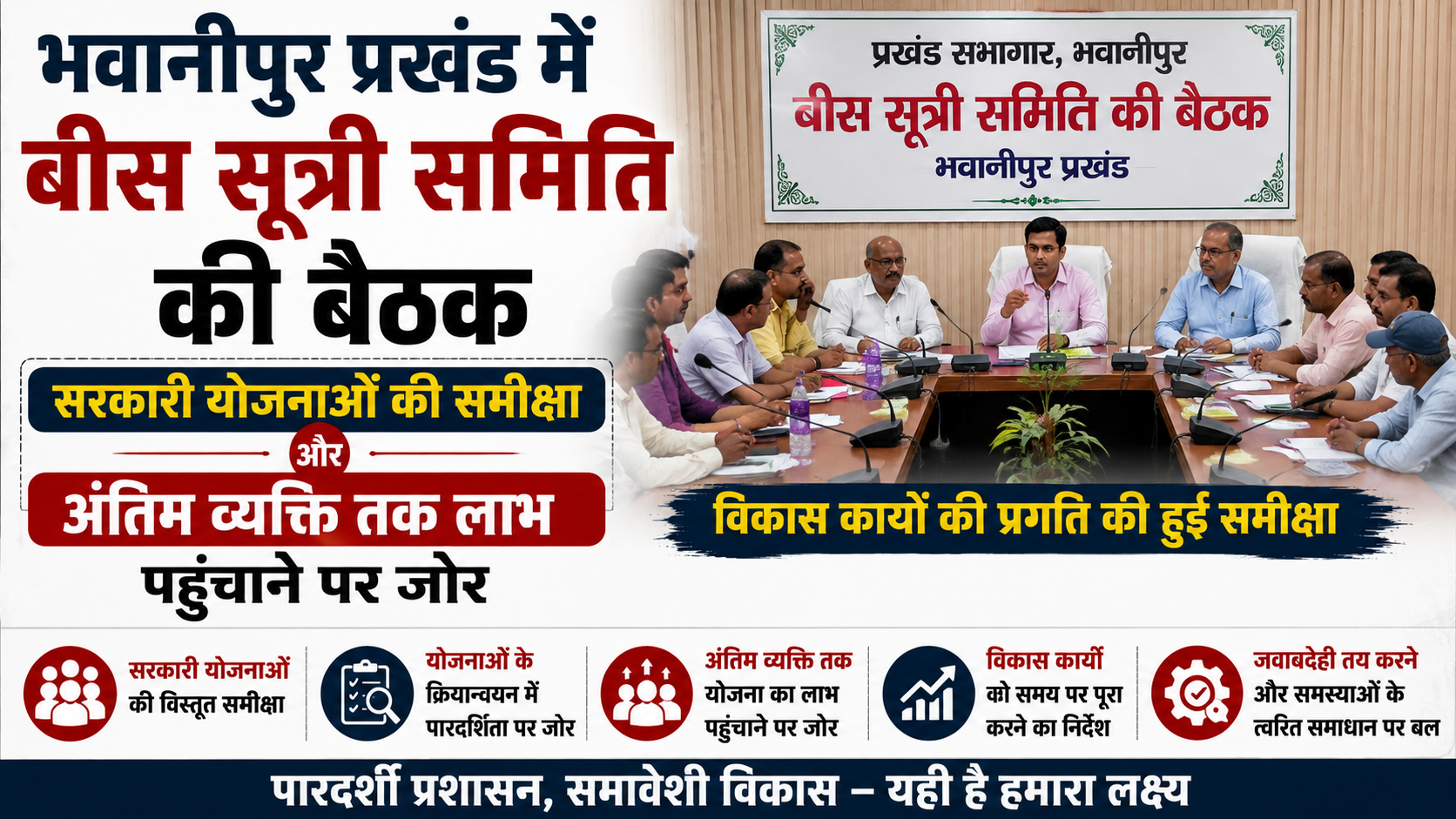
Twenty-Point Committee Meeting Held in Bhawanipur Block, Focus on Government Schemes and Reaching the Last Person
Purnia: A meeting of the Twenty-Point Programme Implementation Committee was held in Bhawanipur block, where various government schemes and development programmes being implemented in the area were discussed in detail. Committee members reviewed the progress of different schemes, raised local issues and emphasized taking necessary steps to resolve problems.
The members stressed that the real objective of government schemes can only be achieved when their benefits reach the last person in society. Many families in rural areas remain deprived of government benefits due to lack of information, documentation issues or other local difficulties. Identifying such beneficiaries and connecting them with government schemes was highlighted as an important priority.
The meeting also emphasized better coordination between officials from different departments and committee members so that unnecessary delays in implementing government programmes can be avoided. The committee stressed the need for regular reviews to monitor the progress of various schemes.
Review of Government Schemes
The main objective of the meeting was to review government schemes being implemented in Bhawanipur block. Discussions covered programmes related to rural development, housing, roads, electricity, drinking water, education, healthcare, agriculture, food supply and social security.
Committee members sought information from officials about the current status of various schemes. They discussed which programmes were reaching beneficiaries and which schemes were facing implementation-related difficulties.
The members emphasized that reviewing schemes should not remain limited to paperwork and official reports. It is also necessary to verify at the ground level whether the intended beneficiaries are actually receiving the benefits.
Focus on Reaching the Last Person
A major focus of the meeting was ensuring that government schemes reach the most disadvantaged and needy people.
Members said the purpose of development programmes is not simply to record achievements in official statistics but to bring meaningful improvements to people's lives.
Many residents in rural areas may not know about the schemes available to them. Others may face difficulties because of missing documents or complicated application procedures. The committee emphasized identifying such cases and helping eligible people overcome these difficulties.
The members also stressed the need for greater awareness at the panchayat level. People should be informed about available government schemes, application procedures and the documents required to receive benefits.
Coordination Needed to Resolve Problems
Local issues related to different government departments were also discussed during the meeting. Members asked officials to listen to public complaints seriously and resolve them within a reasonable timeframe.
In some cases, beneficiaries have to visit several offices or departments to receive benefits under a particular scheme. Better coordination among government departments can reduce such difficulties.
The committee asked officials to resolve problems at the local level wherever possible. If a scheme is facing technical or administrative obstacles, the issue should be communicated to senior authorities so that appropriate action can be taken quickly.
Monitoring Rural Development Schemes
Several rural development schemes are being implemented in Bhawanipur block. The meeting emphasized monitoring projects related to basic infrastructure in rural areas.
Progress on roads, drains, housing, water supply and other civic infrastructure was highlighted as an important area for regular review.
Committee members stressed that there should be no compromise on the quality of development work. Construction should follow prescribed standards, and completed projects should also be reviewed for quality and usefulness.
If complaints regarding irregularities or poor construction quality are received, they should be investigated and appropriate action should be taken.
Education and Healthcare Also Discussed
Education and healthcare were also identified as important areas requiring regular attention.
Members emphasized the need to monitor the condition of schools, student attendance, availability of teachers and basic facilities in rural educational institutions.
Regarding healthcare, the committee stressed that rural residents should have access to essential medical services locally. The availability of services at primary health centres and other healthcare facilities should also be regularly monitored.
Special attention was suggested for ensuring that poor and needy families receive the benefits available under government healthcare programmes.
Attention to Farmers’ Issues
Bhawanipur is an important agricultural area, making farmer-related issues another significant subject for discussion.
The meeting emphasized ensuring that farmers receive timely information about government agricultural schemes, assistance programmes, seeds, fertilizers and other facilities.
Members said that any difficulties faced by farmers should be addressed promptly by the concerned department.
They also stressed the need for monitoring at the panchayat level so that agricultural benefits reach genuine and eligible farmers.
Review of Social Security Schemes
The meeting also discussed the delivery of social security benefits to eligible residents.
Members emphasized ensuring that elderly people, persons with disabilities, widows and other eligible beneficiaries receive the government assistance available to them.
They said that no eligible person should be deprived of benefits simply because of a lack of information or difficulties with the application process. Such beneficiaries should be identified and provided with necessary assistance.
Food and Ration Distribution
The public distribution system was another important area requiring monitoring. The committee emphasized ensuring that eligible families receive their food grains on time.
Members said complaints related to ration distribution should be addressed promptly. Transparent distribution and regular monitoring were considered necessary to ensure that benefits reach the intended beneficiaries.
Weekly Review Meetings
The meeting emphasized maintaining regular monitoring of government schemes and local problems. Members said that frequent meetings are essential to prevent issues from remaining unresolved for long periods.
The committee emphasized holding weekly meetings or review activities so that pending issues can be monitored continuously.
During each weekly review, the status of issues raised in the previous meeting can be assessed, while new problems can also be discussed. Such a system can help maintain continuity and improve accountability in the implementation of government programmes.
Transparency and Accountability
Committee members described transparency and accountability as essential for the successful implementation of government schemes.
They said that information regarding development programmes should be made available to the public according to applicable rules. Greater transparency regarding beneficiaries, project status and implementation progress can help strengthen public confidence.
Complaints should also be investigated properly and resolved through an effective grievance-redressal mechanism.
Need for Greater Public Participation
The meeting also emphasized increasing public participation in development programmes.
Residents should not only be informed about government schemes but should also have opportunities to communicate their problems and suggestions to the administration.
Better communication between villagers, elected representatives and government officials can help resolve many local issues more effectively.
Focus on Ground-Level Development
The central objective of the Twenty-Point Committee meeting was to review government programmes and ensure that they have a real impact on people's lives.
The proposed weekly review mechanism in Bhawanipur block is expected to strengthen monitoring of government schemes. It could help authorities identify local problems at an early stage and accelerate the process of resolving them.
Committee members appealed to officials and departments to work together and maintain effective coordination. They emphasized that ensuring government benefits reach the most needy sections of society is a collective responsibility.
If regular reviews, transparent implementation, timely grievance resolution and ground-level monitoring are carried out effectively, development activities in the rural areas of Bhawanipur block could gain further momentum. The committee's weekly review mechanism could play an important role in strengthening the delivery of government schemes and improving basic services for residents.