

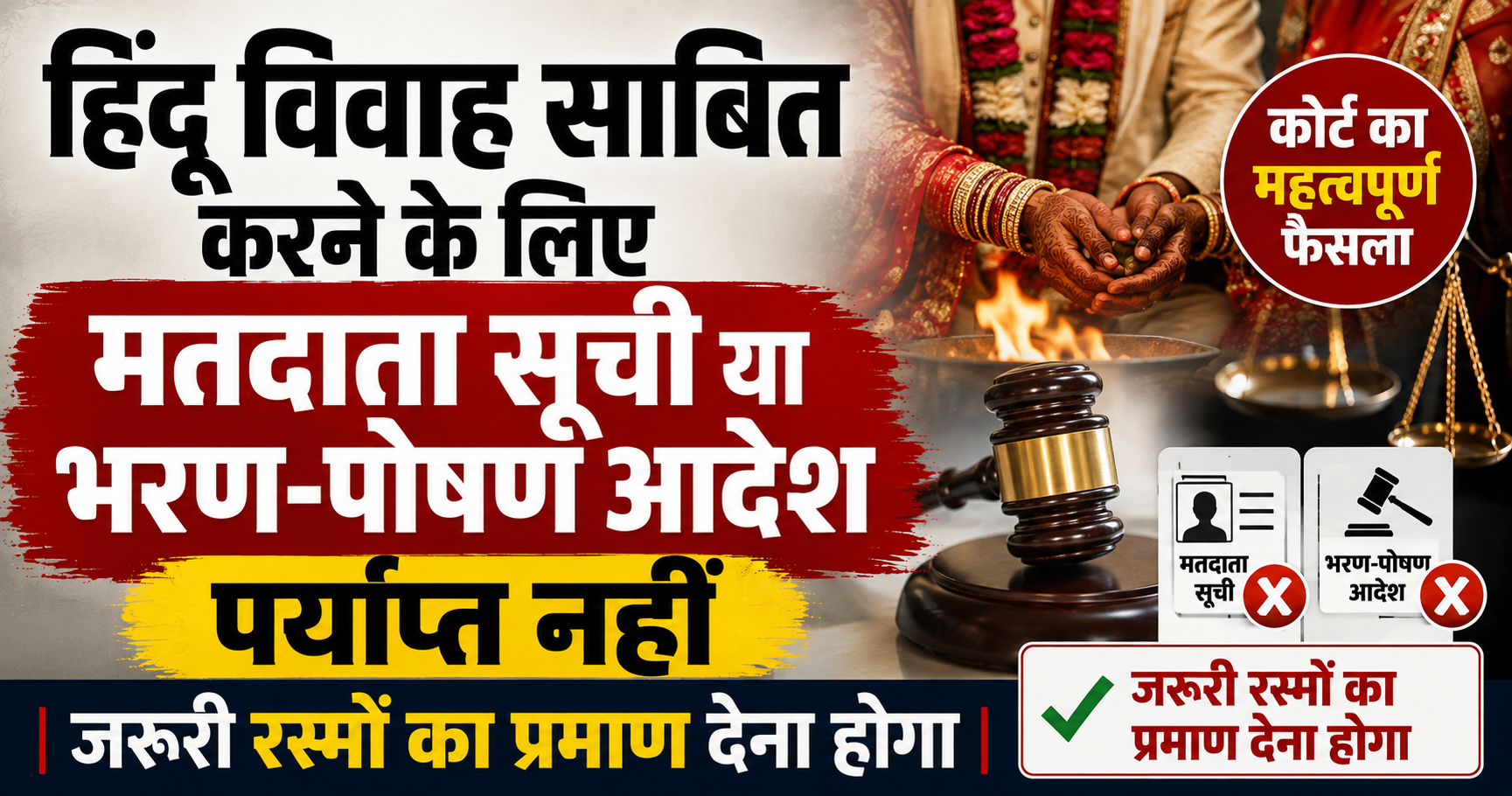
Voter List or Maintenance Order Alone Cannot Prove Valid Hindu Marriage
Patna: The Patna High Court, while delivering an important judgment concerning the validity of a Hindu marriage, has clarified that merely being listed as husband and wife in official records, having names together in a voter list, or obtaining a maintenance order cannot by itself be treated as conclusive proof of a valid Hindu marriage.
The court observed that to establish the validity of a Hindu marriage, it must be shown that the marriage was solemnized according to the applicable Hindu customs, traditions and essential ceremonies.
A division bench comprising Justice Bibek Chaudhuri and Justice Rana Vikram Singh made the observation while dismissing an appeal filed by Durgawati Devi. The judgment highlights the importance of proving the essential ceremonies and customary practices followed during a Hindu marriage.
Marriage Cannot Be Proved Only Through Documents
During the proceedings, various documents and circumstances relating to the alleged marriage were presented before the court. These included references to the voter list and an order concerning maintenance.
However, the High Court clarified that such documents may indicate the existence of a relationship or the parties' social circumstances, but they cannot, by themselves, conclusively establish a valid Hindu marriage.
The court held that when the validity of a marriage is disputed, the concerned party must establish that the marriage actually took place and that it was solemnized in accordance with the essential ceremonies recognized under Hindu law.
The ruling carries significance in cases where a person's marital status is sought to be established solely on the basis of government records, social recognition or an earlier judicial order.
Importance of Ceremonies in Hindu Marriage
Under the Hindu Marriage Act, compliance with applicable customs and essential ceremonies is important for establishing the validity of a Hindu marriage. Marriage practices can vary among different communities, and courts may therefore examine the customary form of marriage followed by the parties.
The Patna High Court specifically referred to situations in which Saptapadi, or the taking of seven steps around the sacred fire, is an essential customary ceremony. In such cases, evidence that the Saptapadi ceremony was actually performed can be important in establishing the validity of the marriage.
Saptapadi is regarded as an important marriage ritual in many Hindu traditions. The court's observation emphasizes that where such a ceremony is required under the applicable custom, evidence of its performance can have legal significance.
Why Is Proof of the Marriage Ceremony Important?
Marriage is not merely a social relationship. It creates legal rights and obligations between the parties. Issues involving maintenance, inheritance, property, pension and other legal rights can depend on whether a legally valid marriage existed.
Therefore, when the validity of a marriage becomes a matter of dispute, the court must determine whether the marriage was actually solemnized in accordance with the applicable law.
If an entry in a government document were automatically treated as conclusive proof of marriage, the court would not be able to examine whether the essential legal requirements of the marriage had been fulfilled. This is why evidence relating to the actual marriage ceremony can become important.
Voter List Entry Not Conclusive Proof
The voter list was also referred to during the proceedings. The court made it clear that an entry in the voter list cannot, by itself, be treated as conclusive proof of marriage.
A woman and a man being recorded as husband and wife in an electoral or administrative record may indicate how they were socially or administratively identified. However, such an entry does not necessarily establish that a Hindu marriage was solemnized according to all the legally required ceremonies.
Consequently, in a dispute over marital validity, documents such as voter lists may need to be supported by other reliable evidence concerning the actual marriage ceremony.
Maintenance Order Alone Is Also Insufficient
The court also clarified that an order granting maintenance to a woman cannot automatically be treated as conclusive proof of a valid Hindu marriage.
In maintenance proceedings, courts may consider the circumstances and evidence available before them while deciding whether relief should be granted. However, the question of whether a legally valid marriage existed may have to be independently established in another proceeding.
This does not mean that a maintenance order has no relevance. Rather, the court has emphasized that such an order cannot, by itself, serve as the final and decisive proof of a valid Hindu marriage.
Appeal Filed by Durgawati Devi Dismissed
After considering the facts and evidence available in the matter, the division bench dismissed the appeal filed by Durgawati Devi.
The decision is considered significant because it underlines the importance of evidence when the validity of a Hindu marriage is specifically disputed.
The broader message from the ruling is that courts may examine the manner in which the marriage was solemnized and whether the essential ceremonies required under the applicable custom were actually performed.
Photographs and Witnesses May Become Important Evidence
In disputes involving the validity of a marriage, photographs and videos of the wedding, wedding invitations, testimony from the priest who conducted the ceremony, statements of relatives and other eyewitnesses may become relevant evidence.
However, the evidentiary value of each document or testimony depends on the facts and circumstances of the individual case.
If a party claims that the marriage was solemnized according to a particular custom, evidence supporting that specific custom and the performance of its essential ceremonies may become important.
Similarly, merely living together for a long period does not necessarily resolve every legal question concerning the validity of a Hindu marriage. Courts examine the facts and evidence of each individual case before reaching a conclusion.
Impact on Family and Property Disputes
Questions concerning the validity of marriage frequently arise in cases involving property disputes, maintenance, inheritance, pensions and other family-related matters.
In such cases, it becomes necessary to determine whether the concerned parties were legally married and whether the claimed spouse has the corresponding legal rights.
The Patna High Court's observation provides further clarity on the role of evidence relating to the actual marriage ceremony in such disputes. It indicates that a marriage cannot necessarily be established solely through government records or an earlier administrative or judicial order.
At the same time, every case is decided on its own facts and under the applicable provisions of law.
Balance Between Law and Custom
Traditional Hindu marriage practices have considerable cultural importance, but their legal significance is determined by the applicable law and recognized customs.
The Hindu Marriage Act takes into account customary practices and the ceremonies required for solemnization of marriage. Consequently, evidence concerning the actual marriage ceremony and the essential rituals performed can play an important role in cases where the validity of the marriage is disputed.
The Patna High Court's ruling reinforces this principle by emphasizing that a claim of marriage cannot necessarily rest solely on social or administrative records.
What Is the Message for the Public?
The judgment also carries a practical message for people: documents and evidence relating to a marriage should be preserved carefully. Marriage certificates, photographs, invitation cards, videos, records relating to the ceremony and other relevant documents can become useful if a legal dispute arises in the future.
This may be particularly important in cases where a marriage has not been formally registered and evidence of the ceremony becomes necessary.
The Patna High Court's decision underlines the principle that a claim of a valid Hindu marriage cannot necessarily be established only through social or administrative records; evidence concerning the applicable law and essential marriage ceremonies may also be required.
A voter's list entry or a maintenance order may provide evidence about the relationship between two individuals, but where the validity of the marriage itself is disputed, proof concerning the actual solemnization and required ceremonies can have significant legal importance.
The ruling is therefore likely to serve as an important reference in future disputes involving the validity of Hindu marriages and the type of evidence required to establish such a marriage in court.