

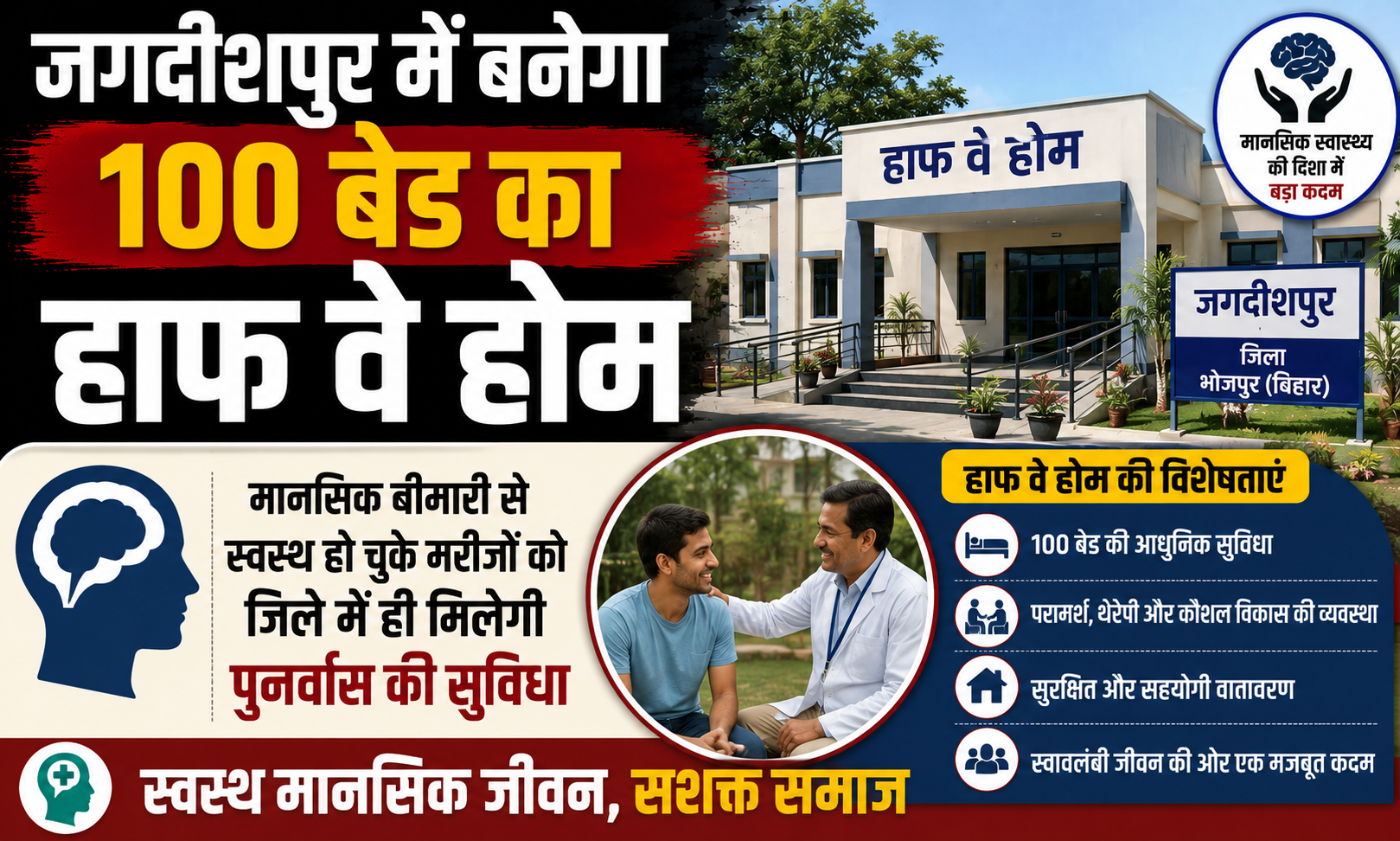
100-Bed Halfway Home to Be Established in Jagdishpur, Rehabilitated Mental Health Patients to Receive Care Within the District
Ara/Bhojpur: A major initiative aimed at strengthening mental healthcare services is set to take shape in Jagdishpur of Bhojpur district. A 100-bed Halfway Home will soon be established to provide rehabilitation facilities for people who have recovered from mental illness but still require support before returning to independent life. A proposal for the project has already been sent to the Social Welfare Department for approval.
Once approved, the project will move forward with construction and other administrative formalities. The facility is expected to benefit recovered patients—especially unidentified individuals who are unable to return to their families—by providing rehabilitation services within their own district instead of transferring them to institutions elsewhere.
A Major Boost for Mental Healthcare
Awareness about mental health has increased significantly in recent years, but rehabilitation facilities remain limited in many parts of the country. Even after recovering from mental illness, many patients need continued support before they can successfully reintegrate into society.
Recognizing this need, the government is promoting the establishment of Halfway Homes. These facilities serve as transitional rehabilitation centers where patients can stay in a safe and supportive environment after being discharged from hospitals.
What Is a Halfway Home?
A Halfway Home is a rehabilitation center designed for people who have recovered from mental illness but still require supervised care and support.
Residents receive accommodation, nutritious meals, medical supervision, psychological counseling, psychosocial support, and training in daily living skills. The objective is not merely to provide shelter but to help individuals regain confidence, become self-reliant, and reintegrate into society.
These centers are particularly beneficial for patients whose identities remain unknown or whose families cannot be traced.
Significant Relief for Unidentified Patients
The proposed 100-bed facility in Bhojpur will primarily benefit recovered mental health patients who are unable to return to their homes because their identities or family details are unavailable.
Until now, such patients often had to be transferred to rehabilitation centers in other districts, creating logistical and administrative challenges. Having a dedicated facility within Bhojpur will make rehabilitation more accessible, efficient, and patient-friendly.
Proposal Sent to the Social Welfare Department
According to officials, a detailed proposal for establishing the 100-bed Halfway Home in Jagdishpur has already been submitted to the Social Welfare Department.
After receiving approval, the administration will begin the process of land allocation, infrastructure development, procurement of necessary resources, and recruitment of staff.
Officials aim to complete the project within the prescribed timeline so that the facility can begin serving patients as soon as possible.
Equipped with Modern Facilities
The proposed Halfway Home will offer a safe and comfortable environment for residents.
The facility is expected to include comfortable accommodation, nutritious meals, continuous medical supervision, psychological counseling, recreational activities, vocational training, and other essential support services.
Regular health check-ups, access to prescribed medications, and supervision by qualified mental health professionals will also be provided.
Focus on Rehabilitation and Self-Reliance
Mental health experts emphasize that medical treatment alone is not enough for long-term recovery. Patients often require emotional, psychological, and social support to regain confidence and return to normal life.
The Halfway Home will therefore provide training in personal hygiene, daily living skills, social interaction, group activities, and vocational skills to help residents become independent and productive members of society.
Efforts to Reunite Patients with Their Families
Whenever the identity or family details of an unidentified patient are established, the administration will make efforts to reunite them with their relatives.
This process may involve coordination with the police, social welfare organizations, and other government agencies. Patients whose families cannot be located will continue to receive rehabilitation and long-term support at the facility.
Raising Awareness About Mental Health
Health professionals stress that mental illness is a medical condition like any other and can often be effectively treated with timely intervention.
They also emphasize the need to eliminate stigma and discrimination associated with mental health disorders. Rehabilitation centers such as Halfway Homes play a vital role in helping recovered patients rebuild their lives with dignity and confidence.
A Significant Initiative for Bhojpur
The establishment of a 100-bed Halfway Home in Bhojpur is expected to substantially strengthen the district's mental healthcare infrastructure.
The project will not only improve rehabilitation services for patients but also enhance coordination between the Health Department and the Social Welfare Department. Experts believe that if the initiative proves successful, similar facilities could be developed in other districts across Bihar.
The proposed 100-bed Halfway Home in Jagdishpur, Bhojpur, represents an important step toward improving mental healthcare and rehabilitation services in the district. A proposal has already been submitted to the Social Welfare Department, and construction will begin after official approval. Once operational, the facility will provide rehabilitation, care, and skill development for recovered mental health patients—particularly unidentified individuals—within their own district. The initiative is expected to strengthen mental healthcare services while helping patients rebuild their lives with dignity, independence, and social inclusion.