


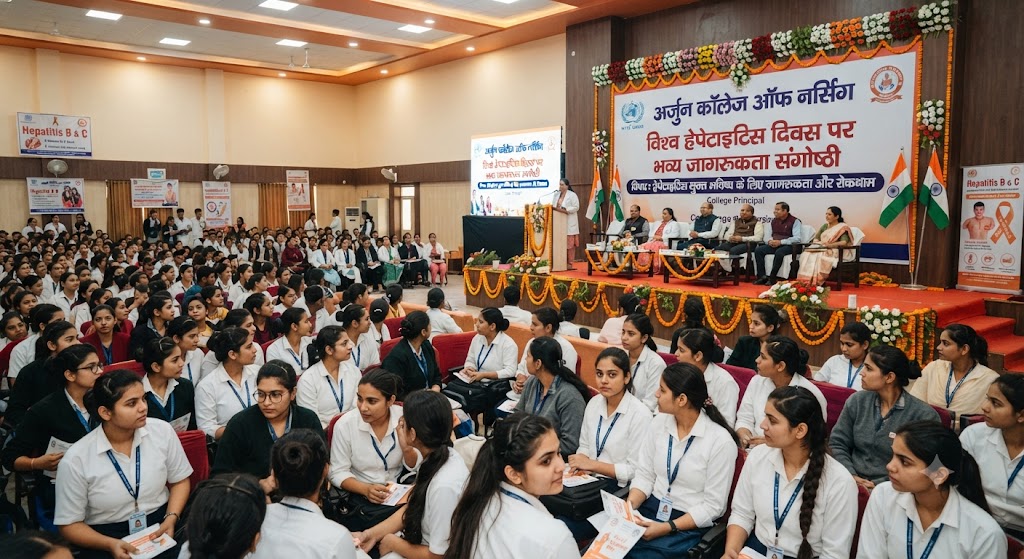
Awareness Symposium Organized on World Hepatitis Day at Arjun College of Nursing; Principal Prof. Himanshu Provides Detailed Information on Symptoms and Prevention of the Disease
Bhagalpur, Special Correspondent: A special awareness symposium-cum-workshop was organized on the occasion of 'World Hepatitis Day' at the prestigious educational institution Arjun College of Nursing in Naugachhia, coming under Silk City Bhagalpur. The primary objective of this important program was to make nursing students, healthcare workers, and nearby ordinary citizens aware of the types, causes of transmission, symptoms, and modern medical treatment of hepatitis—a serious disease affecting the liver. The program was presided over by the college's Principal, Prof. Himanshu, who shed detailed light on various facets of hepatitis in his address and delivered a message to society to remain vigilant against this disease.
Lighting of the Lamp and Objective of the Symposium
The program commenced in the college auditorium with the lighting of the lamp by the chief guest and the principal.
Significance of Health Education: Speaking on behalf of the organizing committee, it was stated that being a nursing institution, it is the moral responsibility of Arjun College of Nursing not only to impart textbook knowledge to its students but also to play an active role in spreading health-related awareness in society.
Growing Threat and Vigilance: Speakers present at the symposium expressed concern that hepatitis is transforming into a 'silent killer' in contemporary times, against which taking precautions in a timely manner is imperative.
Prof. Himanshu's Key Address: What is Hepatitis and Why is it Dangerous?
The keynote speaker of the symposium and college Principal, Prof. Himanshu, explained the medical aspects of hepatitis in very simple language during his detailed address:
Meaning of Hepatitis: He stated that 'hepatitis' directly means inflammation of the liver, primarily caused by viral infection. Additionally, excessive alcohol consumption, the intake of certain specific medicines, and autoimmune diseases can also trigger it.
Major Types (A, B, C, D, and E): Prof. Himanshu detailed that hepatitis is principally of five types—Hepatitis A, B, C, D, and E. Among these, Hepatitis B and C are considered the most dangerous because they can assume a chronic form and lead to life-threatening conditions like cirrhosis or liver cancer.
Primary Causes of Transmission: He explained that Hepatitis A and E primarily spread through the consumption of contaminated water and food, whereas Hepatitis B, C, and D can be transmitted via the exchange of infected blood, unprotected sexual intercourse, the use of infected syringes, or from an infected mother to her newborn infant.
Symptoms and Preventive Measures: 'Vigilance is the Greatest Defense'
During the workshop, nursing students and healthcare workers were trained to recognize early symptoms of hepatitis and adopt preventive measures:
Key Symptoms: Loss of appetite, persistent fatigue, vomiting or nausea, pain in the upper right abdomen, dark yellow urine, and yellowing of the eyes and skin (symptoms of jaundice) can indicate hepatitis.
Practical Preventive Measures:
Always drink boiled or purified drinking water and avoid outside, open, and contaminated food items.
Children and adults must get timely Hepatitis B vaccinations.
Always ensure the use of disposable and new syringes in hospitals or clinics.
Pay special attention to personal hygiene and wash hands regularly with soap.
Active Participation of Students and Healthcare Workers
Hundreds of students from Arjun College of Nursing participated enthusiastically in this awareness symposium.
To spread awareness in society regarding hepatitis, students also presented a short play and street play (nukkad natak), conveying the message that this disease can be completely defeated through timely testing and vaccination.
A Q&A session was organized at the conclusion of the symposium, where students posed several questions to the faculty regarding hepatitis treatment and advanced medical technologies, which were satisfactorily resolved by the experts.
This World Hepatitis Day symposium organized at Arjun College of Nursing in Naugachhia proved immensely successful in not only sensitizing future nursing professionals but also the general public toward a grave health issue. Conducted under the guidance of Principal Prof. Himanshu, this event presents an exemplary model of health education and social responsibility, which will help safeguard people from this severe or critical disease in the days to come.


