


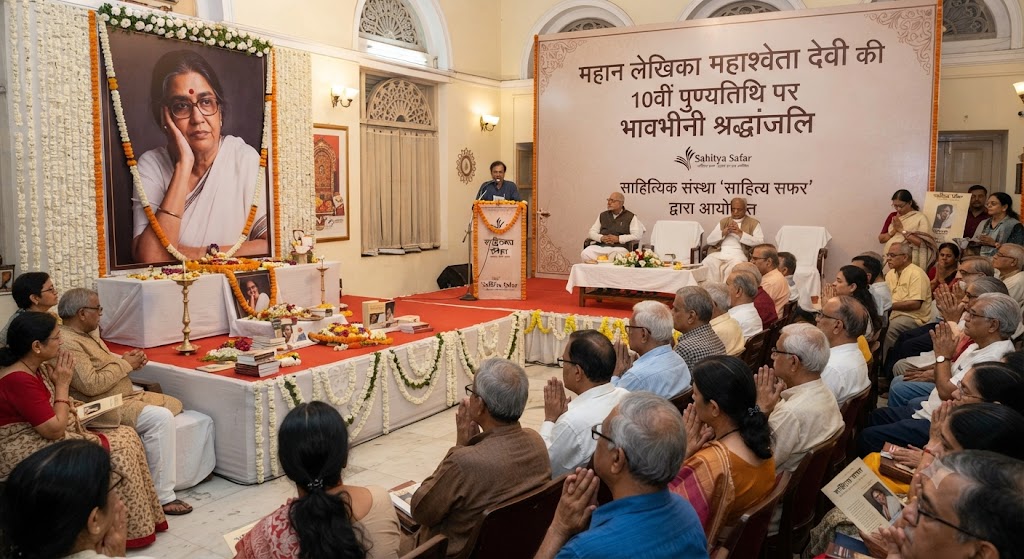
10th Death Anniversary of Mahasweta Devi Observed by Literary Organisation 'Sahitya Safar'; Jagatram Sah 'Karnpuri' Presides Over the Event, Speakers Pay Tribute and Recall Her Rebellious Spirit and Literature That Became the Voice of the Marginalized
Bhagalpur, Special Correspondent: The 10th death anniversary of Mahasweta Devi—a stalwart of modern Indian literature, recipient of the Ramon Magsaysay and Jnanpith awards, and a great writer and social activist—was observed in an extremely solemn and intellectual atmosphere under the auspices of 'Sahitya Safar', a prominent literary organization active in promoting literature and culture in Silk City Bhagalpur. This tribute-cum-symposium, held at a major auditorium in the city, was presided over by eminent litterateur and creator Jagatram Sah 'Karnpuri'. Several renowned litterateurs, intellectuals, writers, and young creators of Bhagalpur were present on the occasion, paying heartfelt floral tributes to Mahasweta Devi's portrait and engaging in a detailed discussion on her rebellious and pro-people literature.
Lighting of the Lamp and Saluting Mahasweta Devi's Persona
The program commenced with the garlanding of Mahasweta Devi's portrait and the lighting of the lamp.
Sahitya Safar's Initiative: In their addresses, members of the organization stated that Mahasweta Devi was not merely a writer, but the vocal voice of indigenous tribes, Dalits, the exploited, and native populations residing on the fringes of the country. Her pen possessed the power to carry the cries of the underprivileged straight to the corridors of power.
Presidential Address: Presiding over the event, senior litterateur Jagatram Sah 'Karnpuri' underscored Mahasweta Devi's life struggles and literary contributions in his presidential speech. He remarked, "Mahasweta ji never made her art a tool for mere entertainment or intellectual indulgence, but instead transformed it into a potent weapon for social justice and change."
Detailed Discussion on Mahasweta Devi's Works and Versatile Talent
During the symposium, speakers shed light on various aspects of Mahasweta Devi's famous works and multifaceted personality:
'Hazaar Chaurasi Ki Maa' and 'Aranyer Adhikar': Discussing her novels—especially the historical novel based on the life of Birsa Munda, 'Aranyer Adhikar' (Right to the Forest), and the poignant novel composed against the backdrop of the Naxalbari movement, 'Hazaar Chaurasi Ki Maa' (Mother of 1084)—speakers noted that these works are invaluable treasures of Indian literature. The saga of systemic cruelty and ordinary human resistance found within these novels is rare in literature.
Journalism and Social Activism: Speakers recalled that Mahasweta Devi did not merely wield her pen; she took to the streets for tribal rights. The dedication with which she fought for the rights of the Lodha and Shabar tribes in Purulia, Bankura, and Medinipur in West Bengal serves as an inspiration for a new generation of writers.
Mahasweta Devi: Messiah of the Exploited and Neglected
Speakers gathered at the symposium asserted that Mahasweta Devi's literature stands as testament that whenever injustice and inequality grow in society, her writings will continue serving as a mirror to the system.
She brought the tribal community's language, culture, and their struggle for jal-jungle-zameen (water, forest, and land) into mainstream literature on a national canvas.
In today's era when intellectual freedom and pro-people journalism and literature face threats, the relevance of Mahasweta Devi's life and her rebellious spirit grows even more pronounced.
Prominent Presence at the Tribute Meeting
Concluding the program, a two-minute silence was observed to pray for the peace of the departed soul. Several distinguished literature lovers of Bhagalpur and activists of 'Sahitya Safar' made special contributions toward the success of this intellectual and literary event. On this occasion, emerging young poets of the city also recited some of their poems dedicated to Mahasweta Devi, rendering the entire atmosphere even more sensitive.
This commemoration organized by 'Sahitya Safar' in Bhagalpur on the 10th death anniversary of Mahasweta Devi symbolizes that great creators never die; they remain immortal through their thoughts and works. This event succeeded entirely in instilling a sense of responsibility toward society among a new generation of writers and readers.


