

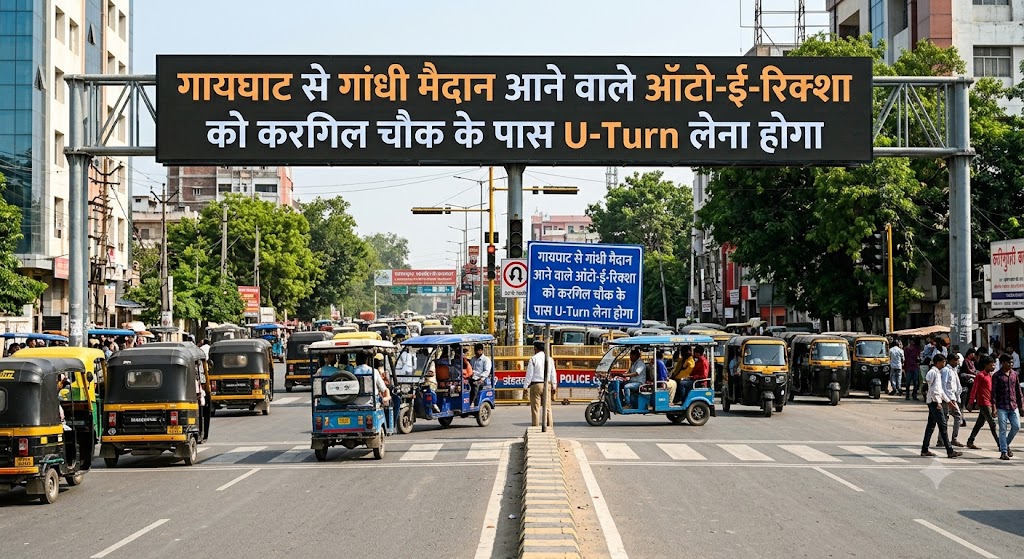
Auto-Rickshaws and E-Rickshaws From Gaighat to Gandhi Maidan to Take U-Turn Near Kargil Chowk
A new traffic plan has been introduced on Patna’s busy Ashok Rajpath to improve traffic flow and reduce congestion. According to the traffic advisory, auto-rickshaws and e-rickshaws coming from the Gaighat side toward Gandhi Maidan will now have to take a U-turn near Kargil Chowk and return toward Gaighat. The vehicles will be required to take the U-turn near the western end of the double-decker structure at the designated location.
The traffic police have introduced the arrangement with the aim of controlling vehicle movement, reducing congestion and improving traffic management in the Ashok Rajpath and Gandhi Maidan areas. Ashok Rajpath is one of Patna’s major roads and carries a large number of private vehicles, public transport vehicles, auto-rickshaws and e-rickshaws every day. Traffic congestion is common in the area due to heavy vehicle movement, markets, construction-related activities and other factors.
New Route Instructions for Autos and E-Rickshaws
According to the traffic advisory, auto-rickshaws and e-rickshaws coming from Gaighat along Ashok Rajpath toward Gandhi Maidan will not be allowed to continue directly toward Gandhi Maidan.
Instead, they will have to take a U-turn near Kargil Chowk, close to the western end of the double-decker structure, and return toward Gaighat.
Under the new arrangement, drivers will be required to turn their vehicles only at the designated location. Traffic police will monitor the area to ensure that the U-turn movement does not create unnecessary disruption or affect the movement of other vehicles.
For passengers, this means that people traveling from Gaighat toward Gandhi Maidan by auto-rickshaw or e-rickshaw will need to take the revised route into account. Depending on their destination, they may have to use another mode of transport or walk after reaching the designated point.
Why Has the Traffic Arrangement Been Changed?
Ashok Rajpath is one of the busiest roads in Patna. Several important institutions, markets, educational centers, hospitals and commercial areas are located along or near the road. Traffic pressure increases significantly during different parts of the day.
Continuous movement of autos and e-rickshaws from Gaighat toward Gandhi Maidan can increase congestion at certain points. In addition, vehicles approaching Kargil Chowk and Gandhi Maidan from different directions contribute to traffic pressure.
The revised traffic arrangement is intended to reduce unnecessary vehicle accumulation and improve the movement of traffic. By restricting the movement of autos and e-rickshaws to a designated U-turn point, authorities can manage their flow more effectively.
Increased Responsibility for Traffic Police at Kargil Chowk
Following the new route plan, traffic management around Kargil Chowk will become particularly important. If a large number of autos and e-rickshaws reach the U-turn point at the same time, queues could form.
Traffic police will therefore need to continuously monitor the area. Drivers will have to maintain lane discipline while taking the U-turn. Stopping vehicles in the middle of the road or making unauthorized turns could worsen congestion.
Following traffic personnel’s instructions and using only the designated U-turn point will be essential for maintaining smooth traffic flow.
Cooperation From Auto and E-Rickshaw Drivers Needed
The success of the new traffic arrangement will depend significantly on the cooperation of auto and e-rickshaw drivers. Drivers will need to understand the revised route and inform passengers in advance about the new arrangement.
Passengers often expect public transport vehicles to take them directly to their final destination. Therefore, drivers should clearly explain where the journey will end and where passengers may need to change vehicles.
Drivers should also avoid stopping unnecessarily near the U-turn point. Turning quickly but safely at the designated location will help prevent traffic queues.
How Will Passengers Be Affected?
The new traffic plan will directly affect passengers traveling from Gaighat toward Gandhi Maidan by auto-rickshaw or e-rickshaw.
If these vehicles have to return toward Gaighat after reaching the designated U-turn point near Kargil Chowk, passengers heading toward Gandhi Maidan may need to use alternative transportation for the remaining part of their journey.
Although the change may initially cause inconvenience, authorities are aiming to improve overall traffic movement. If congestion decreases, passengers traveling through the broader Ashok Rajpath corridor could ultimately benefit.
Passengers are advised to understand the revised route before starting their journey. Elderly people, children and passengers carrying luggage may particularly benefit from planning alternative transportation in advance.
Attempt to Reduce Traffic Pressure Around Gandhi Maidan
Gandhi Maidan is one of Patna’s most important public and political locations. Large rallies, public meetings, cultural events and other programs are frequently held in and around the area. During such events, traffic pressure can increase considerably.
Restricting the movement of autos and e-rickshaws toward Gandhi Maidan could help reduce the number of vehicles entering the area. This could make traffic management easier during busy periods and major events.
The U-turn arrangement near Kargil Chowk appears to be part of a broader effort to manage traffic in the area. Its effectiveness, however, will depend on how strictly drivers and passengers follow the revised instructions.
Importance of the Designated U-Turn Near the Double-Decker Structure
The traffic advisory specifically identifies the area near the western end of the double-decker structure as the designated U-turn location.
Having a fixed U-turn point can prevent drivers from making arbitrary turns at different locations along the road. It can also make it easier for traffic police to control vehicle movement and reduce the risk of sudden turns.
Auto and e-rickshaw drivers should therefore avoid making U-turns before or after the designated location and follow the prescribed route.
Private Vehicle Drivers Also Need to Remain Alert
The revised arrangement will not affect only auto and e-rickshaw drivers. Private vehicle owners will also need to exercise caution near the U-turn point.
A sudden increase in U-turning autos and e-rickshaws could temporarily affect traffic speed. Private vehicle drivers should follow traffic signals and instructions from traffic personnel and allow adequate space for vehicles making U-turns.
Speeding, unsafe overtaking and sudden lane changes should be avoided to reduce the risk of accidents.
Following Traffic Rules Is Essential
The success of any traffic advisory depends on public cooperation. Auto and e-rickshaw drivers must follow the revised route and use the designated U-turn point.
Passengers should also remain aware of the changes and plan their journeys accordingly. People traveling toward Gandhi Maidan should be prepared to use alternative transportation if required.
Traffic Arrangement May Be Reviewed
After the new arrangement is implemented, authorities may need to assess its impact on traffic flow. If congestion increases near the U-turn point or problems emerge elsewhere, the traffic plan could potentially be adjusted.
On the other hand, if the new system reduces congestion on Ashok Rajpath and lowers traffic pressure around Gandhi Maidan, it could prove to be an effective traffic-management measure.
Overall, the new traffic advisory for autos and e-rickshaws traveling from Gaighat toward Gandhi Maidan is an important change for both drivers and passengers. These vehicles will now have to take a U-turn near Kargil Chowk, close to the western end of the double-decker structure, and return toward Gaighat. The objective is to improve traffic management and reduce congestion in the busy Ashok Rajpath and Gandhi Maidan areas. Cooperation from drivers, passengers and private vehicle owners will be essential for the new arrangement to work effectively.