

Jitan Ram Manjhi’s Remark Heats Up Bihar Politics, Raises Questions Over Tejashwi Yadav and Alcohol
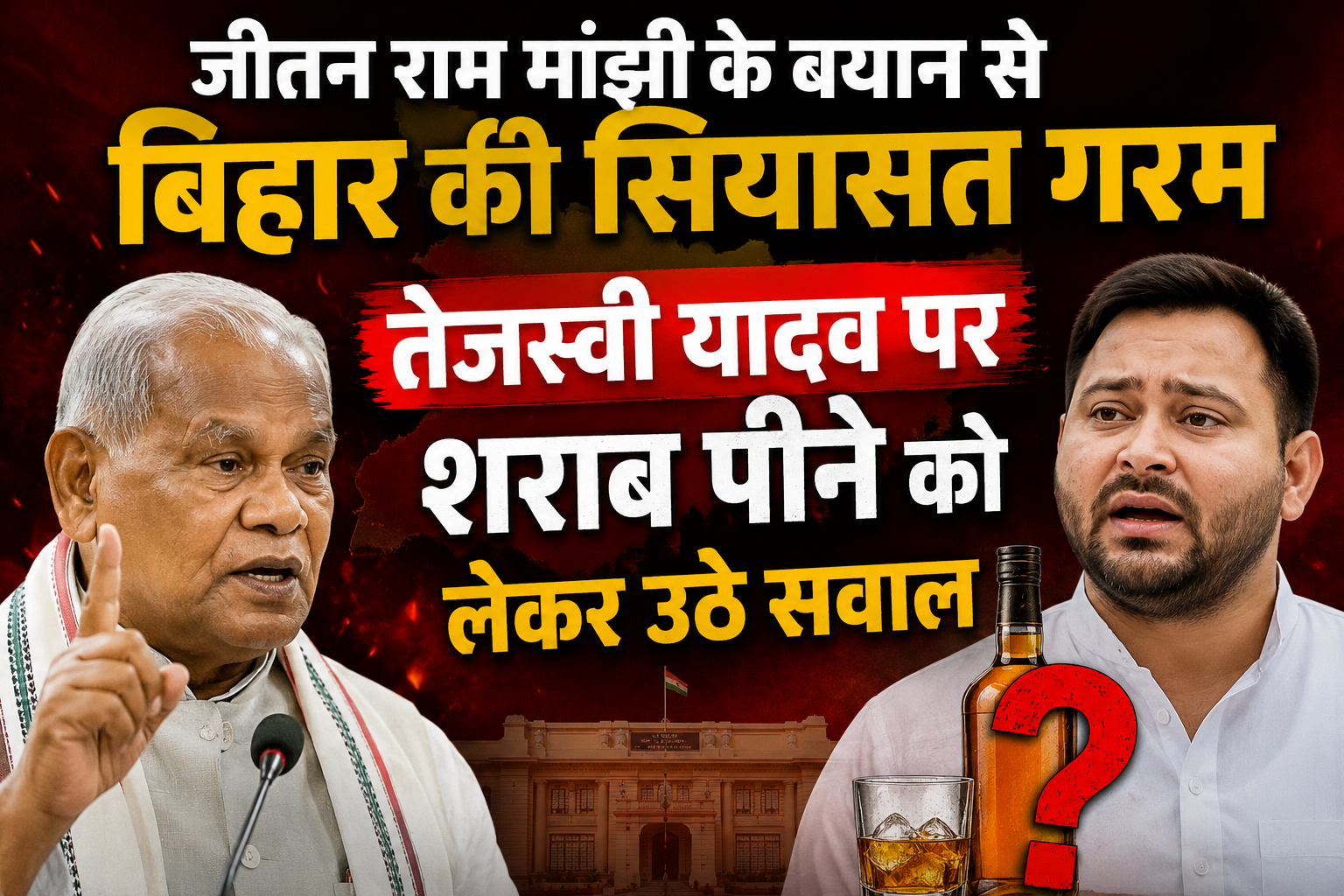
Bihar’s political landscape has once again heated up following a remark by Union Minister and Hindustani Awam Morcha (HAM) chief Jitan Ram Manjhi. Taking a sarcastic dig at Rashtriya Janata Dal (RJD) leader and Leader of Opposition Tejashwi Yadav, Manjhi said, “It seems Babu Sahib’s night-time effect had not worn off, which is why he is offering me condolences.” The remark has triggered a political debate and led to questions being raised about Tejashwi Yadav’s alleged alcohol consumption in Bihar.
Manjhi’s statement comes against the backdrop of Bihar’s prohibition policy, under which the sale and consumption of alcohol are legally banned in the state. Because of this, any public allegation concerning alcohol consumption by a prominent political leader is considered politically sensitive. However, Manjhi’s comment should be understood as a political taunt, and there is no independent confirmation that Tejashwi Yadav had consumed alcohol.
Manjhi’s Comment Sparks a Fresh Political Controversy
Jitan Ram Manjhi’s statement has become a fresh talking point in Bihar politics. His remarks about Tejashwi Yadav have added another dimension to the ongoing political confrontation between the RJD and the ruling alliance.
Political opponents have interpreted the comment as an attempt to question Tejashwi Yadav’s image. Supporters of the ruling camp may view it as a direct political attack on the opposition leader. On the other hand, the RJD could describe the statement as a personal remark that crosses political boundaries.
Personal attacks between political leaders are not uncommon in Bihar, particularly when political tensions increase. However, because Manjhi’s statement is connected to the sensitive issue of alcohol prohibition, it has attracted more attention than an ordinary political exchange.
Alcohol Prohibition Remains a Major Political Issue in Bihar
Alcohol prohibition has remained a subject of political debate in Bihar since the policy was introduced. The government has traditionally presented prohibition as a measure aimed at social reform and improving the well-being and safety of families, particularly women.
At the same time, opposition parties and various sections of society have questioned the implementation of the policy. Reports of illegal liquor production, smuggling and cases involving poisonous alcohol have periodically emerged despite the ban.
In this political environment, allegations concerning alcohol consumption by a senior political leader can quickly become a major political issue.
Manjhi’s statement needs to be viewed in this broader context. However, a political allegation alone cannot establish that Tejashwi Yadav consumed alcohol.
What Did Manjhi Say About Tejashwi Yadav?
Jitan Ram Manjhi directly targeted Tejashwi Yadav with his sarcastic remark. He suggested that perhaps the effect of the previous night had not worn off, which was why Tejashwi was offering him condolences.
The comment has generated considerable discussion in political circles and on social media. Supporters of both sides may interpret the remark differently. Some may consider it political satire, while others could view it as a personal attack.
It is important to distinguish between a political allegation and a verified fact. Manjhi’s statement by itself does not constitute evidence of Tejashwi Yadav consuming alcohol. Without independent verification, such an allegation should not be presented as an established fact.
RJD May Respond Strongly
Attention is now focused on how the RJD responds to Manjhi’s remarks. Tejashwi Yadav is one of the most prominent faces of the RJD and has been projected by the party as a key political leader in Bihar.
RJD leaders may accuse Manjhi of diverting attention from important public issues by making personal comments. They could argue that the government should focus on issues such as employment, inflation, education, healthcare and law and order rather than making personal allegations against opposition leaders.
The ruling alliance, however, could use Manjhi’s remarks as part of its political criticism of the opposition. As a result, what began as a single statement could develop into a larger political exchange.
Debate Intensifies on Social Media
Political statements today spread rapidly through social media. Remarks made during public meetings or political interactions can quickly become viral and generate widespread discussion.
Manjhi’s statement is likely to attract reactions from supporters and opponents of both leaders. Some may treat it as political humor or sarcasm, while others may raise questions about political conduct and personal remarks.
However, the fact that an allegation becomes viral on social media does not make it a verified fact. It is important to distinguish between political statements, allegations and independently established information.
Personal Allegations vs. Political Issues
Bihar politics has frequently witnessed personal exchanges between leaders. However, in a democratic system, policy-related discussions are generally considered more important than personal allegations.
Tejashwi Yadav and Jitan Ram Manjhi represent different political camps and have often taken different positions on major political issues. Their latest exchange can therefore be viewed in the broader context of Bihar’s political competition.
While Manjhi’s remark has brought Tejashwi Yadav’s personal life into political discussion, important public issues facing Bihar remain significant. Employment, education, healthcare, agriculture, floods, roads, electricity and law and order continue to be major concerns for people across the state.
Prohibition Policy Could Come Under Debate Again
Manjhi’s remark has once again brought Bihar’s alcohol prohibition policy into the political spotlight. The policy has been debated for years, with supporters and critics presenting different arguments about its social and economic impact.
If political parties continue to use the issue in their political campaigns, debates could intensify over the effectiveness of prohibition, illegal liquor networks and enforcement of the law.
The opposition could question why illegal liquor and smuggling cases continue to emerge despite prohibition. The government, meanwhile, could highlight enforcement actions and argue that strict implementation is necessary to protect the policy.
What Happens Next?
For now, Jitan Ram Manjhi’s remark has become a major talking point in Bihar politics. The questions raised about Tejashwi Yadav’s alleged alcohol consumption remain political allegations and have not been independently verified.
Therefore, the controversy should be viewed as a political exchange rather than as proof of any personal conduct by Tejashwi Yadav.
If the RJD responds strongly to Manjhi’s remarks, the controversy could escalate further. Such statements can also influence political workers and supporters on both sides, leading to a wider debate.
Overall, Jitan Ram Manjhi’s sarcastic comment has created a fresh political controversy in Bihar. Its connection with the state’s sensitive prohibition policy has made the statement particularly significant. However, no conclusion about Tejashwi Yadav’s alleged alcohol consumption can be drawn solely from Manjhi’s political remark. The coming days will reveal whether the RJD responds strongly and whether the controversy develops into a broader political debate over Bihar’s prohibition policy.