


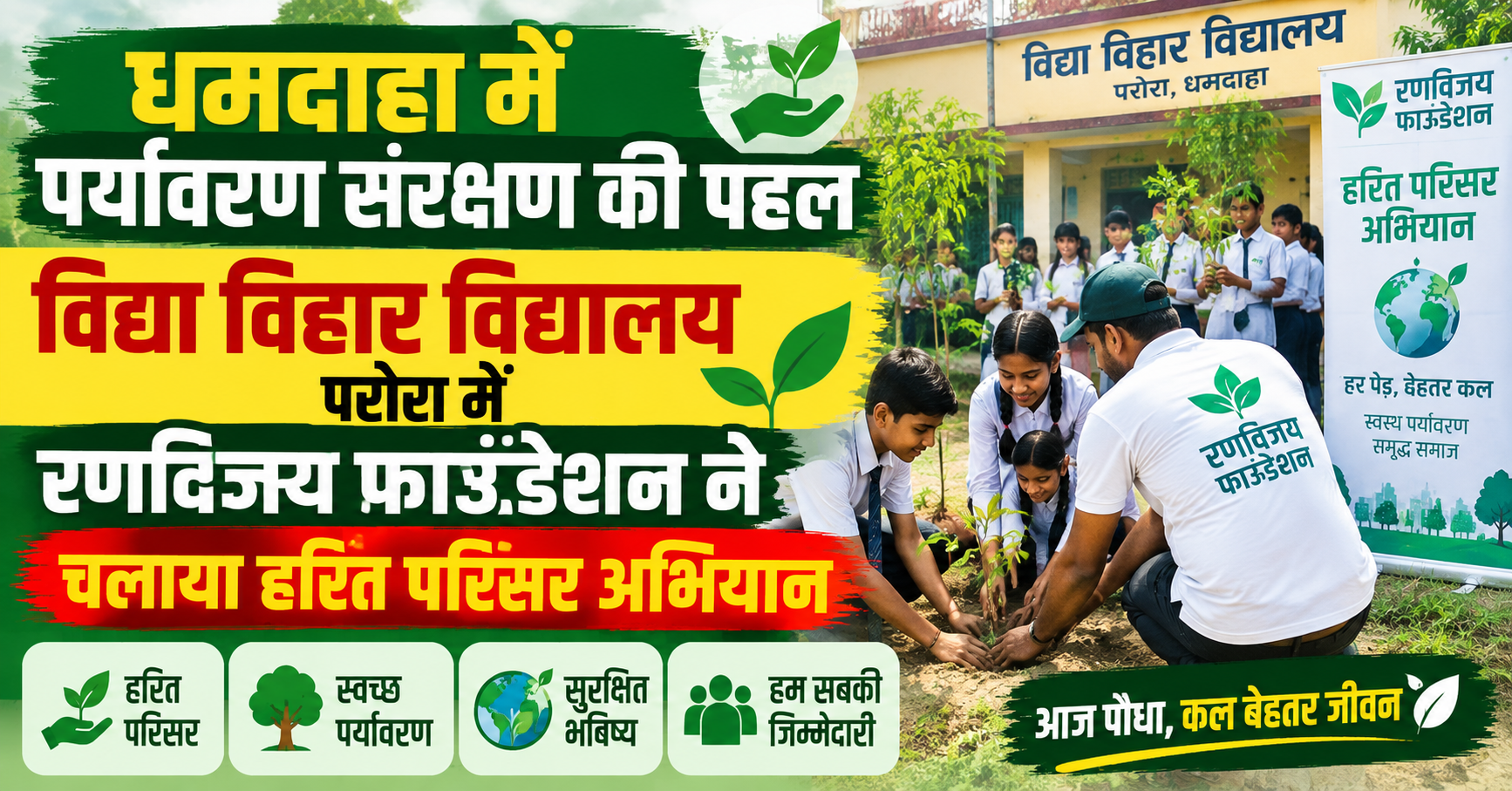
Ranvijay Foundation Promotes Green School Campus at Vidya Vihar School Parora
Dhamdaha: With the objective of promoting environmental conservation and developing a greener school campus, the Ranvijay Foundation, Dhamdaha, launched an environmental awareness and green campus initiative at Vidya Vihar School in Parora. The initiative focused on increasing awareness among students and the school community about environmental protection while promoting greenery across the campus.
At a time when environmental conservation has become a shared responsibility, initiatives involving educational institutions are gaining importance. Rising pollution, declining green cover, increasing plastic waste, water-related challenges and changing weather patterns have created significant environmental concerns. In this context, efforts to transform schools into centers of environmental awareness can play an important role.
Through the initiative, the Ranvijay Foundation sought to connect students with nature and encourage them to understand the importance of protecting the environment. Along with developing a greener school campus, emphasis was placed on encouraging students to care for plants, maintain cleanliness and conserve natural resources.
Goal of Creating a Green School Campus
The primary objective of the initiative at Vidya Vihar School Parora is to increase greenery within the school campus. A green campus not only improves the appearance of a school but can also provide students with a cleaner and healthier environment.
Trees and plants can help moderate local temperatures, improve air quality and provide students with opportunities to connect with nature. A greener environment can also contribute to a positive atmosphere for students.
The foundation emphasized that planting trees should not be treated as a one-day activity. The survival and growth of planted trees depend on regular care and protection. Students can therefore be encouraged to take responsibility for individual plants and help maintain them.
Environmental Awareness Among Students
One of the major objectives of the program was to develop a sense of environmental responsibility among students. Teaching children about the importance of trees, plants and natural resources from an early age can help them become more environmentally conscious citizens in the future.
Students can also carry environmental messages from their school to their homes and communities. Simple actions such as saving water, reducing plastic use and caring for plants can have a wider impact when adopted by families.
Schools can therefore serve not only as centers of academic education but also as important platforms for social and environmental awareness.
Emphasis on Plant Care
Planting trees is only the first step in creating a green campus. Regular maintenance and protection are equally important. In many plantation drives, plants may not survive if they do not receive adequate care afterward.
To make the green campus initiative successful, students, teachers and school authorities will need to work together. Plants need regular watering, protection from damage and appropriate care for healthy growth.
Different groups of students could be assigned responsibility for caring for specific plants. This could help develop a sense of responsibility while strengthening students’ connection with nature.
Connection Between Education and Environment
Connecting environmental conservation with education can be particularly effective. Rather than limiting environmental awareness to textbooks, students can learn through direct interaction with nature.
Plants growing on the school campus can serve as practical learning tools. Students can observe plant growth and learn about soil, water, seasons, biodiversity and other environmental concepts.
A green area within the school can also be used for educational activities related to environmental studies, science and nature conservation.
Importance of Water Conservation
Environmental protection is not limited to trees and plants. Water conservation is another important component. Protecting water resources is essential for the future, particularly in rural and semi-urban areas.
Students can be taught about preventing water wastage, the importance of rainwater and the need to keep local water sources clean.
The school can also promote efficient use of water for watering plants. Reducing unnecessary water consumption and using available resources responsibly can have long-term benefits.
Message to Reduce Plastic Use
Plastic waste is one of the major environmental challenges today. Raising awareness among schoolchildren about the harmful effects of excessive plastic use is therefore important.
Students can be encouraged to avoid single-use plastic and use reusable alternatives wherever possible. Schools can also introduce systems for separating and managing different types of waste.
By linking the green campus initiative with cleanliness and waste management, the environmental campaign can become more comprehensive and effective.
School Can Become a Center for Environmental Awareness
Educational institutions such as Vidya Vihar School Parora can play an important role in promoting environmental conservation at the local level. Activities conducted at a school can have an impact beyond the student community.
Students can share environmental messages with their parents and family members. Schools can also organize awareness programs for people living in surrounding communities.
Regular activities such as tree plantation, cleanliness drives, water conservation campaigns and environmental awareness programs could help establish a lasting green culture on the campus.
Community Participation Is Important
Environmental initiatives are more likely to succeed over the long term when local communities participate. Schools, parents, students, teachers and social organizations can work together to strengthen green initiatives.
Efforts by organizations such as the Ranvijay Foundation can help connect local communities with environmental concerns and demonstrate that small individual actions can collectively create meaningful change.
If each family plants and maintains even one tree, widespread participation could significantly increase greenery across an area over several years.
Importance of Greenery Amid Changing Weather
The role of trees and plants has become even more important amid changing weather patterns and rising temperatures. Urbanization and construction activities have reduced green spaces in many areas.
Increasing greenery within school campuses can be a positive local step toward improving environmental conditions.
Trees provide shade and absorb carbon dioxide while releasing oxygen. However, their long-term environmental benefits depend on proper care and healthy growth.
Developing a Sense of Responsibility Among Children
Giving students responsibility for caring for plants can also help develop discipline and a sense of responsibility. Students can observe plant growth and participate in activities related to their maintenance.
Such practical experiences can make children more sensitive toward nature. They can learn that environmental protection is not merely a subject discussed in textbooks but something that should become part of everyday life.
Regular environmental programs can also encourage positive behavioral changes among students.
Need for Continued Efforts
Creating a green school campus requires more than planting trees once. The initiative needs to continue over time. School authorities should establish systems for monitoring plants, providing water and protecting them from damage.
The school could also create an environmental club or green team. Such a group could organize activities throughout the year related to plant care, cleanliness, water conservation and environmental awareness.
This would help transform the green campus campaign into a regular and sustainable school activity.
A Positive Step Toward Environmental Protection
The environmental conservation and green campus initiative undertaken by the Ranvijay Foundation at Vidya Vihar School Parora in Dhamdaha sends a positive message at the local level. Such initiatives can help connect children with nature while developing a broader sense of environmental responsibility within the community.
The key requirement is to focus equally on the survival and maintenance of plants after plantation. If students, teachers, parents, school authorities and local residents work together to care for the greenery, the school campus could gradually develop into a healthier and more environmentally friendly space.