

Speeding Up Public Hearings; District Magistrate Hears Second Appeals Under Bihar Right to Public Grievance Redressal Act, Issues Strict Directives for Prompt Action on Land Disputes and Certificate Issuance
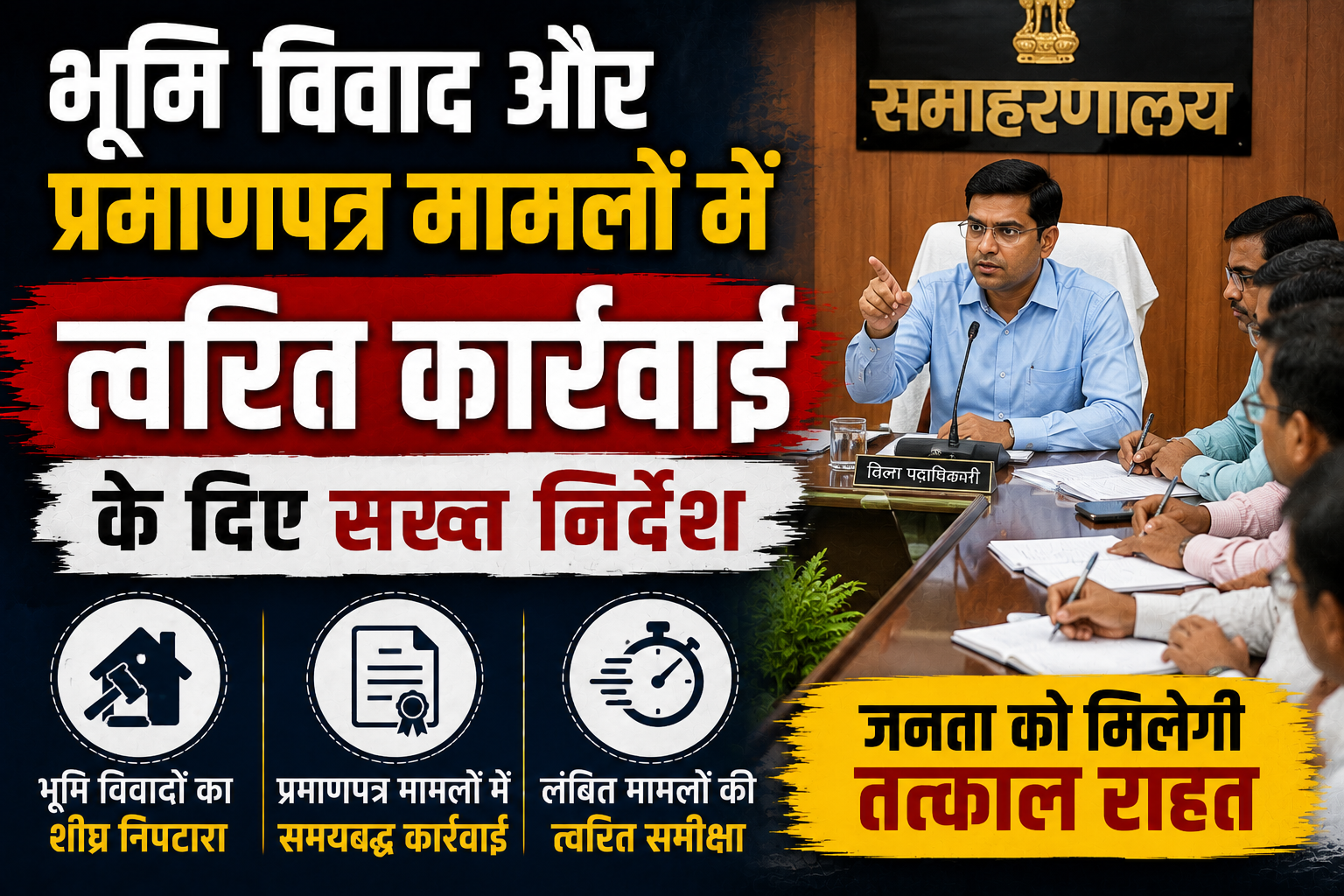
Bhagalpur, Chief Correspondent: Advancing the administrative resolve to ensure time-bound and transparent solutions to the problems of ordinary citizens, the grievance redressal process has been rendered far more effective by the district administration in Bhagalpur. In this sequence, the District Magistrate of Bhagalpur conducted a marathon hearing of second appeals registered under the Bihar Right to Public Grievance Redressal Act. During this high-level hearing held in the collectorate auditorium, the District Magistrate sat face-to-face to listen to the arguments of appellants and authorities from concerned departments connected to various cases. Several vital complaints pertaining to land disputes, illegal occupation of property, delays in issuing certificates, and denial of benefits under various schemes emerged during the proceedings, prompting the District Magistrate to issue stern and explicit directives to the concerned officials.
What Is the Bihar Right to Public Grievance Redressal Act and Its Significance?
Introduced by the Government of Bihar, this is a highly revolutionary and pro-people framework that guarantees ordinary citizens a fixed timeline for the redressal of their grievances concerning government departments.
If a citizen's application is not resolved satisfactorily at the first appellate authority level, they can seek recourse before the District Magistrate or other senior officials through a second appeal.
The primary objective of this law is to establish accountability within governance and administration, ensuring that no common person is forced to make endless rounds of government offices and receives justice in a timely manner.
Various Cases Brought Before the Hearing: Land Disputes and Certificate Hurdles
The largest share of cases brought before the District Magistrate's court for hearings consisted of land disputes and revenue-related matters. Additionally, several applications tied to delays in social security pensions, mutation (dakhil-kharij), and administrative certificate issuance were also included.
Land Disputes and Illegal Occupation Cases: Several appellants complained that their lands were being forcibly occupied or that undue delays were occurring in their cases at the circle office level. Expressing deep displeasure over this, the District Magistrate instructed the concerned circle officers (COs) and station house officers (SHOs) to coordinate mutually and resolve land disputes on a priority basis.
Delays in Issuing Certificates: Adopting a firm stance on pending matters concerning caste, residential, income, or other essential certificates, the District Magistrate made it clear that documents must be provided within the stipulated timeframe under the Right to Public Services (RTPS) Act. Personnel stalling files without valid reasons were warned of disciplinary action.
Stern Warning to Officials: Laxity Will Not Be Tolerated
During the hearings, several instances came to light where officials from the concerned departments were either absent themselves or failed to appear with adequate responses. Treating this with utmost seriousness, the District Magistrate warned all district-level and block-level officials not to take public grievance matters lightly.
The primary directives issued to officials included:
Time-Bound Disposal: The resolution of every complaint must be executed within the designated timeframe. If delays occur in any case, personal accountability will be fixed on the responsible official.
Quality Resolution: Closing cases merely as an eyewash will not be accepted. The complainant must receive genuine relief, and their issue must find a satisfactory resolution.
Field Visits and Physical Verification: In matters associated with land and encroachments, officials must not rely solely on paper reports but conduct physical verification by visiting the site themselves.
Hope Reignited Among General Public and Appellants
Deep satisfaction was observed among appellants due to the District Magistrate personally hearing cases and issuing prompt directives on the spot. Several citizens arriving from distant rural areas with their grievances shared that such high-level hearings have significantly amplified their hope for justice. In multiple instances, the District Magistrate summoned concerned officials over the phone during the hearing itself and ordered immediate resolutions, further cementing the public's trust in the administrative machinery.
This high-level review and hearing conducted by the District Magistrate in Bhagalpur under the Bihar Right to Public Grievance Redressal Act marks a concrete step toward good governance. When the administrative head personally listens to public woes with gravity and cracks down on negligent officials, the system naturally begins to self-correct. This initiative is proving instrumental not only in the swift disposal of pending matters but also in serving as a guarantee of prompt justice for the citizens of Bhagalpur.