
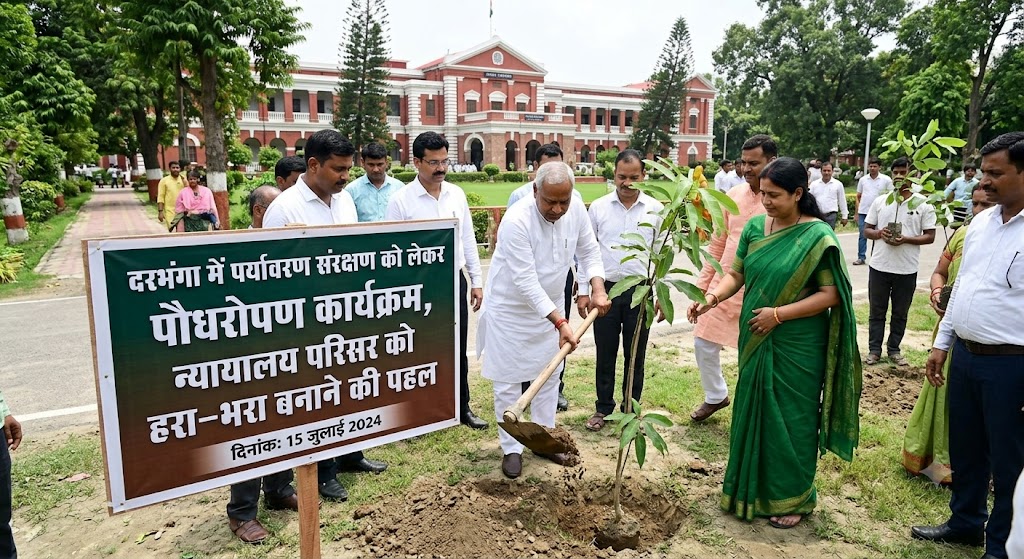
Tree Plantation Drive Held in Darbhanga to Promote Environmental Conservation, Initiative to Make Court Complex Greener
Darbhanga: A tree plantation programme was organized in Darbhanga with the aim of promoting environmental conservation and increasing greenery. The programme, led by Shiv Kumar Kharga, focused on making the court complex greener and more environmentally friendly. Trees of various species were planted during the event, while people were also encouraged to become more aware of their responsibility toward environmental protection.
According to the organizers, the objective of the plantation drive was not limited to increasing greenery within the court complex. It also aimed to develop a sense of environmental responsibility among members of the public. Participants emphasized the importance of protecting and caring for the newly planted trees.
Initiative to Increase Greenery in Court Complex
A large number of lawyers, judicial employees, litigants and members of the public visit the court complex every day. Increasing greenery in such a public institution can help improve the surrounding environment while also sending a direct message about environmental conservation.
During the plantation programme, trees of different species were planted at suitable locations across the premises. Organizers said that once the plants grow, the court complex will have a greener and more pleasant atmosphere. Trees can also help provide shade, reduce dust and pollution and contribute to improving the quality of the surrounding environment.
The initiative, conducted under the leadership of Shiv Kumar Kharga, focused on promoting environmental balance within the court premises. Along with planting trees, participants also discussed the importance of protecting and maintaining them.
Focus on Environmental Awareness
Special emphasis was placed on creating awareness about environmental conservation. Organizers said that simply planting trees is not enough. Regular watering, protection and proper maintenance are equally important to ensure that the plants survive and grow into healthy trees.
At a time when increasing urbanization, deforestation and pollution are creating challenges for environmental balance, plantation drives can serve as an effective way of connecting people with nature.
During the programme, people were encouraged to plant more trees in and around their homes and public spaces and to take responsibility for their maintenance. Empty spaces around homes, offices, schools and other public institutions can be used to expand greenery.
Trees of Different Species Planted
Trees belonging to different species were planted during the programme. The plants were selected and placed according to the available space and local conditions with the aim of developing a healthy green environment over time.
Planting different species can also contribute to biodiversity and environmental balance. Different types of trees and plants can play different roles in improving the local ecosystem.
Organizers emphasized that increasing the number of trees is important, but their survival and long-term maintenance are equally significant. A newly planted tree needs time and proper care before it becomes fully established.
Importance of Plantation in Public Places
Plantation drives in public places such as court complexes can have a wider social impact. People visiting such locations can directly observe the importance of greenery and environmental protection.
When people see properly maintained trees and green spaces in public institutions, they may also become more interested in planting trees themselves. This is why plantation initiatives in government and public institutions are often linked with broader environmental awareness campaigns.
The Darbhanga programme also sought to convey the message that environmental conservation is not the responsibility of a single individual or organization. Meaningful environmental protection requires participation from different sections of society.
Maintaining the Newly Planted Trees
One of the biggest challenges after a plantation drive is ensuring the survival of the newly planted trees. In many cases, large numbers of saplings are planted during campaigns, but some fail to survive because of inadequate maintenance.
Keeping this challenge in mind, the programme emphasized the need for regular care of the newly planted trees. Timely watering, protection from animals and appropriate safety measures may be necessary during the early stages of growth.
Organizers believe that a plantation drive can be considered successful only when the planted saplings survive and eventually develop into healthy trees. Regular monitoring and maintenance will therefore remain important even after the programme has concluded.
Connection Between Environment and Health
Trees are closely connected with human health and quality of life. They contribute to cleaner air and can help reduce pollution. During hot weather, tree cover provides shade and can contribute to moderating local temperatures.
In urban areas, where construction activity and the number of vehicles continue to increase, maintaining green spaces becomes even more important. Plantation within a court complex can provide a relatively better environment for visitors, lawyers and employees.
Small-scale plantation initiatives can have a significant long-term impact when they are conducted regularly. If people also plant and care for trees at an individual level, the overall green cover of cities can gradually increase.
Important Step for Future Generations
Environmental conservation is not only a requirement for the present generation but is also closely linked to the future of generations to come. Increasing tree cover, conserving water and natural resources, and reducing pollution are collective responsibilities.
Tree plantation programmes represent one positive step in this direction. Involving children and young people in such initiatives can help develop a stronger sense of responsibility toward nature.
Organizers appealed to people not to limit tree plantation to specific campaigns or environmental days. Instead, they encouraged people to make planting and caring for trees a regular activity throughout the year.
Community Participation Can Strengthen the Campaign
The success of environmental initiatives depends significantly on community participation. If court employees, lawyers and other people associated with the complex participate in caring for the newly planted trees, the chances of their healthy growth can increase.
Similar plantation programmes can also be organized in other public spaces across Darbhanga. Schools, colleges, government offices and community areas can be connected with such initiatives to expand the reach of environmental awareness campaigns.
The Darbhanga plantation programme once again highlighted the importance of collective efforts for environmental protection. Planting a tree is only the beginning; ensuring that it grows into a healthy tree is a shared responsibility.
Step Toward a Greener Court Complex
The plantation programme organized under the leadership of Shiv Kumar Kharga represents an initiative toward making the court complex in Darbhanga greener. Various species of trees were planted as part of the effort to improve the environment within the premises.
The significance of the programme also lies in its focus on environmental awareness rather than simply planting saplings. Such initiatives can help create a positive environment for making public institutions more green and environmentally friendly.
With increasing population and urban activity, the importance of greenery in a city like Darbhanga continues to grow. Expanding green spaces and conducting plantation drives in public institutions can therefore be a useful step from an environmental perspective.
If the newly planted saplings are properly maintained and similar programmes continue in the future, greenery can gradually increase within the court complex as well as other parts of the city. At the same time, the message of environmental responsibility among residents can become stronger.
Overall, the tree plantation programme in Darbhanga represents a positive initiative toward environmental conservation. Under the leadership of Shiv Kumar Kharga, trees of different species were planted with the objective of making the court complex greener. The long-term success of the initiative will depend on how effectively the newly planted saplings are maintained and whether similar environmental programmes are expanded in the future.