

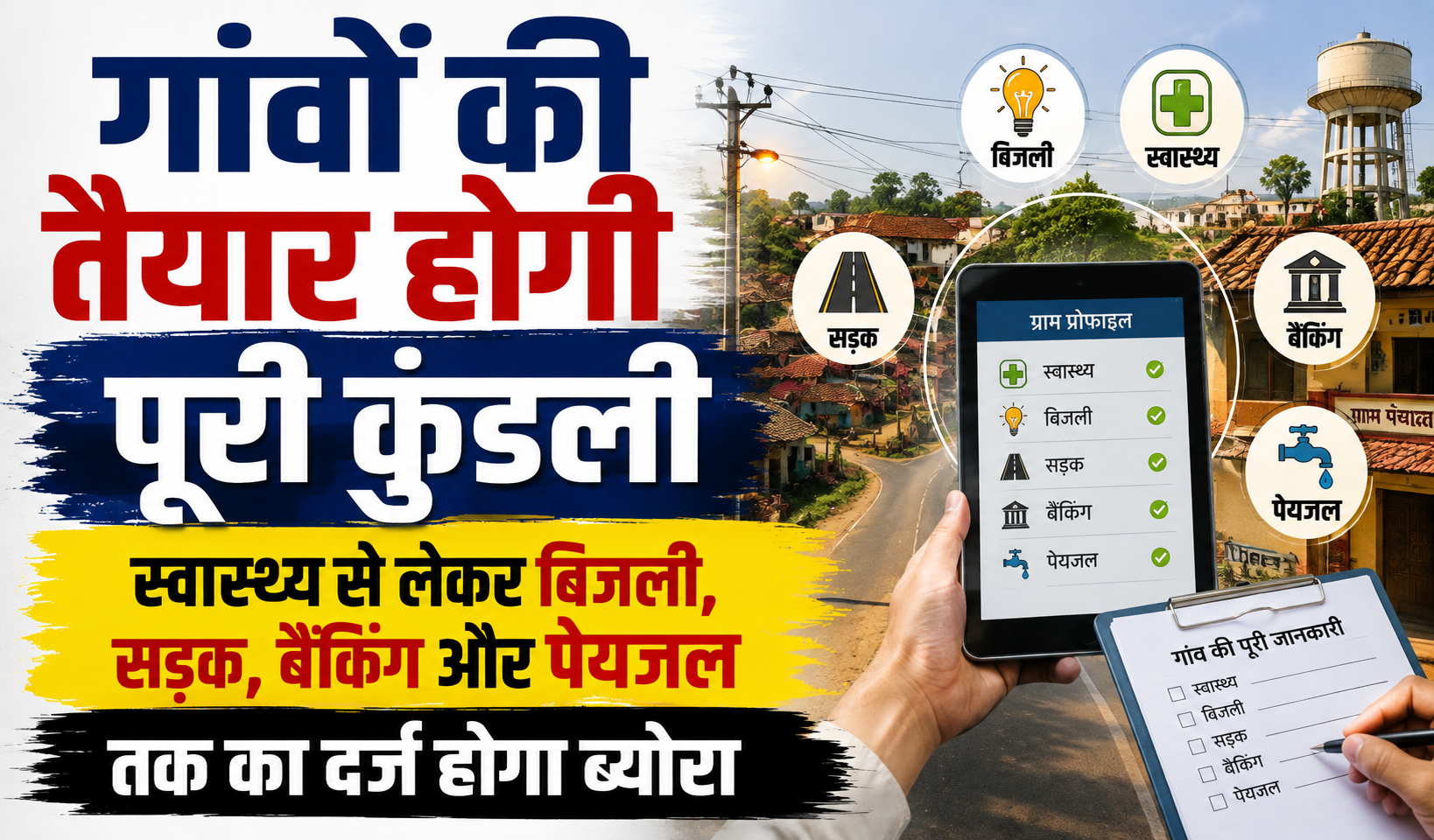
Villages to Get a Detailed Profile, From Healthcare and Electricity to Roads, Banking and Drinking Water
Patna: Bihar is planning to collect detailed information about villages during the census process. The exercise is expected to go beyond simply counting the population and include extensive information about basic infrastructure and socio-economic conditions in rural areas.
Details related to healthcare facilities, electricity availability, roads and transportation, banking services, communication networks, drinking water and sanitation, among other areas, are expected to be recorded. The objective is to prepare a detailed profile of individual villages and provide authorities with a clearer picture of their development needs.
For a state like Bihar, where a large part of the population lives in rural areas, such information could prove highly valuable. Different villages have different requirements depending on their population, geographical location, economic activities and availability of infrastructure. A comprehensive database could help authorities plan development projects according to local needs.
Not Just Population, Village Facilities Will Also Be Assessed
The primary purpose of a census is to collect information about population and demographic characteristics. However, information about basic facilities available in villages can also provide a broader understanding of rural living conditions.
Information such as the number of households, availability of electricity, sources of drinking water, road connectivity, public transportation, access to banking services and communication facilities could help create a comprehensive picture of each village.
Such information could make it easier for the administration to identify areas where facilities are adequate and locations where additional infrastructure is required.
Healthcare Facilities to Be Documented
Healthcare is one of the most important components of rural development. Information about healthcare facilities available in and around villages could form an important part of the village profile.
Authorities may be able to determine whether healthcare centers are available nearby, how far residents need to travel for basic treatment and whether people have access to emergency medical services.
In several rural areas, residents may have to travel to district headquarters or larger cities for specialized treatment. A detailed record of healthcare facilities could help identify areas where additional medical infrastructure is required.
Electricity Availability to Be Recorded
Electricity has become an essential part of rural life, but the quality and reliability of supply can vary between locations. Therefore, understanding the electricity situation at the village level can be important.
Information about electricity availability could help authorities identify villages where power infrastructure requires improvement.
Reliable electricity is directly connected to education, small businesses, irrigation, household activities and digital services. A detailed assessment of village-level electricity infrastructure could therefore play an important role in future development planning.
Roads and Transportation Under Focus
Road connectivity and transportation are essential for rural development. Good roads make it easier for villagers to access schools, hospitals, markets, banks and government offices.
Information about roads and transportation could help identify villages that are well connected to major roads and those where residents face difficulties while travelling.
Road connectivity is also important for farmers. Better roads can make it easier and faster to transport agricultural produce from farms to markets, potentially reducing transportation costs.
Banking Services to Be Assessed
Access to banking services has become increasingly important in rural areas. Government benefits, pensions, scholarships, subsidies and other forms of financial assistance often require access to banking facilities.
Information about the availability of bank branches, ATMs and other banking services could therefore be included in the village profile.
Improved access to banking can help rural residents use savings accounts, loans, insurance and digital payment services more easily.
Communication and Internet Connectivity Also Important
In the digital age, communication infrastructure has become an important part of rural development. Mobile networks and internet connectivity provide access to education, employment opportunities, banking services, government schemes and online information.
Recording the state of communication infrastructure could help identify villages where digital connectivity remains inadequate.
With online education and digital government services becoming increasingly common, internet connectivity is no longer simply a convenience but an important development requirement.
Drinking Water Availability to Be Recorded
Access to clean and safe drinking water is one of the most basic needs of rural households. Information about drinking water sources and availability could therefore become an important part of the village-level assessment.
Authorities could determine which villages have tap-water connections, which areas depend heavily on hand pumps and where residents face water shortages.
Water quality is also directly connected to public health. Contaminated water can increase the risk of various diseases, making accurate information about rural water infrastructure particularly important.
Sanitation Facilities to Be Included
Sanitation is another important indicator of the health and quality of life of a village. Information about toilets, waste management and other sanitation facilities could help authorities understand the condition of rural sanitation infrastructure.
If shortcomings are identified in particular areas, targeted improvement programs could be developed.
Better sanitation can have a positive impact on the health and well-being of the entire community, including children, women and elderly residents.
Could Help in Planning Government Schemes
Detailed village-level information could help the government determine which development programs should receive priority.
For example, if a village lacks adequate healthcare facilities, healthcare infrastructure could be given greater priority. Similarly, villages facing serious road or transportation problems could receive greater attention for infrastructure development.
Information about drinking water, electricity, communication and banking could also help different government departments design programs based on actual local requirements.
Important Database for the Administration
Detailed information collected from rural areas could create an important database for the administration. It could make it easier to compare development indicators at the district, block and village levels.
For example, if facilities are relatively better in one part of a district but inadequate in another, authorities could identify the gap and focus development resources accordingly.
Data-driven planning could also help ensure that government resources are allocated more efficiently.
Identifying the Actual Needs of Villages
Development priorities can differ significantly from one village to another. While road connectivity may be the biggest concern in one village, another may need better drinking water or healthcare facilities.
Preparing detailed village profiles could help identify these local requirements more accurately. This information could allow development programs to be designed according to the specific circumstances of individual communities.
Potential New Foundation for Rural Development
Villages play a crucial role in Bihar’s economic and social structure. Agriculture, livestock, small businesses and rural employment support the livelihoods of a large section of the state’s population.
Detailed information about basic rural facilities could therefore become an important resource for development policy. It could help authorities understand where improvements are most urgently needed.
Overall, Bihar’s plan to prepare a detailed profile of villages during the census—covering healthcare, electricity, roads, transportation, banking, communication, drinking water and sanitation—could become an important step toward better rural planning.
If the information is collected accurately and systematically, it could help the government design schemes according to actual local requirements and make more effective use of available resources. It could also help identify which villages are lagging behind in particular facilities and where immediate intervention is required.
In the coming years, such detailed village-level data could play an important role in determining Bihar’s rural development priorities and ensuring that government programs reach the areas where they are needed most.