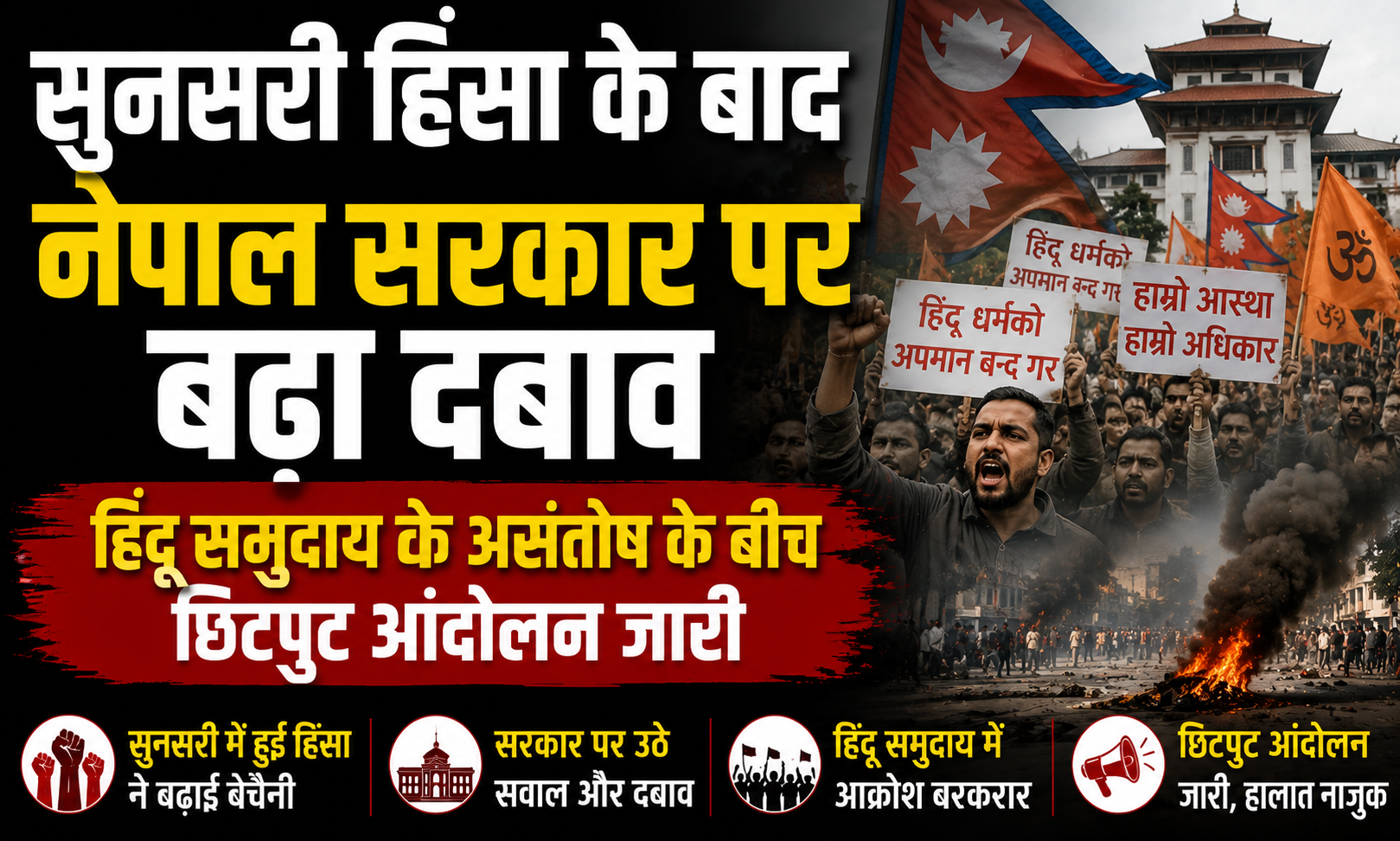
After Sunsari Violence, Nepal Government Faces Growing Hindu Discontent; Sporadic Protests Continue
Muzaffarpur: Nepal’s new government, formed after the Gen-Z movement, is facing fresh challenges following communal violence in Sunsari. The incident has reportedly increased discontent among a section of the Hindu community. However, the dissatisfaction has not yet developed into a nationwide movement. Sporadic protests and demonstrations are being reported in some areas.
Nepal has long faced political instability, social changes and the challenge of maintaining harmony among different communities. The Gen-Z movement had already created new challenges for the government and political establishment. What began as an expression of frustration among young people developed into a wider debate over governance, accountability and political leadership. After the formation of the new government, people expected the administration to reduce social tensions and restore public confidence. The Sunsari incident, however, has created another challenge for the authorities.
Discontent Following the Sunsari Incident
Following the communal violence in Sunsari, voices of anger and concern have emerged from sections of the Hindu community. Local residents have expressed concern over the incident and demanded effective action from the administration. There is also a feeling among some members of the community that authorities should respond quickly and impartially to incidents involving religious or communal tensions.
However, it would not be appropriate at this stage to view the situation as uniform across Nepal. The intensity of reactions differs from one region to another. While protests have taken place in some areas, several other regions remain peaceful. Therefore, the current activities are better described as localised and sporadic protests rather than a nationwide movement.
The Sunsari incident has also intensified discussions about religious coexistence and social harmony in Nepal. The country has a diverse social structure in which people belonging to different religious and ethnic communities have traditionally lived together. Therefore, communal violence in one area can have consequences beyond the immediate locality and may influence political and social debates elsewhere.
New Challenge for the Government After the Gen-Z Movement
The Gen-Z movement in Nepal brought the political dissatisfaction of young people to the forefront. Following the movement, public expectations from the government increased significantly. People are demanding greater transparency, accountability and equal application of the law.
Against this backdrop, the Sunsari violence has increased the government’s responsibility to maintain law and order and preserve public confidence. One of the administration’s biggest challenges will be to ensure an impartial investigation into the incident and prevent any community from feeling that it is being discriminated against.
Given Nepal’s political circumstances, the government will also need to adopt a balanced approach. On one hand, legal action must be taken against those responsible for violence. On the other, the government must respect the democratic right to peaceful protest and expression.
Protests Remain Limited, but the Political Message Is Significant
Although the scale of the protests remains limited, their political message cannot be ignored. Small demonstrations at the local level can serve as an indication that dissatisfaction exists among sections of society.
If the government responds to grievances promptly and ensures transparent action in relevant cases, tensions can potentially be contained. However, if people believe that their concerns are being ignored, small local protests could eventually develop into a larger political issue.
Nepal’s political history has seen several instances in which local incidents have triggered wider political debates. Therefore, the Sunsari incident should not be viewed solely as a law-and-order issue. Its wider social implications also need to be understood.
Government Under Pressure Over Hindu Community’s Concerns
Following the Sunsari incident, concerns about security and religious freedom have reportedly increased among sections of the Hindu community. Members of the community are demanding that violence or discrimination based on religious identity should not be tolerated.
The relationship between religion and politics has also remained a subject of debate in Nepal. As the country’s political system has evolved, questions surrounding religious identity have repeatedly emerged. Consequently, there is a possibility that a communal incident could become part of a broader political debate.
The government’s challenge will be to prevent religious issues from becoming tools for political polarisation. This will require not only administrative action but also dialogue among representatives of different communities.
Social Media Could Create Additional Challenges
In the present era, information about a local incident can spread rapidly to other parts of the country through social media. While this can increase public awareness, it also creates the risk of misinformation and unverified claims spreading quickly.
After a sensitive incident such as the one in Sunsari, verifying the authenticity of information circulated on social media becomes extremely important. Fake videos, photographs from unrelated older incidents or misleading claims can increase communal tensions. Both the administration and civil society therefore have an important role to play.
The government should release factual information about such incidents in a timely manner. A lack of official information can create space for rumours to spread. Transparent communication can play an important role in reducing tensions.
Possible Impact on Border Regions
Nepal and India have maintained close social, cultural and economic relations for a long time. Border areas of India, including Bihar, have regular social and commercial interactions with Nepal. As a result, political or social instability in Nepal can also attract concern in neighbouring Indian regions.
People in Muzaffarpur and other parts of north Bihar naturally take an interest in developments in Nepal. Communities on both sides of the border have family, business and social connections. Therefore, reports of tensions in Nepal can quickly become a subject of discussion in border regions of India as well.
However, given the current circumstances, it would be premature to conclude that the situation represents a broader regional crisis. At present, protests appear to be limited and localised. The future direction of the situation will depend largely on the government’s response and the role played by local authorities.
Role of Political Parties Will Be Crucial
The role of political parties is particularly important in Nepal’s current political environment. If different parties exercise restraint and avoid using communal tensions for political gain, it could help restore normalcy.
On the other hand, if the incident is used to deepen political polarisation, social tensions could increase. Opposition parties also have a responsibility to raise public concerns through democratic means while avoiding violence and provocation.
Religious and community leaders can also play an important role. Local dialogue, appeals for peace and efforts to counter rumours could help reduce tensions.
The Way Forward: Dialogue and Impartial Action
Following the Sunsari incident, the Nepal government’s immediate priority should be rebuilding public trust. If a sense of insecurity continues within any community for a prolonged period, social tensions can intensify. The administration therefore needs to focus on an impartial investigation, legal action against those responsible and protection for affected people.
At the same time, the government should engage with people who are raising their concerns peacefully. In a democratic system, there must be space for disagreement and peaceful protest. However, violence, hate speech and incitement against any community cannot be justified.
At present, the Hindu community’s discontent following the Sunsari incident appears to remain limited to certain areas, with only sporadic protests being reported. Preventing these developments from turning into a broader nationwide movement will be an important challenge for the government.
The government formed after the Gen-Z movement is already facing public expectations and political pressures. In such circumstances, any new incident involving communal tension could become a serious test of its administrative and political capabilities.
In the coming days, the government’s response, the conduct of political parties and dialogue among different communities will determine whether tensions subside or the scope of dissatisfaction expands.
In a diverse and multicultural country like Nepal, maintaining social harmony is not the responsibility of the government alone. Political parties, religious organisations, civil society and ordinary citizens all share responsibility. The Sunsari incident underlines the importance of resolving disputes through impartial law, dialogue and mutual trust rather than through violence.