

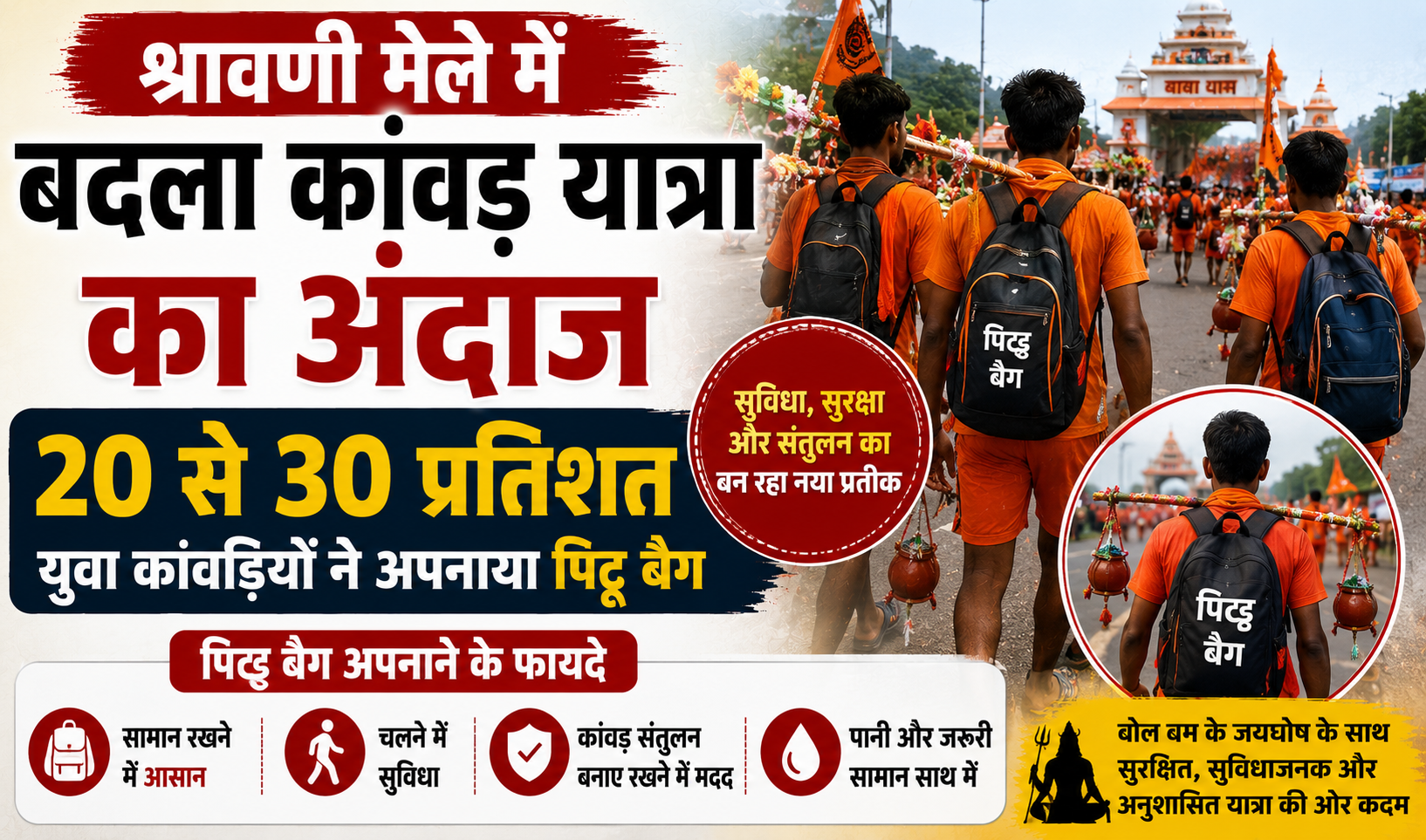
Kanwar Yatra Takes a New Turn as 20–30% of Young Pilgrims Opt for Backpacks
Deoghar/Bhagalpur: The traditional style of the Kanwar Yatra appears to be changing during this year's Shravan Mela. A growing number of young pilgrims are choosing backpacks instead of traditional, decorative kanwars for their journey. It is estimated that around 20–30% of Kanwariyas at the fair have opted for backpacks this time.
For generations, carrying a decorated kanwar on the shoulder has been an important part of the pilgrimage. Devotees traditionally decorate their kanwars with flowers, colourful paper, religious symbols and other decorative items. Local artisans prepare these kanwars in different designs according to pilgrims' preferences.
However, this year, a section of young devotees is increasingly choosing backpacks because they are lighter, more convenient and considerably cheaper. The change is also beginning to affect the business of artisans and shopkeepers who depend on kanwar sales during the Shravan Mela.
Cheaper Alternative to Traditional Kanwars
A traditionally prepared kanwar generally costs around ₹1,000 in the fair area, although the price can be higher depending on its size, design and decoration.
In contrast, some young pilgrims are choosing ordinary backpacks costing less than ₹100. This allows them to reduce their travel expenses while making it easier to carry essential belongings.
Carrying a kanwar continuously for a long distance can place considerable weight on the shoulders and requires the pilgrim to keep both hands occupied. A backpack, on the other hand, can be comfortably secured on the back, leaving the hands free.
Pilgrims can also carry mobile phones, clothes, towels, water bottles and other necessities inside the backpack.
Backpack Trend Growing Among Gen Z Kanwariyas
The change is particularly visible among young, or Gen Z, Kanwariyas. Groups of youngsters wearing T-shirts featuring Mahakal, shorts and traditional gamchas can increasingly be seen carrying backpacks during the pilgrimage.
These young devotees are continuing to maintain the religious spirit of the journey while adapting the mode of travel according to their convenience.
Roshan Jha, who has come from Jehanabad, said that travelling with a traditional kanwar has its own charm, but he chose a backpack this time because it is easier to manage during a long journey.
Convenience During Long-Distance Travel
Kanwar pilgrims often have to walk long distances. As a result, the weight and method of carrying their belongings become important factors.
Traditional kanwars generally include water containers along with decorative materials. Many devotees make their kanwars large and attractive. During crowded sections of the route, carrying and managing a large kanwar can sometimes become difficult.
Pilgrims using backpacks say they find it easier to walk with them. Backpacks are also easier to manage in crowded areas and during rest breaks.
Impact on Kanwar Artisans
The growing popularity of backpacks among young pilgrims is directly affecting the business of kanwar makers and sellers.
During the Shravan Mela, artisans traditionally prepare large numbers of kanwars in anticipation of strong demand. They use bamboo, colourful paper, cloth, flowers and other decorative materials to create different designs.
If a significant number of pilgrims choose backpacks instead of traditional kanwars, sales of decorative kanwars could be affected.
Artisans involved in the trade say that some young customers are now looking for lighter and cheaper kanwars compared with previous years, while others are simply travelling with backpacks.
Tradition Meets Modern Convenience
The shift should not necessarily be viewed as young people moving away from tradition. Many young devotees continue to maintain the religious purpose of the pilgrimage while changing only the way they carry their belongings.
For them, devotion, offering holy water and completing the pilgrimage remain important. At the same time, convenience during a long journey is also a priority.
As a result, some young pilgrims are choosing backpacks as a practical alternative to traditional kanwars.
Influence of Social Media
Social media is also influencing the way young Kanwariyas travel. Pilgrims from different cities and states regularly share photographs and videos of their journeys online.
Images and videos of young devotees travelling with backpacks are increasingly appearing on social media, potentially encouraging others to adopt the same approach.
The availability of lightweight travel bags and other travel accessories through online and local markets has also expanded the choices available to young pilgrims.
Lower Cost Is a Major Factor
Cost is another important reason behind the growing popularity of backpacks.
While a traditional kanwar can cost several hundred rupees or around ₹1,000 or more depending on its design, an ordinary backpack can be purchased at a much lower price.
Young pilgrims also spend money on food, accommodation and other necessities during the journey. Reducing the amount spent on a kanwar allows them to manage their overall travel budget more easily.
Some young devotees believe that when a low-cost and convenient option is available, spending more money purely on decoration is unnecessary.
New Challenge for Kanwar Makers
The changing preferences of pilgrims could become a new challenge for traditional kanwar artisans.
Artisans who have been involved in the business for years may have to adapt to changing consumer preferences. Along with traditional designs, they could consider producing lighter and more affordable kanwars.
Creating attractive but lightweight kanwars that are easier to carry could help artisans respond to the changing market.
If young pilgrims increasingly shift toward backpacks, traditional kanwar businesses could face further pressure. At the same time, artisans who adapt their products to changing demand could find new opportunities.
Changing Pilgrimage Experience
The Kanwar Yatra is not only a religious journey but also a social and collective experience for devotees. Pilgrims from different regions meet one another along the route, walk together and complete the journey amid religious chants and songs.
The use of backpacks is changing the physical appearance of the pilgrimage to some extent, but there is no indication that the enthusiasm of the devotees has diminished.
Young groups continue to travel while chanting religious slogans and participating in devotional activities. However, many are increasingly prioritizing convenience and ease during the journey.
This is creating a combination of traditional faith and modern travel practices within the Kanwar Yatra.
Trend Could Grow in Coming Years
If the proportion of pilgrims using backpacks remains around 20–30% this year, the trend could become more prominent in the coming years.
The preference for convenient and lightweight travel options is particularly likely to grow among younger pilgrims.
However, traditional kanwars continue to have strong religious and cultural significance. A large number of devotees still prefer to undertake the pilgrimage with decorated kanwars.
Therefore, both styles of pilgrimage may continue to coexist. Traditional devotees may continue choosing decorated kanwars, while younger pilgrims may increasingly favour lightweight and practical alternatives.
Same Faith, A New Style
The growing use of backpacks during the Shravan Mela can be viewed as a reflection of changing preferences among a new generation of pilgrims.
The size, decoration and cost of the kanwar may be changing, but the faith and purpose behind the pilgrimage remain intact.
Young Kanwariyas walking with Mahakal T-shirts, gamchas and backpacks demonstrate how traditional religious practices can adapt to changing lifestyles and practical needs.
For kanwar artisans, the trend may be a concern because it could reduce demand for traditional products. At the same time, it could provide an opportunity to develop lighter, affordable and innovative designs.
In the coming years, the Shravan Mela may increasingly feature both traditional decorated kanwars and modern backpacks.